The judge had said in April: “Suppose the margin is 2%, and 15% of the voters identified on the map were not able to vote, then…we will certainly have to apply our minds.”

The Trinamool Congress (TMC) approached the Supreme Court on Monday with a specific argument rooted in the court’s earlier observation. It said that in at least 31 West Bengal Assembly constituencies where it lost to the Bharatiya Janata Party (BJP), the BJP’s margin of victory was less than the number of voters removed from the voter rolls under the Special Intensive Review (SIR) process.

The hearing, before a bench including Chief Justice of India Surya Kant and Justice Joymalia Bagchi, brought into sharp focus a question that had been building since April — whether the controversial voter list revision materially changed the results of the West Bengal assembly elections.
Read also | TMC says SIR deleted more votes than BJP’s margin of victory on 31 seats in West Bengal, Supreme Court responds
The “logical contradiction” question.
In particular, it was deletions made in the “logical inconsistency” category – for misspelled names and the like – that were subject to a review process. This arbitration process, which is still ongoing, cannot make a difference because it came a few days before the polls.
In the TMC plea on Monday, senior advocate and party MP Kalyan Bandhopadhyay (Banerjee) told the bench that the deletions under the SIR adjudication process had a direct impact on the results in several constituencies.
He said the vote gap across the state between the TMC and the BJP amounted to nearly 32,000 appeals, while nearly 35,000 appeals were still pending before the appellate courts.
Senior advocate Menaka Guruswamy, who is also the TMC MP in the Rajya Sabha, pointed out that at the current pace, it would take at least four years for the appellate courts to settle the backlog of 35,000 pending appeals. In this regard, the International Committee of Justice said that accelerating these appeals will remain a priority.
The TMC petition also cited one constituency where the TMC candidate lost by 862 votes, while more than 5,432 people were removed from the rolls awaiting dismissal.
Read also | Former Trinamool spokesperson Riju Dutta apologizes to UP IPS officer Ajay Pal Sharma. This is why
What the court said on the margin of victory
In this argument, he cited an earlier observation by Judge Bagchi on April 13, days before the elections.
At that hearing, the judge posed a hypothetical query to the Election Commission of India which had implemented the SIR: “Suppose the margin (of victory) is 2%, and 15% of the voters identified on the map were not able to vote, then perhaps – we are not expressing any opinion but – we will certainly have to apply our minds.”
The observation was made while hearing a petition from voters whose names were deleted and whose appeals are still pending. However, the Supreme Court has not halted the process, even as thousands of appeals against deletions based on “logical inconsistency” remain pending.

What is SIR, and what makes Bengal different?
The Intensive Special Review is one of the IEC’s exercises to update and clean the electoral rolls. West Bengal’s version, which began in November 2025, has been significantly more controversial than the practice in other states, with the BJP saying it would remove “infiltrators”, a reference to the alleged influx of illegal immigrants from Muslim-majority Bangladesh.
The ECI announced on April 10 that around 90,000 (9 million) names were deleted from state lists during the SIR.
Of these, 27,000 were removed after failing to adjudicate under a category called “logical inconsistency” — a classification that the Supreme Court noted was made exclusively for West Bengal and had no equivalent in the Bihar SIR exercise that preceded it.
Within this category, voters were discriminated against on the basis of seven specific reasons, including instances of age gaps with parents or grandparents, number of children, or mismatched names.
The court took a sharp exception to this. At a hearing on April 14, the board told ECI’s lawyer, DS Naidu, “Your original notification did not touch the 2002 list…yet the grounds for rejection now depend on it.”
When the Election Commission of India tried to clarify its stand, the bench said: “Now you are improvising the submissions you made earlier.”
The court also noted that West Bengal’s deletion rate of 11.6% was the third highest among the nine states that conducted the SIR process, behind only Gujarat and Chhattisgarh.
(Some analysts noted that the deletion rate was disproportionately higher among Muslims, who make up about a third of West Bengal’s population.)
“Somewhere, we became blinded by the impending election,” Justice Bagchi said. The court also showed that it was disturbed by the slow speed of the process.
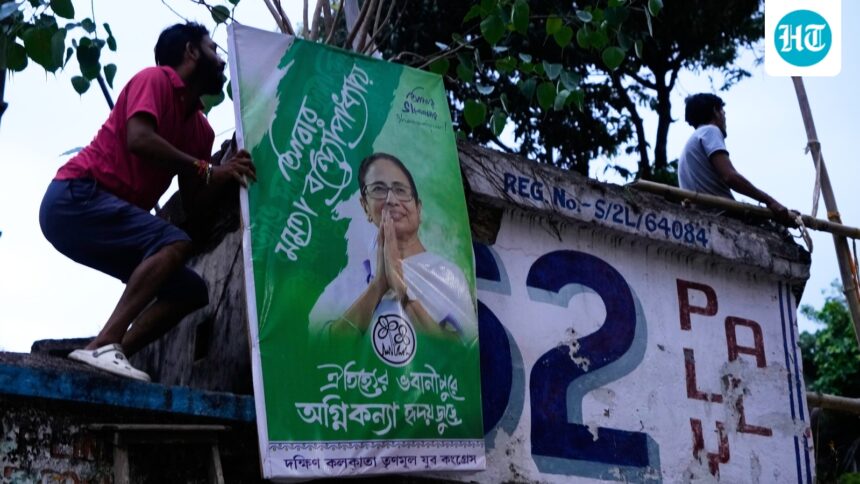
The BJP won the election, ending the TMC’s 15 years in power under Mamata Banerjee, and Suvendu Adhikari was sworn in as prime minister last week.
The TMC’s legal argument does not currently require proof that SIR caused the BJP’s overall victory, but only in specific constituencies does the size of the deletion relative to the margin of victory raise sufficient doubt.
What the court says now
The Supreme Court did not reject the argument on Monday, with Justice Bagchi ordering an application containing full details. The Independent Electoral Commission said the appropriate remedy was to file an election petition.
The bench also said that former chief minister Mamata Banerjee and others were free to file fresh applications and the case was adjourned.

Arish Chhabra is an associate editor on the Hindustan Times online team, where he writes news reports and explanatory features, as well as overseeing the site’s coverage. His career spans nearly two decades across India’s most respected newsrooms in print, digital and broadcast. He has reported, written, and edited across formats—from breaking news and live election coverage, to analytical long-reads and cultural commentary—building a body of work that reflects editorial rigor and a deep curiosity about the community for which he writes. Areesh studied English Literature, Sociology and History along with Journalism at Punjab University in Chandigarh, and began his career in that city, eventually moving to Delhi. He is also the author of Little Big City: What Life is Like from Chandigarh, a collection of critical essays originally published as a weekly column in the Hindustan Times, which examines the culture and politics of a city that is much more than just its famous architecture – and in doing so, holds up a mirror to modern India. During his stints at BBC, The Indian Express, NDTV and Jagran New Media, he has worked across formats and languages; Mainly English, as well as Hindi and Punjabi. He was part of the K team Rak for the BBC Explainer project which has been replicated around the world by the broadcaster. At Jagran, he developed editorial guides and trained journalists on integrity and quality content. He has also worked at the intersection of journalism and education. At the Indian School of Business (ISB) in Hyderabad, he developed a website to streamline academic research in management. At Bennett University’s Times School of Media in Noida, he taught students the craft of digital journalism: from newsgathering and writing to social media strategy and video storytelling. Having moved from small town to larger town to megalopolis for education and work, his intellectual passions lie at the intersection of society, politics, and popular culture—a perspective that guides his writing and worldview. When he’s not working, he’s constantly reading long-form journalism or watching cerebral content, sometimes both at the same time.Read more