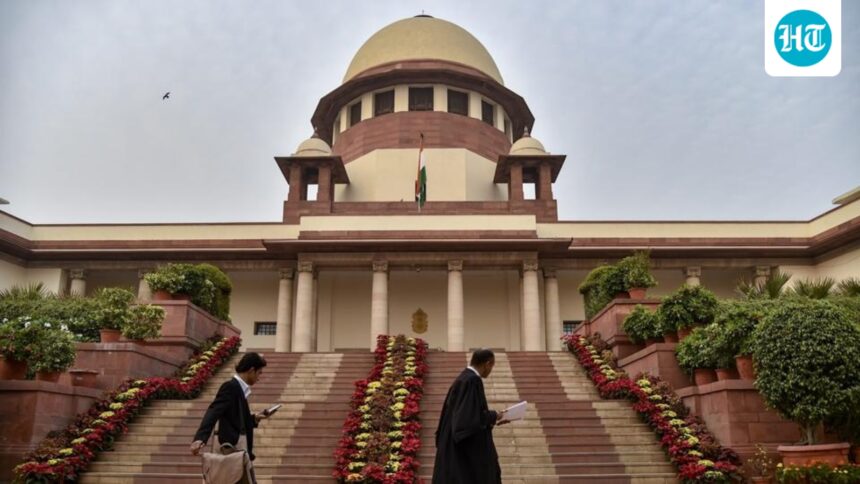
The Enforcement Directorate (ED) on Thursday told the Supreme Court that West Bengal Chief Minister Mamata Banerjee’s actions in obstructing the probe into political strategy firm I-PAC reflect a “pattern” of absence of rule of law in the state, even as it clarified that they do not indicate a “breakdown of the constitutional machinery” in the state.

In a petition filed in January, the ED officers alleged violations of their fundamental rights and sought a Central Bureau of Investigation (CBI) probe into the January 8 incident, when the agency’s investigation into I-PAC was allegedly obstructed by the Prime Minister and senior police officers, who entered the building during a raid and took away documents related to the incident. $2400 Crore Coal Scam.
Citing previous instances in which the Trinamool Congress (TMC) chief allegedly interfered in an ongoing CBI probe into a chit fund scam involving party leaders, the CEO argued that he could not approach the state police due to interference by senior state functionaries.
“You are seriously arguing about the absence of rule of law. We hope that it will not lead to the collapse of the constitutional machinery in the state,” a bench of Justices PK Mishra and NV Angaria said.
Appearing before the ED, Solicitor General Tushar Mehta said, “The ED cannot argue that the constitutional machinery has collapsed. What is being discussed is that the rule of law is absent in the state and since the rule of law is linked to Article 14 of the Constitution, it gives me scope (legal right) to file a petition under Article 32 of the Constitution to protect my fundamental rights.”
“We are just asking you if you are considering such an argument,” the bench explained. The previous day, the court noted that the Prime Minister had put democracy “at risk” by interfering in an ongoing investigation using the entire system under her command.
While appearing before state police officers, senior advocate Menaka Guruswamy told the bench that the proceedings before the court are being used for political campaigns in West Bengal where elections are being held. Taking issue with the Attorney General’s attempt to influence the proceedings, Guruswamy said: “He is using these proceedings to spread on social media. Let him not misuse the proceedings in court to use them as a weapon on social media in a political campaign.”
The court said it had no control over what the media reported. However, during the hearing, the bench cited a case in which the DGP visited the I-PAC headquarters on January 8 based on a complaint received by the family of an I-PAC employee, Prateek Jain, alleging trespass in the house. The ED officials convinced the Director General and senior police officials by showing them a valid authorization letter.
The ED’s raid against I-PAC came in connection with a money laundering probe into illegal coal mining based on a first information report registered by the CBI in November 2020. The allegations relate to illegally mined coal from Eastern Coalfields Ltd’s mines in the state for which the ED has already questioned TMC general secretary and MP Abhishek Banerjee, accusing him of being a beneficiary of the alleged scam.
Earlier, the Chief Minister filed an affidavit denying allegations that she obstructed the investigation at the ED and took documents from Jain’s house. Her response stated that she did not retrieve the party’s secret documents from the I-PAC office except with the approval of the Emergency Department officers present on site.
Justice Mishra said, “The DGP has seen the authorization letter and yet they have registered an FIR against the ED officials at the request of the Chief Minister. There is a lot I want to say but I am restricting myself as everything is being reported.”
“This is not an isolated case when the Chief Minister interferes in an ongoing investigation and frustrates it. There is a complete and utter failure in the rule of law and order in the state,” Mehta said. He pointed out that the current case relates to illegal smuggling of coal worth more than that $2700 Crores. He added that this money was transferred to I-PAC as the ED was raiding I-PAC’s offices and residences of its employees.
The Bengal government has raised objection in principle to the admission of the ED’s petition alleging that violation of fundamental rights can only be claimed by a citizen and not a government department. A group of senior lawyers, including Abhishek Manu Singhvi, Kapil Sibal and Shyam Divan, among others, submitted to the state that even ED officials cannot file a petition as they are seeking relief as ED officers and not individually.
Additional Solicitor General (ASG) S V Raju, appearing in another petition filed by ED officials involved in the I-PAC raid, said the crime registered against them affects them individually irrespective of the abaya they wear.
The court asked Raju, “Are you on the same page as a solicitor general”, noting that Mehta argued that just because a person is an ED officer, he does not cease to be a citizen of the country and that the ED seeks to represent the collective interest of these officers.
West Bengal also filed an Article 32 petition along with several other states, and on each occasion, the court received it and passed its orders, Mehta noted. The judge said: “Just as you claimed that incidentally the ED officers have individual rights, does the CM not have individual rights?”
However, the Court held that accepting Article 32 petitions at the request of States entailed an “inherent danger” because it would open the floodgates. The court can exercise this discretion on a case-by-case basis, Mehta said.
The court adjourned the matter for further hearing on May 13 and extended its January 15 order staying the FIRs lodged against the ED officials.