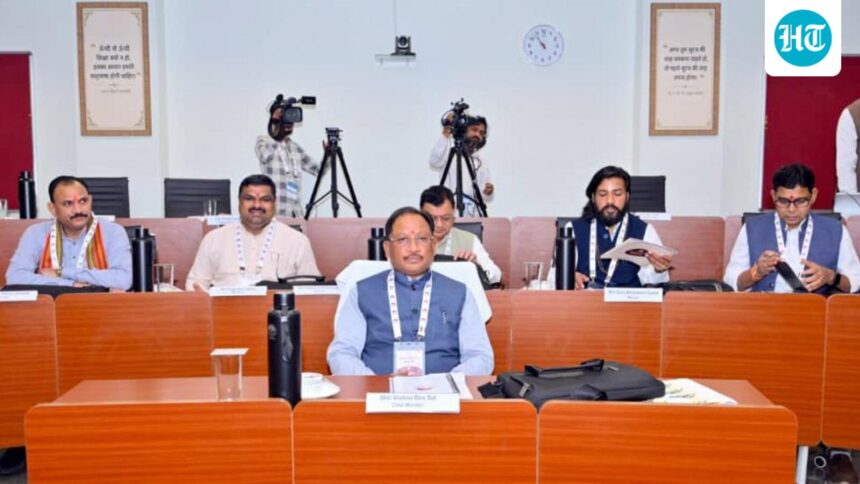
Artificial intelligence, rural economy and changing governance demands took center stage as the third edition of Chhattisgarh Cabinet’s ‘Chintan Shivir’ commenced at the Indian Institute of Management (IIM), Raipur, on Saturday.

The two-day training programme, organized by the state Governance and Convergence Department in collaboration with IIM Raipur, aims to equip ministers with modern administrative practices and prepare them to face emerging governance challenges.
Describing the training camp as a necessity in the changing times, Prime Minister Vishnu Deo Sai said governments must constantly learn, evaluate their performance and prepare to face future challenges.
“The aim is to make governance more effective, innovation-driven and results-oriented while promoting the vision of advanced Chhattisgarh,” Sai said.
The first day’s deliberations focused on transforming governance from a routine administrative exercise to a trained, accountable and results-oriented system in line with the national vision ‘Fixit Bharat’.
The program began with a session by motivational speaker and spiritual guide Gaur Gopal Das on how the role of public representative goes beyond departmental responsibilities. He interacted with the ministers about leadership, life values, emotional balance and sensitivity in public life.
Read also:Chhattisgarh CM Sai visits leprosy rehabilitation centre, praises model of self-reliance
He also stressed that the quality of governance depends not only on policies and social welfare plans, but also on the vision, integrity and decision-making capabilities of those responsible for their implementation.
Technology and future governance emerged as another key area of discussion on the opening day.
Chief Administrative Officer Abhay Karandekar spoke about the increasing role of artificial intelligence, data-driven decision making, and digital governance. He highlighted how technology can improve the efficiency and responsiveness of public service delivery, especially in remote and tribal areas.
During a session on agriculture and rural economy, NITI Aayog member Ramesh Chand stressed the need to increase rural incomes, strengthen agricultural value chains, encourage local enterprises and adopt a village-centric development model.
The discussion highlighted the importance of agriculture, villages and forest products to the economy of Chhattisgarh and the need to keep farmers and the rural economy at the center of policy making for sustainable development.
The changing situation in Bastar also figured prominently in the deliberations. As the security situation improves, the government’s focus is increasingly shifting towards development in the region.
The next phase in Bastar is expected to focus on infrastructure, education, healthcare, tourism, investment and livelihood generation, requiring faster public service delivery and a more responsive governance model.
The training program also aims to strengthen political and administrative leadership, improve policy formulation, encourage innovation and enhance coordination between government departments to meet rising public expectations.