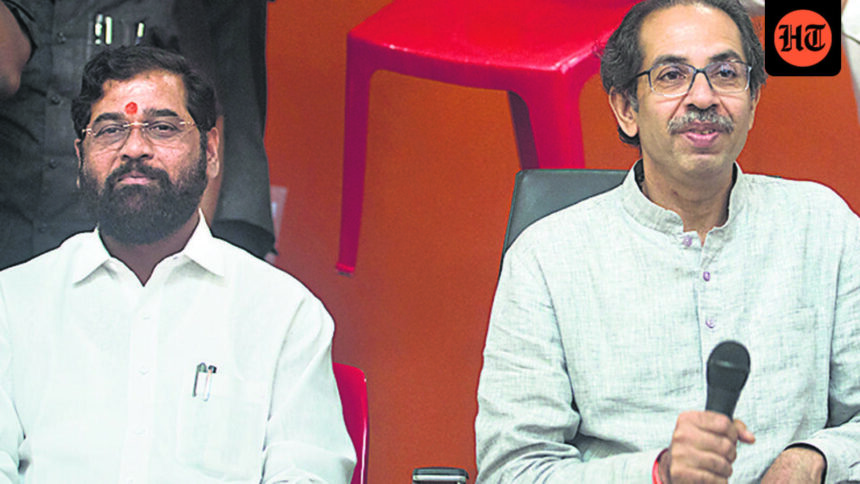
MUMBAI: The recent departure of six MPs from the Uddhav Thackeray-led Shiv Sena comes at a particularly symbolic moment. The party, which is preparing to enter the 60th year since its founding, finds itself facing another organizational setback after a turbulent period marked by the 2022 rebellion led by Eknath Shinde, the loss of its traditional name and symbol and the ongoing struggle to remain politically relevant in Maharashtra.

Much of the discussion about the split focuses on why it occurs. But what is more important is understanding how it became possible. The current crisis is not just about leaders changing their positions. It reflects the weakening of the Sena idea that has supported the party for six decades, and the emergence of a political system in which regional parties are finding it increasingly difficult to maintain their positions vis-à-vis the dominant Bharatiya Janata Party.
Reconsider Senna’s idea
Throughout much of its existence, the Shiv Sena has simultaneously functioned as a movement, a social institution and a political organisation. It was established to protect the interests of Marathi speakers in Mumbai and Maharashtra, and gradually evolved into one of the most influential political formations in the state. What distinguished the Senate was not only its electoral success, but the ecosystem it created around itself. Through its network of shakhas, it has integrated itself into everyday life, serving as a center for grievance redress, local mediation, social interaction, and political mobilization. For generations of young men and women, Cena has become a vehicle for political participation, social mobility and public recognition.
Its appeal was based on a combination of Marathi pride, Hindutva appeal, the grassroots presence, cultural assertiveness and charismatic leadership of Thackeray. Most importantly, she built an emotional connection with her supporters. Loyalty to the Sena chief, a position that had always been in the hands of the Thackeray family, was expressed through the language of shraddha and nishtha (faith and devotion). Bal Thackeray often described the Shiv Sena not as an ideology but as a “state of mind” and this idea was grounded in both material and emotional foundations. It provided access to patronage networks, civic problem solving, and political participation while providing identity, belonging, and a sense of purpose. This combination transformed the Shiv Sena from a political organization into a social force.
The resilience of this idea has been tested time and again by defections and rebellions. Chhagan Bhujbal’s exit in 1991 exposed tensions between the leadership and the party’s expanding social base. The departure of Narayan Rane and Raj Thackeray in 2005-06 brought questions of succession and organizational democracy to the fore. However, these exits never threatened the party’s survival because neither Bhujbal, Rane nor Raj sought to become the Shiv Sena. They left her. The 2022 insurgency led by Eknath Shinde was radically different. For the first time in the party’s history, the conflict became a struggle over the ownership of the Sena name, its symbol, its organization, and its legacy. More importantly, it challenged the principle on which the Senate had operated for six decades: that loyalty to the Thackeray family was the ultimate source of legitimacy within the organization. Perhaps for the first time, legitimacy can be drawn from sources outside Matoshree. This was a major crack in the idea of Cena itself.
The insurgency also exposed long-standing structural weaknesses. Almost every major split revealed excessive centralization of power, limited internal coordination, weak conflict resolution mechanisms, a command structure too dependent on Thackeray, and constant ideological repositioning. For decades, Bal Thackeray’s charisma made up for these limitations. But over time, the weaknesses of this model became increasingly apparent. The Senate has struggled to articulate a development vision that transcends identity politics and electoral realism, which has made it difficult to respond to the changing aspirations of voters in Maharashtra.
BJP moment
The Shiv Sena’s current state of flux is also rooted in the transformation of the political economy that created and once sustained this state. Over the past four decades, Maharashtra has witnessed major economic and political changes. Rapid urbanization, the expansion of capital-intensive sectors, and the professionalization of electoral politics have reduced the centrality of these networks. Politics has become resource-intensive, while individual politicians have greater bargaining power and mobility than before. In this environment, access to state power is often more important than organizational loyalty. It is against this backdrop that the rise of the BJP assumes great significance. For decades, the Shiv Sena has balanced Marathi regionalism with Hindutva, allowing it to occupy a distinct political space. The BJP’s greater appeal to Hindutva and development has changed this. With its superior organizational capacity, financial resources, institutional reach, and ideological cohesion, the BJP has increasingly become the primary vehicle for politicians seeking power and political security.
The result was a gradual transformation of Cena himself. A party that was previously held together by emotional ties now has to compete with the logic of power, resources, and political survival. While internal discontent was the immediate trigger for the 2022 rebellion, the political heft of the BJP and the changing political economy created the conditions in which challenging the Sena’s idea became possible.
What does it mean for Maharashtra
The significance of the recent defections extends far beyond the future of Thackeray or Shinde. Maharashtra was once characterized by the presence of multiple centers of political power. Today, the BJP occupies a much more dominant position, while its rivals are forced to constantly renegotiate their relevance, alliances and organizational survival.
So the question facing the Shiv Sena (UBT) is not just whether or not it can continue to claim ownership of the Sena idea and revive it. Rather, it is a question of whether a regional party built on identity, loyalty and local mobilization is able to reinvent itself in an era increasingly shaped by central political power, the national narrative and the dominance of the BJP. The answer will determine not only the future of the Shiv Sena but also the future of regional politics in Maharashtra. The last army standing is still fighting. But perhaps for the first time in its history, the battle is not just over power, but over political relevance, organizational survival, and the idea of what a regional party could be in contemporary India.
*doctor. Sanjay Patel is a Mumbai-based researcher working on Maharashtra politics and urban informality. His doctoral work examines the Shiv Sena’s journey between 1985 and 2022.