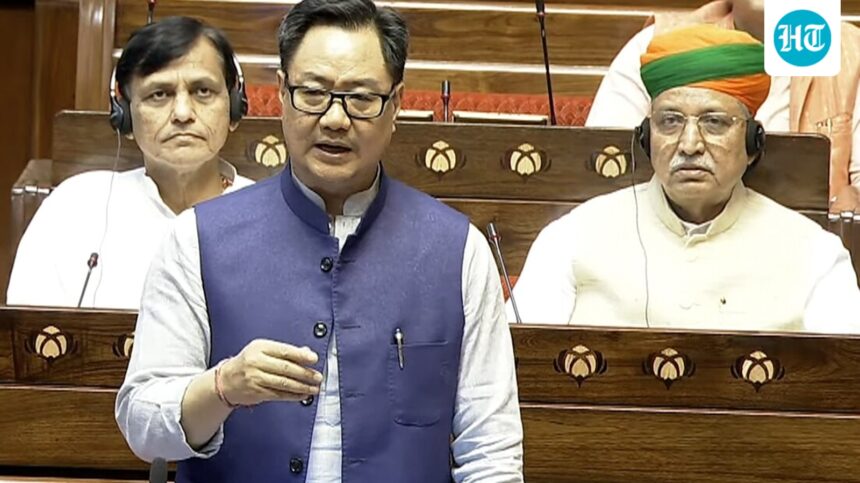
The Union government on Tuesday allayed fears that the delimitation exercise, which will be implemented to implement 33% reservation for women in legislative assemblies by 2029, will be politically disadvantageous for southern states, adding that seats will be distributed fairly across districts.

Parliamentary Affairs Minister Kiren Rijiju said there was an attempt to “mislead” the southern states that they would lose in the demarcation process because they adhere to population definition criteria.
He said: “If you review the provisions of the entire bill, you will find that every state, district and community has been taken care of… There is nothing to worry about. In the past some people have tried to mislead that the southern states will lose because of their success in family planning. In fact, these southern states are fortunate because even though population growth and a proportionately smaller population are controlled, they still gain.”
Read also | Redrawing boundaries to redraw electoral lines in India
It is certainly not clear how the southern states would not lose their relative power in Parliament if the government’s proposal were accepted. The Centre’s legislative push to reserve a third of seats in Parliament and state legislatures includes raising the maximum seats in the Lok Sabha from 550 to 850, with the seats allocated to the states. The reserved constituencies and their boundaries are determined by the Delimitation Commission on the basis of the last population census, which means the 2011 census in this case.
Details have emerged from the bills circulated by the government to lawmakers ahead of the three-day session of Parliament between April 16-18, including the Delimitation Bill, 2026, the Constitution (One Hundred and Thirty-first Amendment) Bill, 2026, and the Union Territories Laws (Amendment) Bill, 2026.
The draft laws will be discussed in a special session of Parliament from April 16 to 18.
Read also | Sonia Gandhi vs PM Modi: Women’s quota is good. The issue is border demarcation’ | Expansion of Lok Sabha explained
HT’s analysis shows that if the 2011 census was used, the proportional representation of the five southern states combined would rise from 20.1% to 18%, and the proportional representation of Uttar Pradesh and Bihar would increase from 22.1% to 25.1%.
Although the draft bills shared with lawmakers did not mention the number or percentage by which seats would be increased, a government official said the final decision-making mandate rests with the demarcation commission.
“The final figures will be decided by the Delimitation Commission and will also take into consideration factors like population of SC and ST communities, geographical extent etc,” said the official, who spoke on condition of anonymity.
Read also | Do not create a storm in the quiet south: Stalin on border demarcation
Even as the opposition raised concerns over the political representation of the southern states, Rijiju said: “No state loses. Seats in every state and district will be distributed fairly as an increase in the total number of seats is provided for in this proposed bill. We will take care of the aspirations of every community and district.”
He said that despite comments made by opposition parties against the bills, the issue of reservation for women received support from all political groups across various ideologies.
“In the political arena, different political parties have different views, but when it comes to women’s reservation, there will be no difference in terms of coming together and supporting the cause of women empowerment. This is a historic moment to show how Indian society is thinking about shaping the future and giving women a leadership role… and I am very happy that no political party is opposing this,” Rijiju said.
The minister said that as Parliamentary Affairs Minister, he had reached out to every political party. “I feel proud that the Indian community is coming together and all the MPs are coming together for the cause of women’s empowerment. When we passed the bill in the last House, no political party opposed it in principle and everyone was together in spirit. Every party is together, some statements may have been made for political purposes or some comments may have shown differences of opinion, but the basic aim is to provide reservation for women in Parliament and in the assemblies,” he said.
Prime Minister Narendra Modi also expressed his gratitude to all political parties for coming together on this issue of national interest, Rijiju said. “It would be very painful if they delayed this any further, because it is an issue that has been delayed for 40 years,” he said.
Replay tooM | CM Siddaramaiah says the demarcation plan distorts representation
However, the Opposition continued to express reservations about the increase in the number of Lok Sabha seats and the delimitation process that redraws the boundaries of constituencies on a large scale on the basis of population and geographical compactness.
“The bills being introduced in the name of implementing reservation for women amount to a death sentence in federal India,” said John Prithas, leader of the Communist Party of India (Marxist) in the Rajya Sabha. “The accompanying delimitation bill, which was introduced as part of this exercise, would strip the southern states – which have successfully implemented population control measures – of their legitimate political power.”
According to the government employee mentioned above, seats will be allocated to women on a rotational basis for three terms. “The bills will be introduced by Union Law Minister Arjun Ram Meghwal in Lok Sabha on the 16th and the discussion on passage of the bills is expected to be 18 to 20 hours in Lok Sabha and around 10 hours in Rajya Sabha…” the functionary said.
The Prime Minister and Union Home Minister Amit Shah are also expected to speak.