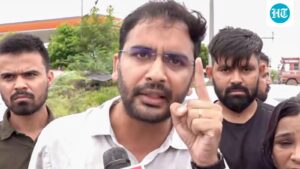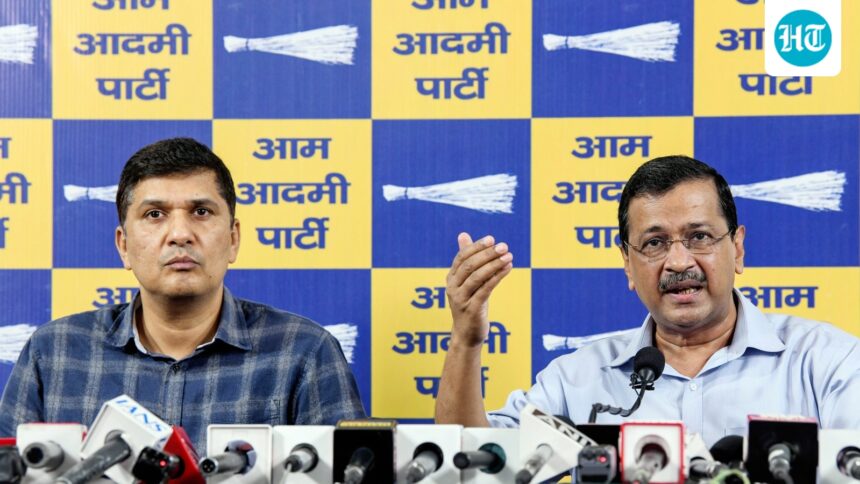
Former Delhi Chief Minister Arvind Kejriwal on Wednesday cited student-led political movements in Bangladesh and Nepal while attacking the Center over the cancellation of NEET-UG 2026, saying Indian youth can also enforce accountability in cases of paper leakage. His remarks came as opposition parties intensified their criticism of the BJP-led government after the National Testing Agency (NTA) canceled the medical entrance examination over allegations of widespread leakage.

Addressing a press conference, the Aam Aadmi Party (AAP) chief said the repeated paper leaks had shaken the confidence of aspirants and wondered whether earlier investigations by the Central Bureau of Investigation (CBI) had led to stringent punishments being imposed on those responsible.
“If Generation Z in countries like Bangladesh and Nepal can change the government, Indian youth can also ensure accountability in cases of paper leaks,” Kejriwal said.
He claimed that the CBI probe into the NEET paper leak “will achieve nothing” and claimed that several incidents of paper leakage have occurred in BJP-ruled states since 2014. He also extended his support to the protesting students, saying the government “only understands the language of Andolan”.
Why was NEET-UG 2026 cancelled?
The National Testing Agency (NTA) on Tuesday canceled the NEET-UG exam conducted on May 3 after reports that questions worth nearly 600 marks were leaked before the exam.
The exam was conducted in 551 cities in India and 14 cities abroad through more than 5,400 centers, in which about 22,000 students participated.
The controversy intensified after investigators uncovered what officials described as an organized nationwide network that included training centers, hostel operators, counterfeiters and card analysts.
According to investigators, a third-year BAMS student from Nashik allegedly purchased NEET question paper for $10 lakh and later sold to a contact in Gurugram for $15 lakh through postal transfers.
The leaked paper was allegedly used to prepare a ‘guess paper’ of 410 questions, with around 120 actual NEET questions embedded inside it before it was distributed across coaching centres, hostels and paid WhatsApp groups, officials said.
The case has now been handed over to the Central Bank of Iraq.
Rahul Gandhi accused of “organized corruption”
Opposition leader Rahul Gandhi accused the BJP-led Center of allowing “organised corruption” to flourish in the education system and said students’ dreams had been “shattered”.
“The hard work, sacrifices and dreams of over 22 lakh students have been crushed by this corrupt BJP regime,” Gandhi said in a post on X. He added that students were forced to endure “psychological stress, financial burden and uncertainty” while the “paper mafia” escaped punishment.
The Congress party also claimed that examination irregularities have become the “hallmark” of the BJP government, alleging that more than 89 examination papers have been leaked in the last 10 years.
DMK and Kamal Haasan renew their anti-NEET stand
The controversy also reignited Tamil Nadu’s long-standing opposition to NEET.
Kamal Haasan said the hard work of 22,000 students had been ruined due to “criminal conspiracies” and wondered who would take responsibility for the mental suffering faced by the aspirants.
Haasan said he could not recall “a single NEET exam conducted without allegations of malpractice” and reiterated his demand for education to be brought back on the state list.
Meanwhile, DMK spokesperson Saravanan Annadurai claimed that the cancellation vindicated the party’s stance against NEET and renewed calls to scrap the examination and base medical admission on Class 12 marks instead.
Students and parents express their anger
The cancellation also sparked widespread concern among students and parents, many of whom said their years of preparation had been thrown into uncertainty.
Parents have complained that while students face strict biometric checks, clothing restrictions and surveillance at centres, authorities have failed to secure the examination system itself.
Education consultants and activists have questioned how such a leak could happen despite AI monitoring, GPS-tracked papers, biometric verification, and 5G jammers being deployed during the exam process.