In an astonishing coincidence, if there can be one in politics, Arvind Kejriwal and Ashok Mittal parted ways on the same day – and in opposite directions.

On April 24, Kejriwal moved out of the Lutyens’ Delhi house to which Mittal had been allotted as Rajya Sabha MP, and which he had given to the AAP to live in since last year. In a post on X, Kejriwal said the Center has now allotted him a bungalow as directed by the court due to his position as national coordinator of AAP. “I have now moved into that house with my family,” Kejriwal said.
Within hours, Mittal left the AAP and joined the ruling Bharatiya Janata Party at the Centre, dealing a heavy blow to the party leader whom he had once personally recruited into the party’s ranks.
Mittal was not alone. He was among seven AAP Rajya Sabha MPs – including Raghav Chadha, Swati Maliwal, Harbhajan Singh, Sandeep Pathak, Rajinder Gupta and Vikramjit Sahney – who “merged” into the BJP on Thursday, in the largest single-day exodus in the party’s history.
Kejriwal reportedly invited MPs to his home on Friday evening in a last-ditch effort to prevent the strike, but that meeting never happened.
Kejriwal’s first public reaction was characteristically combative. “The BJP has shaken Punjabis,” he added, describing the defections as an external conspiracy rather than an internal collapse, and pointed to the only state in which the party is in power and faces elections early next year.
Mittal has been a big part of AAP’s Punjab story.
It was Kejriwal who brought Mittal – founder of Lovely Professional University and a prominent Punjabi businessman whose family started with a popular laddoos shop called Lovely Sweets in Jalandhar – to the Australian Academy of Paediatrics, and awarded him a place in the Rajya Sabha in 2022.
When Kejriwal resigned from his post as Delhi chief minister in September 2024 after being released on bail in a tax policy case, he was suddenly without a home. He vacated the Prime Minister’s official residence at 6 Flagstaff Road, which had long been targeted by the BJP as the “Sheesh Mahal”, for ornate renovations.
“When,” Mittal said in a video message in October 2024 [Kejriwal] When he resigned as Prime Minister, I learned that he had no place to stay. I invited him to be my guest at my residence in Delhi, and I am very happy that he accepted my request.
Kejriwal moved with his family to the MP Mittal’s official residence at 5 Ferozshah Road, near the AAP headquarters. He will live there for a little over a year.
What Happened Between Them: ED Raid In Focus
Before the arrangement could collapse, came the Enforcement Directorate (ED) raid.
In April 2026, a few days after the AAP promoted Mittal to replace rebel Raghav Chadha as the party’s deputy leader in the Rajya Sabha, central agency ED teams conducted searches at multiple locations linked to Mittal, including his residence and the LPU campus in Punjab.
The raids were linked to alleged financial irregularities involving business entities linked to the Lovely Group.
Kejriwal and Punjab CM Bhagwant Mann of AAP described the raids as politically motivated. The BJP has defended these measures as anti-corruption measures.
Within about a week, the exits came.
Kejriwal on Friday vacated Mittal’s house and moved to a Type VII government bungalow in Lodhi area, the residence allotted to him in his capacity as national party chief. Mittal left the party the same evening.
The chain of events thus goes back to early April, when AAP stripped Chadha of the position of deputy leader in the Rajya Sabha and handed over the role to Mittal. Chadha, cornered by an anti-defection law — which requires at least two-thirds of party lawmakers to approve a merger to avoid disqualification — has quietly reached out to other disgruntled MPs.
By the time the group moved, its numbers were sufficient to cross that constitutional threshold.
Situation in Punjab to AAP
This also means that the AAP has now lost seven of its 10 MPs in the Socialist Parliament. Six of the leavers were elected from Punjab, with the AAP bagging all seven seats from the state soon after its landslide victory in the 2022 Assembly elections.
There has been a buzz in the state over “outsiders” like Chadha and Sandeep Pathak, both AAP strategists; People who are not politicians or wealthy industrialists are selected.
The current rupture arrives in a markedly different context than the previous waves of internal turmoil witnessed by the AAP. The party has survived the ideological exits of co-founders like Prashant Bhushan and Yogendra Yadav in 2015, and the political fallout with Kumar Vishwas and Kapil Mishra after that; Yet they continued to win elections.
It swept 67 seats in Delhi in 2015, 63 seats in 2020, and 92 of the 117 seats in Punjab in 2022.
But this exodus comes after the AAP lost the Delhi elections in 2025, winning just 22 seats to the BJP’s 48. Punjab elections are scheduled to go to polls in about 10 months. Mann described the rebels as “traitors.” When he asked whether the party had made wrong choices in the beginning, he said that these people were chosen for the Socialist Revolutionary seats because they were prominent in their fields. “If there’s a machine that can read minds, let me know, and if I can order it from Amazon!” he said sarcastically on Friday.
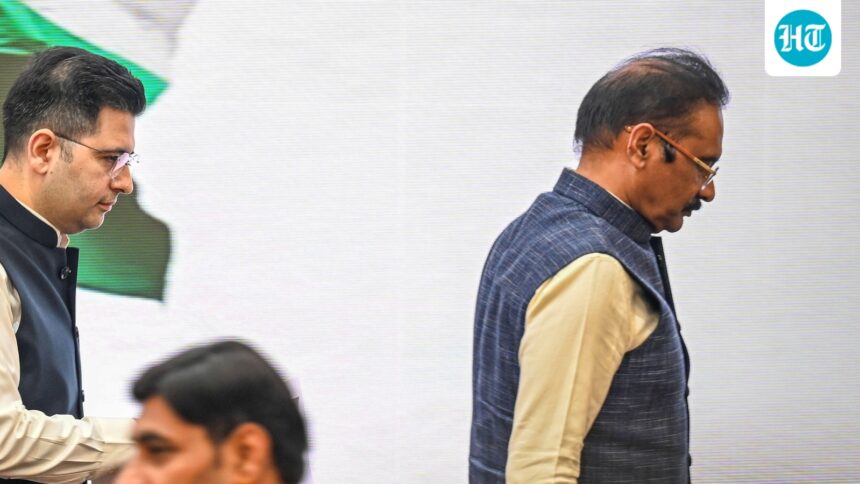
Flanked by Pathak and Mittal, Chadha said the party was no longer aligned with its principles and they admire the work of Prime Minister Narendra Modi. Mittal nodded and later took BJP membership with them.