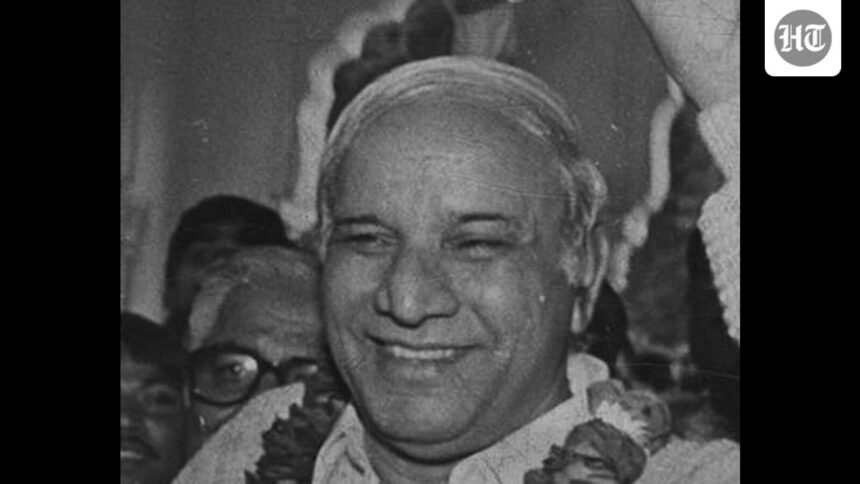
On 3 June 1995, Mayawati was sworn in as Chief Minister of Uttar Pradesh after the collapse of the coalition of the Samajwadi Party (SP) and the Bahujan Samaj Party (BSP). BSP founder Kanshi Ram told HT soon after that he would like to make Mayawati the chief minister. He said that by choosing her to head the BSP-led government in Uttar Pradesh, he was training her for the top role in the country. Kanshi Ram saw himself only as a guide.

Kanshi Ram, the enigmatic leader, expected fractured governance in the 1996 national elections and saw an opportunity to repeat his 1995 experience in New Delhi, where all major parties seemed keen to work with the burgeoning Dalit party. He successfully maneuvered Mayawati’s rise in Uttar Pradesh even though the Bharatiya Janata Party (BJP) had a numerical superiority in the state legislature.
Kanshi Ram repeatedly cited Dalit icon Bhimrao Ambedkar’s call for Dalits to seek power at the highest level for their liberation. His calculations proved accurate regarding the hanging house. The Janata Dal leadership overtook him to form the government under Deve Gowda.
The country’s highest elected office eluded Mayawati even when she took over the leadership of the BSP and secured a clear five-year term to govern Uttar Pradesh in 2007, a year after Kanshi Ram’s death. Ahead of the 2027 Assembly elections, calls are growing for India’s highest civilian award, the Bharat Ratna, to be given to Kanshi Ram, even as his dream of Mayawati becoming prime minister appears far-fetched. Since then the BSP’s support base has eroded significantly. It won just one seat in the 403-member Uttar Pradesh Assembly in 2022. The BSP has no seats in Parliament.
Congress leader Rahul Gandhi was among those who called for Bharat Ratna to Kanshi Ram in an ironic turn of events. Kanshi Ram, known for his tough style, described the Congress and the BJP as enemy number one and number two, likening them to snake charmers. He vowed to oust Congress from power in his lifetime. Kanshi Ram wanted the BSP to replace the Congress as the leading party. He even called Mahatma Gandhi a “Manuvadi,” or supporter of caste hierarchy. He described his ally-turned-arch-rival Mulayam Singh Yadav, who approved his appointment as chief minister because of his background as a backward caste leader, as a thief.
In 1996, Kanshi Ram agreed to ally with the Congress in the Uttar Pradesh Assembly elections, allotting barely 100 of the 425 seats after Prime Minister Narsimha Rao visited him. He will soon abandon the Congress after the elections and form a coalition government with the BJP.
Even as the BJP and the BJP shared power, Kanshi Ram and Mayawati attacked the “Manuvadi-Brahmin” political hegemony. The tensions led to the fall of the BSP governments in 1995, 1997 and 2003.
Kanshi Ram partially achieved his mission of overthrowing the Congress. But the BJP has gone from strength to strength, while the BJP struggles to gain relevance. As other parties vie for Dalit votes and the BJP grows in importance, it increasingly cites Kanshi Ram, whose “85% (non-upper caste) versus 15% (upper caste)” policies clash with Prime Minister Yogi Adityanath’s “80% (Hindu) versus 20% (Muslim)” gambit. Kanshi Ram united the so-called lower castes against the upper castes, while Adityanath thrives on religious polarization.
Political parties are playing the role of gallery, hoping to win the sympathy and support of Dalits by demanding Bharat Ratna for Kanshi Ram, arguably the second most important symbol of the community, which represents 20-21% of the population of Uttar Pradesh, after Ambedkar.
The BJP-led Union government had previously granted Bharat Ratna to Chaudhary Charan Singh and Mulayam Singh Yadav, who opposed Hindutva policies. The BJP won some Dalit votes through welfare schemes but lost support in the 2024 national elections over issues such as alleged threats to the constitution and quotas. The BJP is hoping to woo them again, even as the Jatavs, the BJP’s core supporters, remain optimistic about the BJP’s revival. Bharat Ratna for Kanshi Ram could help the BJP make further inroads in the Dalit vote bank.
Despite the erosion of its support base, the BSP represents the determination of Dalits and the belief that they can still rule if united. The BSP leadership expects a hung house in Uttar Pradesh in 2027, where Mayawati is perhaps the only leader whom all political parties will be willing to support, or at least not openly oppose.