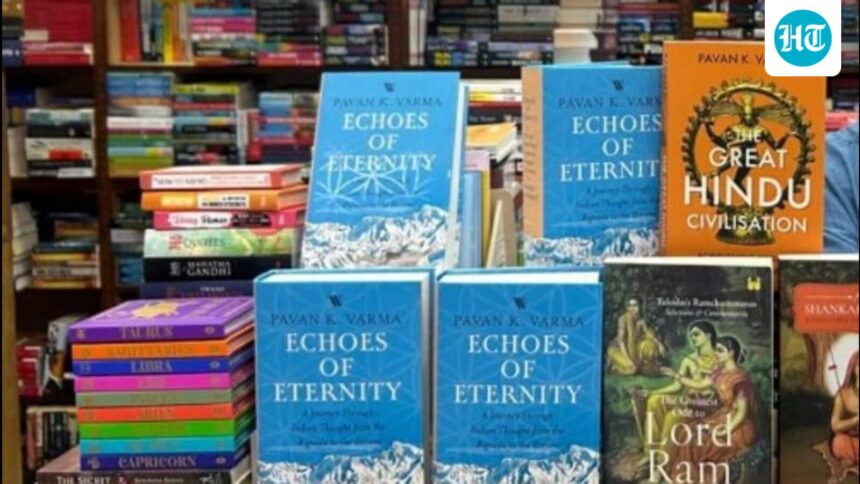
The question I’m often asked is why, in my latest book Echoes of Eternity: A Journey Through Indian Thought from the Rigveda to the Presenta compendium of the wonderful wisdom our Earth has acquired over the past eight thousand years, I have chosen to include J. Only Krishnamurti and Osho are among India’s contemporary philosophers.

The question is valid, and others could have made different choices. However, my criterion was to select those who I felt had made an original contribution to Indian philosophy, and it was impossible to include them all. In my opinion, Krishnamurti and Osho left the mark.
J. Krishnamurti (1895-1986) was born into a Telugu Brahmin family. His father worked for the Theosophical Society, and when the family moved to the society’s headquarters in Adyar, the young Krishnamurti was “discovered” by Charles Webster Leadbeater, who he believed would become a world-class teacher in the future.
Under the guidance of Annie Besant, Krishnamurti was taught and prepared to lead a global spiritual movement. But in 1929, he dramatically disbanded the organization founded around him, the Order of the Star, declaring that “truth is a land without a path.” This act remains one of the most notable instances of rejection of spiritual authority in modern history.
Krishnamurti believed that each individual should undertake his or her own search for truth without being dictated or conditioned by what others believe or want them to believe. In this research, the key was the quality of courageous honesty and absence of fear. One aspect he emphasized was observing one’s thoughts silently, without judgement, and with complete awareness. The process itself will lead to stillness of the mind, and in this stillness paves the way to truth.
Such a path may be lonely, but it was better for him than organized religion. One of his favorite jokes was: A man finds the truth on the side of the road and puts it in his pocket. His friend asks him: What will you do with him? The answer: “Let’s organize it.” Krishnamurti used this joke repeatedly because it summed up his lifelong criticism of religions, ideologies, and gurus.
Born Rajneesh Chandra Mohan Jain, Osho (1931-1990) grew up in central India and was known from childhood for his rebellious temperament. He studied philosophy and later became a professor before becoming a public speaker and spiritual teacher in the 1960s.
Unlike Krishnamurti, Osho openly embraced controversy. He challenged traditional morality, criticized political and religious institutions, and spoke extensively about sexuality, arguing that spiritual growth should not depend on repression. This gained him loyal followers and fierce opponents.
The most dramatic chapter of his life occurred in the United States, where his followers established the municipality of Rajneeshpuram in Oregon. The experiment ended amid legal disputes, immigration charges, and criminal activities committed by some close associates. Osho denied his direct involvement in those crimes and blamed members of his inner circle. He eventually returned to India, spending his final years in Pune.
His lifestyle attracted great attention due to his ownership of dozens of luxury Rolls Royce cars, prompting critics to accuse him of hypocrisy. Osho responded that he was making the point that spirituality and material abundance should not be opposed.
Osho was a gifted orator and often mixed his speeches with jokes. One of these went like this: Ibn Nasr al-Din returns home carrying a chicken. “Where did you get it?” Nasr al-Din asks. “I stole it,” the boy says. Nasr al-Din turns proudly to his neighbor and says: “This is my son. He may steal, but he will not lie!” The joke exposes our strange and varied morality: we often admire honesty while ignoring much greater wrongdoing.
Osho often said that life itself is a joke and that the seriousness of man is the real problem. He once remarked that although Buddha’s last message was “Be your own light,” his message might have been: “Be your own fool.” The point was not frivolity but freedom from ego. People who can laugh at themselves are less trapped by self-importance.
It could not have been Osho and Ji. Krishnamurti is more different in temperament. Osho loved stories, jokes, paradoxes and laughter. Krishnamurti was more strict and austere, though he also had a subtle sense of humour. Krishnamurti sought freedom through the complete negation of psychological dependency. Osho sought freedom through a fuller experience of life and consciousness. One is like a radical philosopher of consciousness; The other is a mystical celebration and transformation. Krishnamurti was reserved, elegant, and disciplined, and highly suspicious of followers, organizations, and spiritual authority. Osho was flamboyant, provocative, charismatic, and comfortable building a large movement around himself.
However, both have left a lasting mark on modern spirituality, because each, in his own way, challenged humanity to think independently and seek direct experience rather than indirect belief.
(Pavan K Varma is an author, diplomat and former Member of Parliament (Rajya Sabha). The views expressed are personal)