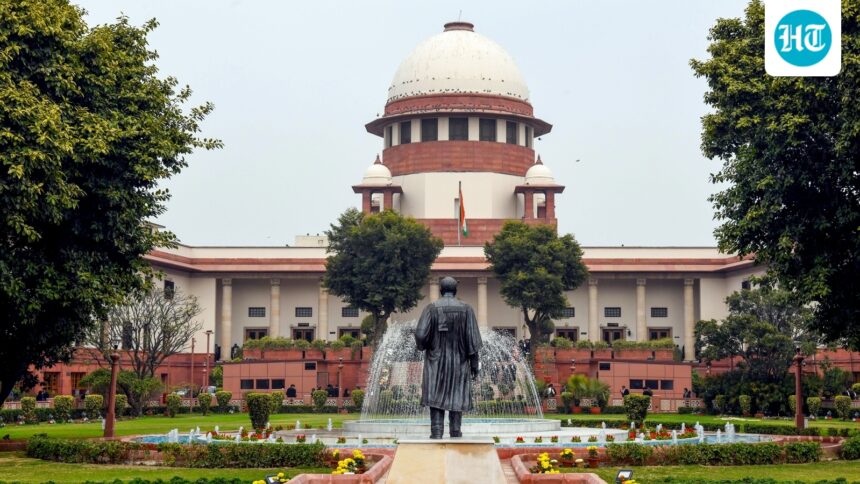
“Election commissioners are on par with judges of the Supreme Court,” a two-judge bench of the Supreme Court said on Thursday, arguing that it would be good if the government approved the appointments of Supreme Court judges at the same speed with which it appointed election commissioners.

The observation came as the court was hearing a batch of petitions challenging the CEC and EC (Appointment, Conditions of Service and Term of Service) Act, 2023, after senior advocate Vijay Hansaria, representing the petitioner, Congress leader Jaya Thakur, said the Supreme Court had in March 2024 refused to stay the law when two election commissioners, Gyanesh Kumar (current CEC) and Sukhbir Singh Sandhu, had to be appointed. He explained how the search committee selected six names, the selection committee filtered out the two names, and the presidential order was issued appointing them – all in one day on March 14, 2024.
The Supreme Court was told during the hearing that the current law was introduced after the Supreme Court in the Anup Baranwal judgment (2023) directed that a selection committee comprising the Prime Minister, Chief Justice of India and the Leader of the Opposition in the Lok Sabha appoint all future CECs and electoral councils, but with the caveat that the provision would operate until Parliament enacted a law.
“What happened before Anoop Baranwal was judged? Why did Parliament not pass a law,” a bench of Justices Dipankar Datta and SC Sharma asked advocate Prashant Bhushan representing another petitioner – Association for Democratic Rights (ADR). Bhushan said the framers of the Constitution allowed Parliament to make a law under Article 324 of the Constitution, but for 73 years no law was made and the court had to step in to fill this legal vacuum. He cited parliamentary debates to show how opposition parties demanded a law but chose not to do so when they took power.
“Whoever comes to power does the same thing. It is very unfortunate for the country,” the judge said.
Justice Datta commented: “I remember what one parliamentarian said… ‘the tyranny of the unelected’. This should be equated with the tyranny of the elected.” The other judge interrupted him, saying: The tyranny of the majority.
Referring to the current law, Bhushan said: “This law restores the same situation that existed before the 2023 ruling.” The selection committee provided under the Act is chaired by the Prime Minister and includes the Leader of the Opposition in the Lok Sabha and a Cabinet Minister.
“Despite the opposition of the Leader of the Opposition, appointments are being made. You cannot pass a law that brings the same drawback as confirmed by this court, i.e. preserving the independence of the Election Commission from executive control,” Bhushan said, adding that the Baranwal case underscored that the independence of the poll panel begins at the appointment stage.
Hansaria also told the court that the series of events related to the appointments of Kumar and Sandhu came a day before the bench was to hear the pleas regarding the viability of the law. However, the bench did not consider this application because there was nothing on record attributing any motive to the government.
All the petitions sought to declare the law unconstitutional and asked the court to propose some mechanism to ensure independence in CEC/EC appointments. The Center has opposed the petitions and will submit applications next week.