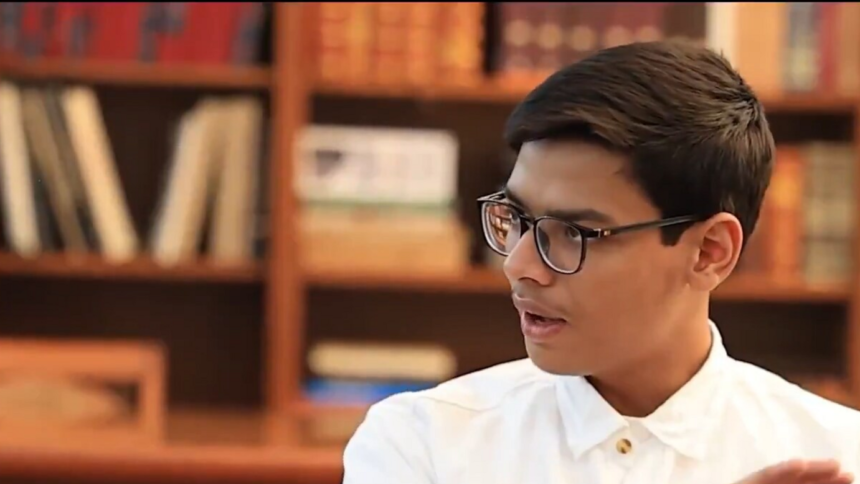
Cartoon references and short phrases are a key part of how he communicates, as well as some serious inspiration from Hindi Urdu poets who don’t easily relate to Generation Z

When the Central Board of Secondary Education reminded Class XII students of the last day to apply for re-evaluation, the teenager whose blog has turned the board on its head in the past few days had an application. “Can you please extend the deadline please as I have been busy this week exposing you,” Sarthak Siddhant wrote on X on Sunday, cheekily responding to the board’s notice.

Rude ripostes seem to be his signature style online, mixing them with cartoon references and one-liners, as well as some serious inspiration from Urdu and Hindi poets not easily associated with his generation – Sahir Ludhianvi and Ramdhari “Dinkar” Singh.
His joke at CBSE’s expense capped a week in which his blog probing the board’s new On-Screen Marking (OSM) system went viral; He was impeached before the Parliamentary Standing Committee on Education; The government then transferred two senior CBSE officials and ordered an investigation into the OSM vendor and system; Opposition leader Rahul Gandhi and his family met him. He said that journalists flocked to his home in Ranchi.
“A very rational approach to living life and thinking”
Behind the scrutinizing of bids and ruthless scrutiny is an 18-year-old who grew up in Bokaro, a government steel mill town in Jharkhand, and moved to the state capital Ranchi after his father died when he was in class 10. He says he doesn’t have a phone. His love for the Internet comes from his original love for everything computer related.
In a profile on one of his main websites, he called himself an “internet kid” and “idiot,” an atheist with a “very rational approach to living life and thinking.” His idea of society is “very French Revolutionary.”
“I am who I am,” says the profile, written long before there was any interest. He concludes his words there by saying: “I will not change myself for you.”
When he said in a recent interview that he doesn’t like to watch movies or web shows, and instead likes “old songs with meaningful lyrics playing in the background while I work on my computer,” he was asked to choose his favorite song.
He cites Saher’s human poetry
He reached Sahir Ludhianvi, and the lines “Tu Hindubanega na Musalmanbanega, Insan ki aulaad hai insaanbanega,” “You will neither be a Hindu nor a Muslim;” You are a son of man, and you are a human being. This powerful message about secularism by Ludhianvi appeared in the 1959 film “Dhool Ka Phool,” decades before the Internet was properly conceived. Sahir Ludhianvi (1921–1980) was one of the leading voices in the progressive writers’ movement and a Padma Shri awardee.
Another poet who mentions his name there, and refers to him repeatedly in his account In his interview with L Hindu, Sarthak Siddhant cited, “Lohe ke ped hare honge, tu gaan prem ka gaata chal; nam hogi yeh mitti zarur, aansu ke kann barsata chal.” The poem speaks of “trees of iron” that will one day turn green if “your tears wet the soil beneath them.”
“He should keep asking questions.”
“The only message of this poetry is that one must keep asking questions and make constant efforts to get answers,” he said.
On X earlier in the week, he shared an on-screen recitation of the Hindi poem in a male voice.
In his responses to “Samar sheesh hai – nahi baap ka baaji keval vaad; jo tatast hain, samai lekija onka bhi aparadh,” is written in Hindi.
He told Rahul Gandhi in their interaction that he traced his inquisitive mind to his upbringing, which challenged notions. He also referred to his parents’ inter-caste marriage in multiple interviews as something that sets him apart. As did bereavement.
He said: “After my father died of a heart attack two years ago, I began to question concepts such as religion, philosophy and faith.” He mentioned to Newspaper laundry How his parents were “progressive and conservative at the same time.”
Regarding his position, he said, “A kind of social justice,” based on “a lot of freedom, a lot of freedom of expression.” But he added that Indian politics “is not about ideology” but is concerned with specific issues.
Siddhant was raised by two computer engineers who ran their own academy and, by his own account, used a computer mouse at the age of three.
And he said to Hindustan Times He surpassed the school curriculum by Class 6 or 7, taught himself programming, software development, robotics and the Internet of Things, and turned to artificial intelligence in 2023.
For his Class XII boards, he sat for Science and Computer stream: Physics, Chemistry, Mathematics, Computer Science and English. He is now waiting for admission to college. His entrance exams are over, and he expects to study engineering in Bengaluru, combining data science, artificial intelligence and civic technology, he told HT.

Arish Chhabra is an associate editor on the Hindustan Times online team, where he writes news reports and explanatory features, as well as overseeing the site’s coverage. His career spans nearly two decades across India’s most respected newsrooms in print, digital and broadcast. He has reported, written, and edited across formats—from breaking news and live election coverage, to analytical long-reads and cultural commentary—building a body of work that reflects editorial rigor and a deep curiosity about the community for which he writes. Areesh studied English Literature, Sociology and History along with Journalism at Punjab University in Chandigarh, and began his career in that city, eventually moving to Delhi. He is also the author of Little Big City: What Life is Like from Chandigarh, a collection of critical essays originally published as a weekly column in the Hindustan Times, which examines the culture and politics of a city that is much more than just its famous architecture – and in doing so, holds up a mirror to modern India. During his stints at BBC, The Indian Express, NDTV and Jagran New Media, he has worked across formats and languages; Mainly English, as well as Hindi and Punjabi. He was part of the crack team for the BBC Explainer project which was replicated around the world by the broadcaster. At Jagran, he developed editorial guides and trained journalists on integrity and quality content. He has also worked at the intersection of journalism and education. At the Indian School of Business (ISB) in Hyderabad, he developed a website to streamline academic research in management. At Bennett University’s Times School of Media in Noida, he taught students the craft of digital journalism: from newsgathering and writing to social media strategy and video storytelling. Having moved from small town to larger town to megalopolis for education and work, his intellectual passions lie at the intersection of society, politics, and popular culture—a perspective that guides his writing and worldview. When he’s not working, he’s constantly reading long-form journalism or watching cerebral content, sometimes both at the same time.Read more