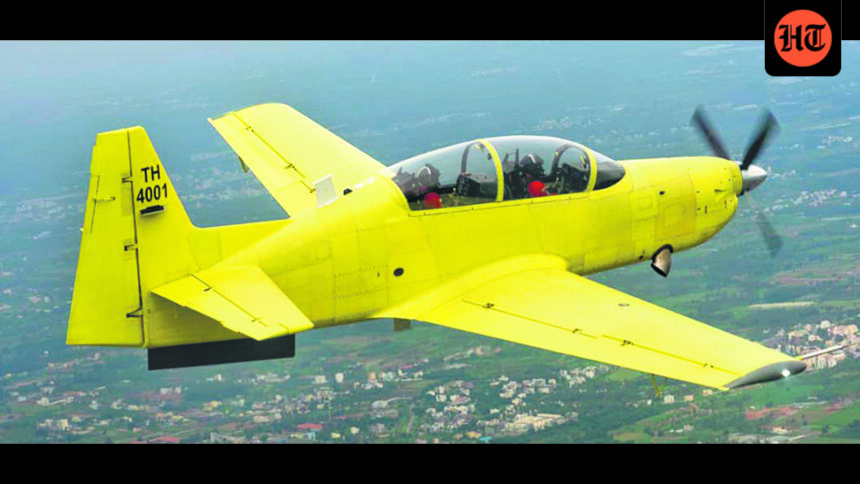
US firm Honeywell has overcome supply chain bottlenecks and delivered the first batch of engines for its overdue indigenous basic trainer aircraft – which are critical for the Indian Air Force – to Bengaluru-based Hindustan Aeronautics Limited (HAL), officials familiar with the matter said on Wednesday.

Honeywell has delivered three TPE331-12B turboprop engines for the HTT-40 (Hindustan Turbo Trainer-40) aircraft being built at HAL, and assured the state-run company of timely supplies, the officials said, requesting anonymity.
“HAL aims to speed up aircraft deliveries as engine supplies stabilize,” an official said. The platform will serve as a springboard for pilots to develop important flying skills.
The Air Force requested 70 basic trainers $6,838 crore three years ago for training of junior pilots. Under the contract, HAL was supposed to supply 12 aircraft to the Indian Air Force in the financial year 2025-26, but it has not delivered a single aircraft so far due to unavailability of engines.
Under a $100 million contract signed almost four years ago for the supply and manufacture of 88 TPE331-12B engines/sets, Honeywell was supposed to deliver the first engine in September 2025. The American company will supply 16 units and HAL will build the rest through technology transfer.
Another official said that the remaining engines are expected to be provided at a rate of two engines per month. Two series production HTT-40s are already flying with TPE331-12B Class B (used) engines powering the prototype aircraft.
The new manufacturing facility for the HTT-40s will help speed up deliveries. Last October, Defense Minister Rajnath Singh inaugurated the production lines of the LCA Mk-1 and the HTT-40 basic trainer aircraft in Nashik to meet the growing needs of the Air Force. HAL is now capable of producing 20 HTT-40 aircraft annually at its factories in Bengaluru and Nashik.
The tandem-seat HTT-40 has an air-conditioned cockpit, modern avionics, hot refueling capability (refueling with the engine running on the ground), and zero ejection seats (for safe ejection at low speeds and low altitudes). HTT-40 currently has 56% local content, which will gradually increase to more than 60% through localization of key components and subsystems.
Currently, entry level (Phase 1) flight training for all novice pilots is carried out on Pilatus PC-7 MkII basic training aircraft of Swiss origin. Phase 1 training is common for all pilots and then there is a triple distribution to the fighter, transport and helicopter routes.
Those selected for the fighter stream go on to phase two training on PC-7 MkII and Kiran Mk-1A jet trainers and then phase three on British-origin Hawk advanced jet trainers before they can fly supersonic fighters. Pilots from the other two tracks are conducting their training in the second and third stages on different types of transport aircraft and helicopters.
Plans to purchase more Pilatus PC-7 MkII training aircraft were damaged in July 2019 after the Ministry of Defense suspended its business dealings with Pilatus Aircraft Limited for a year for violating a pre-contract integrity agreement. $2,900-crore deal for 75 head coaches, also taking into account the Indian investigations against the company for alleged corruption and irregularities. The contract with Pilatus included a clause to pursue the purchase of another 38 aircraft.