India’s position on the US-Israeli attack on Iran, and the latter’s expansion of the conflict to include Arab countries and oil trade routes, should not be governed by “emotional” reasons, a senior former Indian diplomat said.

“The issue is not whether India should be for or against Israel, the US, Iran, or the Gulf states in an emotional or ideological sense,” Nirupama Menon Rao, former foreign secretary, wrote on X.
“The issue is whether any of these relationships, as they currently operate, advance India’s long-term interests without narrowing India’s strategic independence,” she said.
He follows | Live updates on the US-Iran conflict
Rao, who served as India’s envoy to the US, China and Sri Lanka during her career, said India’s strength “has always been in balance – in keeping multiple relationships alive at once, in speaking across divides, and in refusing to let any single partnership become a trap.”
Read also | Jaishankar and Iranian Foreign Minister discuss the role of BRICS in regional security amid conflict in West Asia
She said this should not be seen as weakness: “It is the essence of serious statecraft for a country of India’s size, geography and cultural depth.”
She said the tone of local discourse has changed in “recent years.”
“There is a marked tendency to see Israel less as a partner than an object of admiration, even envy – a symbol of absolute power, quick retaliation, and the fantasy of unfettered power. Much of the media has jumped on board this train, welcoming Israel as a country India has specific interests with, rather than as a projection of its own ideological desires,” she said.
This is where the “danger” lies, she said, adding that admiration for Israel’s military prowess cannot be considered a strategy. “It is an emotional replacement… We cannot inherit another country’s siege mentality as if it were our own.”
Read also | India and the US are closing in on a crucial minerals deal, and a big announcement is expected soon: envoy Sergio Gore
“The real test for India is not whether it can build power,” she said. “It is whether it can maintain room for manoeuvre, protect its energy and maritime interests, maintain its credibility throughout West Asia, and maintain its voice. A country like India should not suffer from ‘Israeli envy’. It should have the confidence to be itself. I am sure it can.”
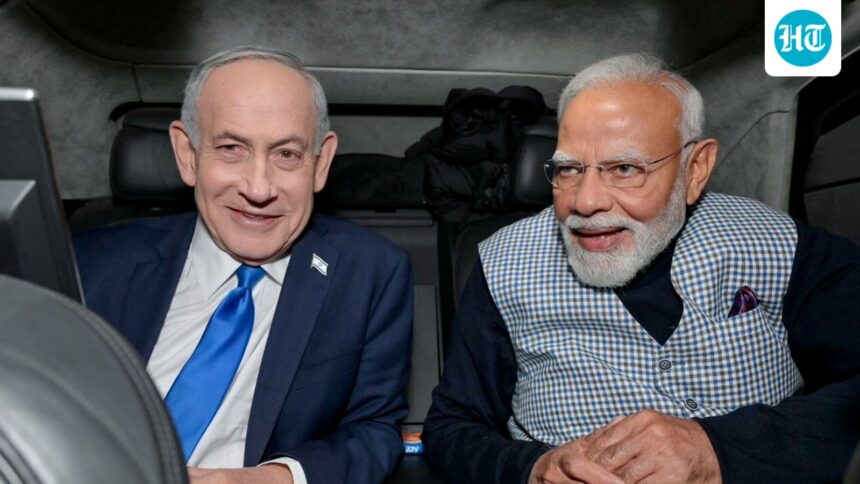
India has sought to project a pro-peace image in the US-Iran conflict, even as the opposition viewed Prime Minister Narendra Modi’s visit to Israel ahead of the outbreak of war on February 28 as prior tacit support for the US and Israel.
Prime Minister Modi visited Israel on February 25-26, met Prime Minister Benjamin Netanyahu and addressed a special session of the Knesset in Jerusalem, where he declared that “India stands with Israel, firmly, with complete conviction, at this moment, and beyond.”
US-Israeli military strikes on Iran began less than 48 hours after Modi left Israel.
Since the start of the war, New Delhi has not issued any statement condemning the initial attack on Iran. In a phone call with UAE President Sheikh Mohammed bin Zayed, Modi said he “strongly condemns the attacks on the UAE and condoles the loss of life”, though he did not mention Iran by name – making it India’s first and only condemnation so far of any party in the conflict.
This week, Prime Minister Modi also spoke with Iranian President Masoud Pezeshkian, their first conversation since the start of the war. India’s official condemnation of the killing of Iranian Supreme Leader Ali Khamenei came only on March 5, through the Foreign Minister.
On Friday, Union Minister Giriraj Singh accused Leader of the Opposition in Lok Sabha Rahul Gandhi of “spreading confusion and misinformation” over the availability of LPG in the country as the West Asian war hits vital supply routes.
Gandhi claimed that India’s energy security had been “compromised” by a “flawed” foreign policy and that the government had “traded” the United States for the right to determine relations with various oil suppliers.
While raising the issue in Lok Sabha, Gandhi said that a war between the US, Israel and Iran would have far-reaching consequences. The raging conflict in West Asia sparked an LPG crisis in India, where people were forced to stand in long queues for hours to buy cylinders.
With the conflict closing the Strait of Hormuz – the narrow sea lane between Iran and Oman through which India gets much of its crude oil imports and gas supplies – oil companies have prioritized home kitchen supplies while cutting back on commercial users such as hotels and restaurants.