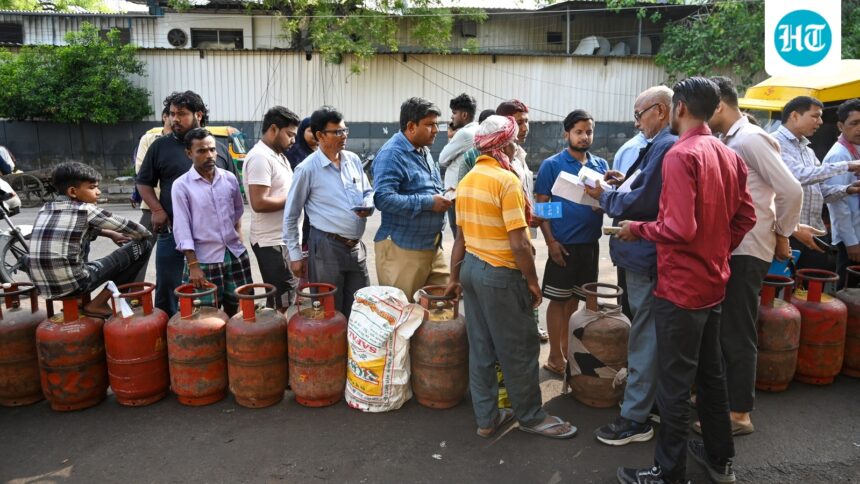
The government on Wednesday raised gas allocations for fertilizer plants to 95% of their needs and allowed commercial LPG supplies to additional sectors, including agriculture, pharmaceuticals, paint, ceramics, foundry and glass, officials said, moves that came hours after the United States and Iran agreed to a two-week ceasefire.

Natural gas supplies to fertilizer plants have again increased from 90% to 95% of their requirements, Sujata Sharma, Joint Secretary at the Ministry of Petroleum, said in a press conference. This is the second increase in a week. Today, Monday, the government raised gas allocations to the fertilizer sector from about 70% to 90%. Natural gas is the fuel and raw material for fertilizer plants.
Currently, gas for the first time to meet the requirements of 100% domestic consumers is supplied through pipelined natural gas (PNG) and automobiles through compressed natural gas (CNG).
LPG supply center
Talking about LPG supplies, Sharma said the government on Wednesday issued an order allowing commercial LPG supplies to additional sectors like agriculture, uranium, heavy water, pharmaceuticals, paint, ceramics, foundry and glass. She added that the order proposes to meet 70% of their gas needs before March “with a total sectoral limit of 200 tons per day.”
The government initially cut off LPG supplies to commercial consumers in order to meet the requirements of 332 million domestic household customers.
After ensuring supplies to domestic consumers, on March 12, the government allowed commercial LPG supplies in a metered manner to hospitals and educational institutes, Sharma said. This amount has since gradually increased to 70% and covers restaurants, dhaba, hotels, canteens, community kitchens, steel, automobile, textiles, chemicals and plastics sectors.
The government also doubled the supply of 5kg free trade liquefied petroleum (FTL) gas, which is mainly sold to migrant workers. The move came after the industry feared a possible exodus of migrant workers due to shortage of 5 kg FTL in several industrial clusters. Sharma said supplies to FTL consumers have been increased. More than 110,000 FTL cylinders were sold on Tuesday alone, she said. Since March 23, a total of 8,90,000 FTL cylinders have been sold, it added.
Energy crisis amid the US-Iran war
After the outbreak of war in West Asia on February 28, energy supplies were damaged. Before the war, India imported 60% of its LPG needs, 90% of which came from West Asia, mostly Qatar.
According to officials, a 15-day ceasefire may help strengthen energy supply chains and calm rising fuel prices. Benchmark Brent crude prices, at $72.87 a barrel before the war in West Asia, rose to $119.5 by March 9, but fell sharply by 15.3% after news of the ceasefire to $92.55 a barrel (at 5.35 IST on Wednesday). India is the world’s third-largest consumer of crude oil after the United States and China, and imports more than 88% of the crude oil it processes.