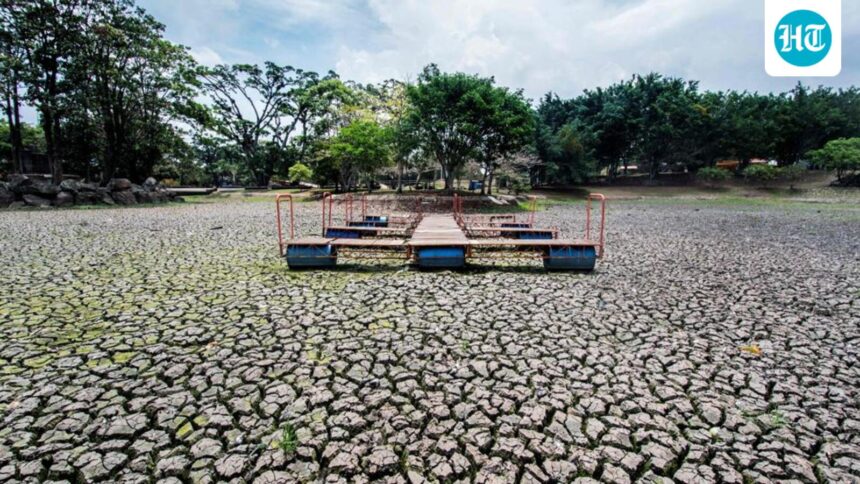
India faces a harsher summer and weaker monsoon as El Niño conditions develop over the tropical Pacific, indicating the possibility of hotter and drier conditions in large parts of Asia, weather agencies said.

“We will issue a statement soon based on our models on the onset of El Niño,” said Mrutyunjay Mohapatra, Director General of the India Meteorological Department.
The Japan Meteorological Agency said Wednesday that oceanic and atmospheric conditions characteristic of El Niño have already appeared over the tropical Pacific, indicating that El Niño is underway.
Read also | How good or bad have the monsoon rains been so far? | Number theory
In India, El Niño is generally associated with below-normal monsoon rainfall and high temperatures during the summer months.
The IMD, on May 29, downgraded its monsoon forecast, stating that rainfall over the country is likely to remain below normal at 90% of the long period average (LPA), with a model margin of error of ±4%. The previous forecast issued in April had expected rainfall at 92% of the LPA.
The southwest monsoon remains critical to India’s economy, especially because nearly half of the country’s cultivated area lacks irrigation facilities. Monsoon rains also replenish 91 major reservoirs that support drinking water supplies, industries and power generation.
This year the monsoon takes on added importance amid geopolitical and weather concerns. Farmers are already facing the prospect of disruption to fertilizer supplies due to conflict in West Asia, while scientists have warned that El Niño conditions could lead to further disruption of rainfall.
“The science is clear: El Niño will arrive on our doorstep in the coming months with 90% certainty,” UN Secretary-General António Guterres said in a statement issued on June 2. “The world must treat it as an urgent climate warning.”
He added: “El Niño conditions will add fuel to the fire of a warming world. The impacts will be more powerful, travel farther, and cross borders with devastating speed. The only effective response is climate action that equals the crisis – ending addiction to fossil fuels, accelerating the transition to renewable energy sources, protecting the most vulnerable, and providing early warning systems for all.”
Second warmest May on record: C3S
Last month was the second-warmest May ever recorded globally, across land and sea surfaces, the Copernicus Climate Change Service (C3S) said on Wednesday.
According to the analysis, sea surface temperatures across the tropical Pacific Ocean have remained exceptionally high as the tropical Pacific Ocean continues to shift toward El Niño conditions.
May recorded a global average surface air temperature of 15.81°C, which was 0.55°C warmer than the 1991-2020 average for the month and second behind May 2024. The month was also 1.42°C warmer than the estimated pre-industrial average of 1850-1900.
The average sea surface temperature during May reached 20.90 degrees Celsius, which is the second highest level recorded for this month after May 2024, which recorded 20.93 degrees Celsius.
“Sea surface temperatures have remained at exceptionally high levels across much of the tropical Pacific Ocean, as the tropical Pacific Ocean continues to shift toward El Niño conditions, which are expected to develop in the coming months,” C3S said.
Across Europe, the month saw a rapid shift from unusually cold conditions to one of the oldest and most intense heatwaves ever recorded in Western Europe, according to C3S.
The heatwave broke many May temperature records, especially in France, the United Kingdom, Ireland and Portugal. The climate service said the event reflects a long-term warming trend in Europe and an increased frequency of extreme heat events that occur earlier in the season.
“May 2026 was the second warmest May on record globally, adding to exceptional global warming, with near-record temperatures in both the atmosphere and oceans,” said Samantha Burgess, Strategic Lead for Climate at the European Center for Medium-Range Weather Forecasts (ECMWF). “In Europe, an unusually early and intense heatwave shows how quickly extreme weather events are becoming the new normal rather than the exception.”
Outside Europe, wetter-than-average conditions prevailed in northern and southeastern North America, areas of the northern Indian subcontinent, western China, parts of Brazil, South Africa, and large parts of Australia.
In contrast, drier than average conditions were recorded across the central United States, large parts of Central Asia, Madagascar, southwestern Australia, and much of South America.
The analysis also indicated that extratropical regions that experienced wetter than average conditions during the period from March to May 2026 included parts of northern and eastern North America, Iraq and the Middle East, Central Asia and China, and much of southern Africa and Australia.
In the Arctic, sea ice extent during May was about 4% below average, making it the fourth lowest extent on record for May. Sea ice cover remained below average in most Arctic marine sectors, especially in the northern Barents Sea and around Svalbard.
In Antarctica, sea ice extent was about 9% below the May average, ranking seventh lowest for the month and remaining close to historically low levels observed over the past two years.