India on Tuesday implicitly criticized China for supporting Pakistan during a short but intense conflict last year, saying responsible countries should consider how their efforts to protect terrorist infrastructure affect their global standing.

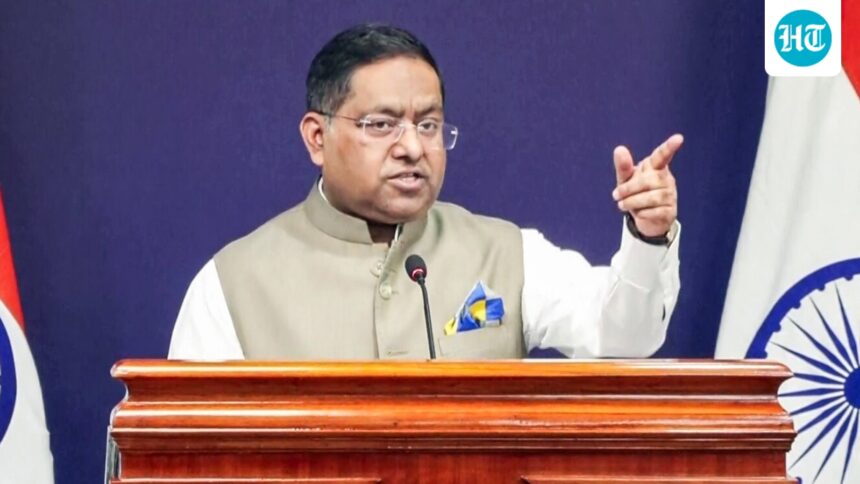
External Affairs Ministry spokesman Randhir Jaiswal’s comments came days after CCTV aired an interview with a military aviation engineer, who said his company provided technical support to Pakistan during the four-day conflict in May 2025.
India launched Operation Sindoor on May 7, 2025, as a targeted response to the terror attack in Pahalgam in April last year that killed 26 civilians, Jaiswal said in a press conference.
Indian military strikes on terrorist infrastructure in nine locations sparked hostilities that ended when Indian and Pakistani military officials reached an understanding on May 10, 2025.
“Reports confirm what was known”
“We have seen these reports that support what was previously known. Operation Sindoor was a precise, targeted and calibrated response to the terrorist attacks in Pahalgam, with the aim of destroying state-sponsored terrorist infrastructure operating out of Pakistan and at its behest,” Jaiswal said while responding to a question about the media report about China providing support to Pakistan during the conflict.
“It’s for the nations [which] They consider themselves responsible if supporting attempts to protect terrorist infrastructure affects their reputation and standing.”
The report broadcast by CCTV last week was the first confirmation of China providing field support to Pakistan during the hostilities.
According to the South China Morning Post, Zhang Heng, an engineer at the Aviation Industry Foundation of the Chengdu Aircraft Design and Research Institute in China, told CCTV that he provided technical support to Pakistan during the conflict.
Chinese plane in focus
“At the support base, we repeatedly heard the roar of fighter planes taking off and the constant wail of air raid sirens,” Zhang said.
He said his team was driven by “the desire to do a better job with field support” and to ensure their equipment could “truly operate at its full combat potential.”
“This was not only a recognition of the J‑10CE, but also a testament to the deep bond we formed by working side by side, day in and day out,” Zhang said.
The J-10CE is the export version of the Chinese J-10C fighter jet. Pakistan is the only known operator of the plane outside China.
Xu Da, another employee of the Chengdu Aircraft Design and Research Institute who was also involved in providing field support to Pakistan during the conflict, told CCTV about the aircraft’s performance during the hostilities. “In terms of the great results that the J-10CE had, we weren’t very surprised, it wasn’t surprising at all,” Shaw said.
“The aircraft needed the right opportunity,” Shaw said. “When that moment came, the aircraft delivered exactly as we knew it would.”
On May 7, Lt. Gen. Rajeev Ghai, the Indian Army’s deputy chief of staff for strategy, highlighted “collusion” between Pakistan and China in last year’s conflict.
“The fact is that Pakistan and China, as they put it, have a relationship that is deeper than the seas and higher than the mountains – that is a given. The fact that Pakistan has 80% of its military equipment of Chinese origin is a given,” he told a press conference.