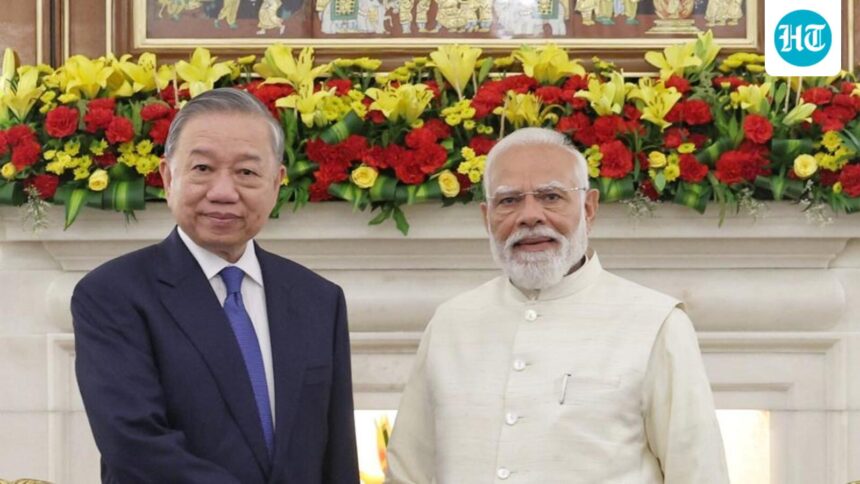
India and Vietnam on Wednesday raised their ties to an enhanced comprehensive strategic partnership and set a target to boost trade to $25 billion by 2030, as Prime Minister Narendra Modi and Vietnamese President To Lam held talks focused on expanding cooperation in trade, defence, and critical minerals.

Lam arrived in India within a month of assuming office as president of Vietnam, which has emerged as an important security and trade partner for India in Southeast Asia. Accompanied by a number of ministers and a large delegation of businessmen, he will also travel to Mumbai, the financial center, to boost bilateral trade, which has doubled over the past decade to nearly $16 billion.
During the meeting between Modi and Lam, the two sides concluded 13 agreements to advance cooperation in areas ranging from critical minerals and pharmaceuticals to payments and digital technologies.
Modi noted in a joint media interaction that Vietnam became India’s first comprehensive strategic partner in the Association of Southeast Asian Nations (ASEAN) region a decade ago, and said: “Based on this strong foundation, today we are raising our relations to the level of an enhanced comprehensive strategic partnership.”
This will enhance cooperation in the areas of connectivity, security, sustainability and supply chain resilience. He added that the two sides decided to increase bilateral trade to $25 billion by 2030, and the memorandum of understanding between the drug authorities will increase access to Indian medicines in Vietnam.
“It is also expected that exports of Indian agricultural, fish and livestock products to Vietnam will become easier. Very soon, Vietnam will taste the taste of India’s grapes and pomegranates, and we will taste Vietnam’s durians and pomelos,” Modi said. At the same time, new initiatives in vital minerals and energy cooperation will ensure economic security and supply chain resilience.
Lam said bilateral relations have been upgraded on the basis of strategic convergence, and the two sides will deepen political trust and economic cooperation by linking the value chain, removing barriers, and expanding market access.
“India has made significant progress as a hub for growth and innovation in the world,” Lam said.
“We will link together our strategic visions and development strategies to better address the turmoil the world is experiencing today.”
He added: “We will work to advance defense and security cooperation to become a strategic pillar to contribute to enhancing an environment of peace and stability.” Without directly referring to the South China Sea, Lam said that both sides support freedom of navigation and overflight and the peaceful resolution of disputes.
Modi described Vietnam as a fundamental pillar of India’s policy in dealing with the East, and said that the two sides share a common vision in the Indo-Pacific region. “Through our enhanced defense and security cooperation, we will continue to contribute to the rule of law, peace, stability and prosperity,” he added.
Lam added that Vietnam supports India playing a greater role in multilateral forums, and is willing to work more closely together in addressing common challenges facing the region.
The two sides also supported the review of the ASEAN-India Trade in Goods Agreement (AITIGA) by the end of the year to provide new impetus to trade and investment.
Modi thanked Vietnam for its strong condemnation of the Pahalgam terrorist attack last year and for standing by India in the fight against terrorism.
“To strengthen financial connectivity, today we decided to strengthen cooperation between our central banks. India’s UPI and Vietnam’s express payment systems will soon be linked. Moreover, we are working to strengthen state-to-city and city-to-city cooperation between the two countries,” he noted.
Among the 13 agreements concluded by the two sides are a memorandum of understanding on cooperation in the field of critical minerals between IREL (India) Limited and the Institute of Technology for Radioactive and Rare Elements (ITRRE) in Vietnam; A Memorandum of Understanding between the Reserve Bank of India (RBI) and the State Bank of Vietnam (SBV) on cooperation in payment systems and digital payments; Memorandum of Understanding between the Central Drugs Standards Control Organization (CDSCO) of India and the Drug Administration of Vietnam on cooperation in the field of medicines and medical devices; A memorandum of understanding between the Ministry of Electronics and Information Technology of India and the Ministry of Science and Technology of Vietnam on cooperation in the field of digital technologies; and a Memorandum of Understanding between NPCI International Payments Limited (NIPL) and the National Payment Corporation of Vietnam (NAPAS).
The MoU on cooperation in the field of critical minerals underscores the importance that the two countries attach to supply chain resilience and diversification, P Kumaran, Secretary (East), Ministry of External Affairs, said at a press conference. “India also thanked Vietnam for inviting it to participate in Vietnam’s nuclear energy sector,” he said.
Kumaran said cross-border digital payments connectivity will benefit tourists and businesses, and the MoU between CDSCO and the Vietnamese Drug Administration will facilitate market access for Indian pharmaceutical companies and ensure access to high-quality, affordable Indian medical products for the people of Vietnam.
Kumaran responded to a question about the possibility of selling the BrahMos missile system to Vietnam by saying: “We are talking about a number of platforms, and the BrahMos platform is also one of them.”
He said that the two sides look forward to establishing a 2+2 dialogue between the Ministries of Foreign Affairs and Defense, as well as seeking an agreement on the exchange of white shipping information, cybersecurity and artificial intelligence-enhanced security measures.
.