India and South Korea have agreed to update their existing free trade agreement, Union Commerce Minister Piyush Goyal said on Monday, adding that the two partners are working towards a “more balanced” partnership to address New Delhi’s concerns over the growing trade deficit between the two countries.

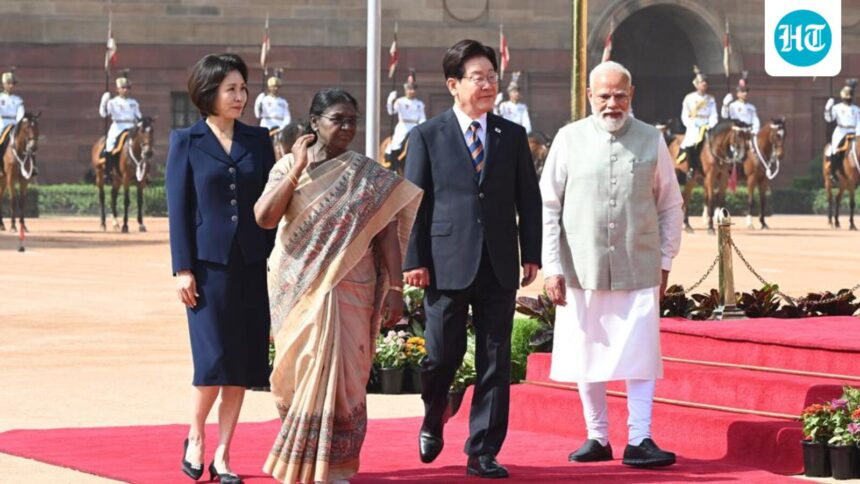
Goyal’s comments come on the heels of Prime Minister Narendra Modi’s statement at the joint press conference with ROK President Lee Jae-myung earlier in the day that the two sides have taken “several important decisions” to boost their bilateral trade from $27 billion to $50 billion by 2030, including upgrading the India-Korea trade agreement “over the next year.”
India imported goods worth $21.06 billion from South Korea in 2024-25, and exported $5.82 billion, resulting in a trade deficit of $15.24 billion.
The timeline for completing the update to the India-South Korea Comprehensive Economic Partnership Agreement (CEPA) is important, as negotiations on it have been ongoing for nearly a decade.
After coming to power, the Modi government realized that some of the FTAs signed earlier were largely one-sided and weak on rules of origin, allowing products from a third country to reach India with concessional customs duties.
On June 18, 2016, New Delhi and Seoul agreed to review the Comprehensive Economic Partnership to make it more comprehensive and balanced.
The negotiations to update the agreement have so far witnessed 11 rounds of meetings, the last of which was held in Seoul in July 2024. The pace of the talks is expected to accelerate after the two sides appointed chief negotiators, and the matter appeared on the agenda for the talks between Lee and Modi on Monday.
India and South Korea signed the Comprehensive Economic Partnership Agreement in Seoul on August 7, 2009, and the agreement was activated on January 1, 2010.
Speaking on bilateral trade at the India-Korea Business Forum during the Korean President’s visit to New Delhi, Goyal said: “We have agreed to work on a fast track, on a mission basis, to upgrade the comprehensive economic partnership, address several non-tariff barriers, ease doing business between the two countries, ease rules of origin, expand market access, and open doors in both countries so that we can target growth towards a more balanced economic partnership and not a single economic partnership, which is defined by a very large economic partnership.” trade deficit.”
The event was jointly organized by the Federation of Indian Chambers of Commerce and Industry and the Federation of Korea Industries (FKI).
According to Goyal, the prospects for bilateral trade and economic cooperation between India and South Korea are huge.
He added: “Our leaders have tasked us… to double this growth by 2030. That’s four years. So, we are looking at approximately 18% growth, if we are to double it in the next four years.”
The minister said that given the size and scale of opportunities available between the two countries, this number may far exceed $50 billion, which confirms the “true potential” of this partnership.
“The amount of effort that the leadership of both countries is investing in this relationship… I think we need to focus on launching the next phase of this partnership, and to that end, this visit will be a very crucial start to a new chapter.”
Speaking at the forum, Lee said that India, as the world’s fourth largest economy and home to 1.4 billion people, stands as a fundamental pillar of the global economy. He said that there is great scope for expanding business and trade, adding that bilateral trade has great scope for growth and is expected to double, with continued efforts, along with the ongoing negotiations on the Comprehensive Economic Partnership Agreement.