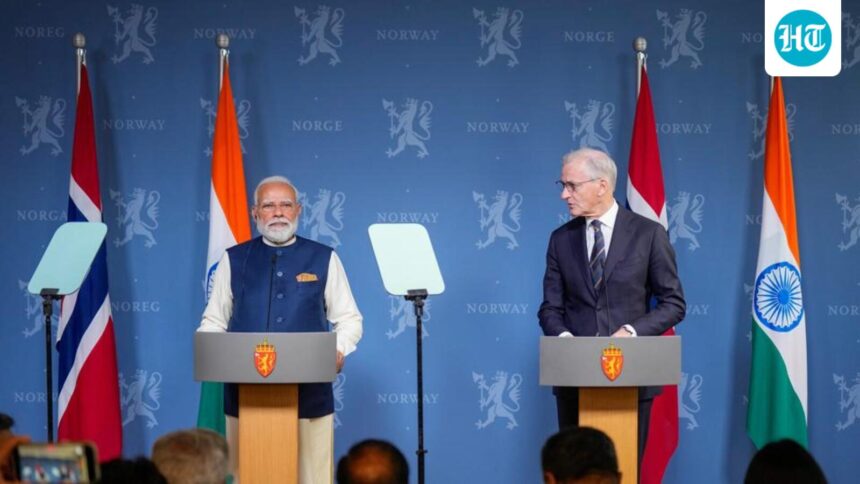
India and Norway on Monday upgraded their ties to a green strategic partnership and concluded agreements for cooperation in the areas of health, space and digitalisation, with Prime Minister Narendra Modi and his Norwegian counterpart Jonas Jahr Sture stressing the importance of trust-based relations in an era of economic uncertainty and conflicts.

Modi – the first Indian Prime Minister to visit Norway in more than four decades – and Storr held talks at the State Guest House focused on boosting trade and investment and enhancing cooperation in green transition and renewable energy. The war in Ukraine and the conflict in West Asia also emerged in the talks in the context of geopolitical turmoil on the global stage.
“The world is going through a period of instability and uncertainty. Whether it is Ukraine or West Asia, conflict continues in many parts of the world. At this time, India and Europe are entering a new golden age in their relations,” Modi said in a joint media interaction, speaking in Hindi.
Storr added that democracies must stand against those who “use” diplomacy, trade and technology as weapons. “At a time of increasing protectionism and more tense geopolitical dynamics, it is more important than ever that we stand together for a rules-based order,” he said, against the backdrop of turmoil caused by US trade and tariff policies.
The two leaders said the new green strategic partnership will facilitate close cooperation in technologies and research to drive the green transition in both countries. Modi said the partnership will help companies on both sides develop global solutions in clean energy and green shipping that combine India’s scale, speed and talent with Norwegian technology and capital. The partnership will provide a basis for action on “knowledge, resources and ambitions for the green transition,” Storr added.
Read also:Prime Minister Modi’s visit to Norway to focus on digital technology, health and space
This is only the second green strategic partnership that India has entered into, after a similar understanding in 2020 with Denmark, which, like Norway, is seen as a pioneer in green technologies.
The MoU on health signed by the two sides will enhance cooperation in high-quality, high-tech health services, digital health, artificial intelligence, and health research and technology. Another MoU signed by the Indian Space Research Organization (ISRO) and the Norwegian Space Agency would expand space cooperation.
Modi said that the Digital Development Partnership Agreement will contribute to human development in countries of the Global South through digital public infrastructure projects in India. Storr noted that the two sides will deepen cooperation in digital public infrastructure and digital public goods.
The two sides also concluded an agreement on specialized advisory services for tunnel construction, and another agreement on ocean energy projects.
Modi was earlier scheduled to visit Norway to attend bilateral meetings and co-chair the India-North Summit in May 2025, but was forced to cancel the trip in the wake of the Pahalgam terror attack last April and subsequent Indian military strikes on terror infrastructure in Pakistan.
Referring to these developments, he said: “During that difficult period, Norway showed true friendship by standing firmly with India against terrorism. Today, as I come to Norway, I express my deep gratitude for this solidarity.”
Besides the agreement on reforming global institutions, Modi said India and Norway have a shared commitment to eliminating all forms of terrorism.
Modi said the trade and economic partnership agreement signed by India and the European Free Trade Association (EFTA) last year – a four-nation bloc that includes Norway – is a blueprint for progress and shared prosperity, and the two sides are working to “translate the promises of this agreement into results.”
The trade deal also aims to attract investments worth $100 billion and create one million jobs in India over 15 years, and steps to implement these provisions are understood to have emerged in talks between the two leaders.
The two sides also agreed to expand research cooperation in the areas of sustainability, ocean energy, geology and health, and connect universities and emerging ecosystems in the fields of engineering, artificial intelligence and cyber security, Modi said. He also stressed the importance of Norway for cooperation in the field of Antarctic and Antarctic research. “We are grateful to Norway for the operations carried out by the Indian Arctic Research Station Himadri,” he said.
Referring to Norway’s decision to join the New Delhi-led Indo-Pacific Initiative, Modi said the two major maritime nations would enhance cooperation in maritime economics and maritime security.
Storr also highlighted the importance of strengthening connections with countries with shared values despite differences in times of uncertainty, polarization and conflict. He said, without going into details: “There may be differences. They are small compared to the big challenges on the global stage, and we need to work together.”
“Norway and India do not always agree on all issues. No one does. And we are both respectable democracies that deal with these issues in ways that live up to democratic standards,” Storr said, adding that “cooperation works better than unilateralism and isolation” in confronting global challenges.