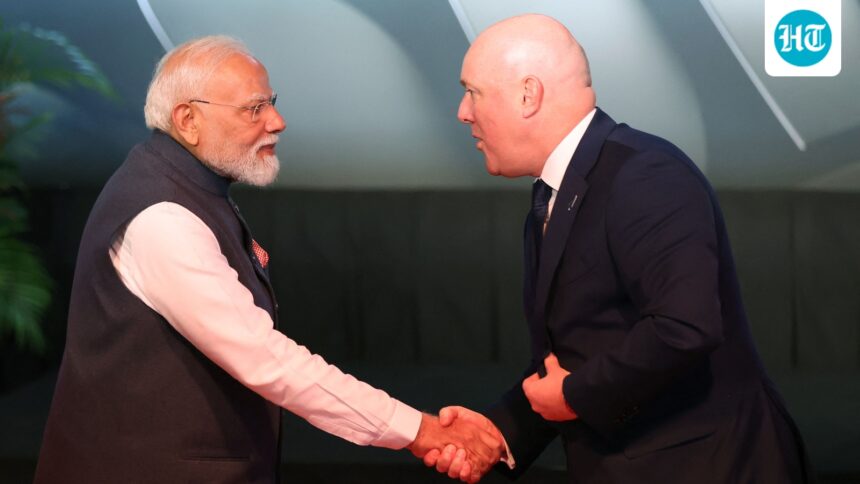
India and New Zealand on Saturday upgraded their ties to a strategic partnership and set a five-year target to double their annual bilateral trade in goods and services to… $35,000 crore by 2030 after talks between Prime Minister Narendra Modi and his New Zealand counterpart Christopher Luxon.

The meeting resulted in 18 concrete outcomes, including 10 agreements. The most important of these were a roadmap to expand relations in the next four years, a framework for enhancing maritime cooperation in the Indo-Pacific region, and a mutual logistics support agreement between the Indian Navy and the New Zealand Defense Forces.
“We have decided to elevate our ties to a strategic partnership. We will move forward in every sector with clear goals and tangible results,” Modi said after the talks.
A joint statement noted that Modi and Luxon exchanged views on the Indo-Pacific region and reaffirmed their shared commitment to a free, open and prosperous region. They also stressed the importance of protecting sovereignty, territorial integrity and the rules-based international order.
The two Prime Ministers called for freedom of navigation, overflight and other legal uses of the seas, in accordance with international law, especially the 1982 United Nations Convention on the Law of the Sea.
In line with their focus on enhancing cooperation in the Indo-Pacific region, the two sides also agreed to establish a maritime security dialogue to enhance cooperation, coordination and information exchange.
Modi arrived in Auckland last night on the third and final leg of his three-nation tour that has largely focused on expanding cooperation in the Indo-Pacific against the backdrop of China’s growing influence in the region.
The visit comes in the wake of the recent signing of the India-New Zealand Free Trade Agreement (FTA).
In his remarks during the talks, Modi said deeper cooperation between India and New Zealand, both maritime nations, will inject new strength into the Indo-Pacific region.
“As two maritime nations, our close cooperation brings new strength to the Indo-Pacific region, and our relations can inject new energy to achieve our common goals of peace,” the Prime Minister said in Hindi.
The two Prime Ministers agreed to work towards an ambitious goal of doubling bilateral trade in goods and services to NZ$7 billion, or nearly NZ$7 billion. $35,000 Crores by 2030.
They also decided to work together to ensure the early entry into force of the Free Trade Agreement.
Modi and Luxon, who addressed the conflict in West Asia, expressed concern over the renewed escalation of tensions and called on all parties to exercise restraint, de-escalate tensions and ensure the protection of civilians, the joint statement said.
The statement added that they “called for the full restoration of freedom of navigation and the flow of global trade through the Strait of Hormuz, while opposing any restrictions on shipping.”
The two leaders stressed the importance of dialogue, diplomacy and adherence to international law to achieve a peaceful and lasting solution to the conflict.
Modi and Luxon also called for “bold and effective” reform of the United Nations and affirmed their support for expanding the Security Council.
The two leaders also discussed the importance of stable, transparent and resilient supply chains, and acknowledged India’s “important role” in promoting resilience across global energy networks.
“They expressed deep concern about the impacts of unrest across the Indo-Pacific region, noting that stability of global supply routes is essential to the region,” the joint statement said.
The two sides noted in particular that this is particularly acute for Pacific Island nations, where economies are highly vulnerable and rising oil prices increase the costs of electricity generation, shipping, transportation, agriculture and fishing.
Regarding Ukraine, Modi and Luxon expressed concern about the ongoing war, which continues to “cause enormous human suffering and global consequences,” according to the statement.
The two leaders also reaffirmed their condemnation of terrorism in all its forms, including cross-border terrorism.
The two leaders condemned in the strongest terms the terrorist attack in Pahalgam and the terrorist incident near the Red Fort last year and stressed the need to hold those responsible for the attacks accountable.
They called for a “zero tolerance” approach to terrorism, and stressed the need to disrupt terrorist financing networks and safe havens.