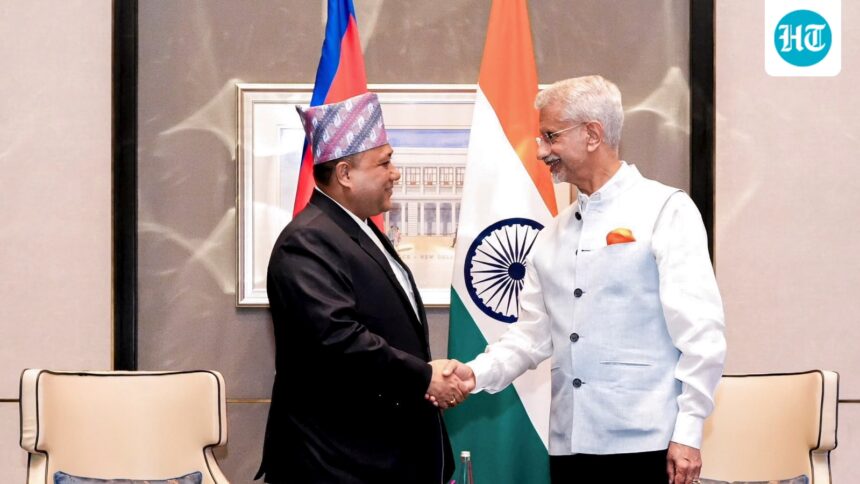
India and Nepal on Saturday discussed ways forward in bilateral relations and development cooperation in the wake of the change in government in Kathmandu, with visiting Nepali Foreign Minister Shisir Khanal calling for a “genuinely transformative relationship” led by economic transformation and results-based diplomacy.

Khanal arrived in New Delhi on Friday, days after a visit by Rabi Lamichhane, head of Nepal’s ruling Rastriya Swatantra Party, signaling the new regime in Kathmandu’s desire to move relations with India forward. The Revolutionary Socialist Party won a landslide victory in the general elections held in March, months after the so-called “Generation Z” uprising that toppled the government of former Prime Minister KP Sharma Oli.
External Affairs Minister S Jaishankar met Khanal on Saturday to review bilateral relations, including development cooperation, connectivity, trade, transit, energy and people-to-people relations, and discuss regional and multilateral issues.
Jaishankar said on social media that the two sides had a detailed discussion on “our unique partnership” and reiterated India’s commitment to working with Nepal for mutual progress and prosperity.
In his televised opening remarks at the meeting, Khanal said that Nepal’s new government has a “clear and decisive mandate for good governance, economic transformation and results-based diplomacy.” “We carry no legacy baggage, only a firm resolve to build a truly transformative relationship with our near neighbor and most important partner,” he added.
He referred to Lamichhane’s article in the Hindustan Times that described India and Nepal as stakeholders in a proud ancient civilisation, and said Kathmandu gives “top priority” to its ties with New Delhi.
In his opening remarks, Jaishankar said that India and Nepal share a very special relationship built on a strong foundation of people-to-people ties, cross-border connectivity and shared cultural and religious traditions. He said: “Today we have an opportunity to move forward in… newer fields such as startups, artificial intelligence, information technology….”