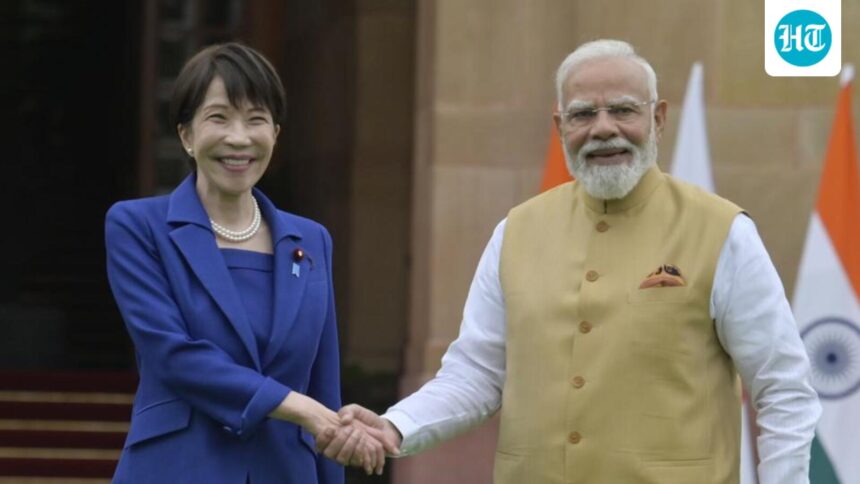
India and Japan on Thursday unveiled measures to expand cooperation in defence, energy security, rare earths and artificial intelligence, and finalized a joint roadmap for economic security, with Prime Minister Narendra Modi and his Japanese counterpart Sanae Takaishi stressing the importance of mutual trust underpinning bilateral relations in a global order facing increasing uncertainty.

Takaishi, on her first visit to India since becoming Prime Minister, arrived with a high-level business delegation and joined Modi at the 16th annual India-Japan summit. The leaders also participated in a joint economic forum focused on boosting Japanese investments in India. In addition to agreeing on a set of steps to deepen defense cooperation, including joint development of military platforms, the two sides agreed to update the trade agreement concluded in 2011.
Under Takaishi’s leadership, Japan has focused on strengthening ties with like-minded partners such as India, Australia and South Korea against the backdrop of China’s continued aggression across the region. According to a joint statement, Modi and Takaishi expressed “grave concern” over the situation in the East China Sea and South China Sea, and opposed unilateral actions that endanger freedom of navigation as well as attempts to change the status quo by force.
In a joint media interaction with Takaishi after their talks, Modi referred to his remarks made at the G7 summit last month that mutual trust is the greatest strategic asset in an environment of global uncertainty, and said the India-Japan partnership “stands the test of this principle in all respects.”
“Japan and India must leverage our strengths to become stronger and more prosperous together in the midst of chaotic international affairs. Establishing such integrated cooperative relations has become more important than ever,” Takaishi added.
Modi said the measures agreed by the two sides to expand cooperation in defence, energy, trade, investment, artificial intelligence, pharmaceuticals and shipbuilding will enhance regional peace and prosperity. He referred to Takaichi as his “little sister”, and she responded by calling him “big brother”.
“In the current era of uncertainty, India and Japan are fully aware of the importance of economic and energy security. In this direction, we adopted a joint roadmap on economic security today,” Modi said, adding that the roadmap will enhance supply chain resilience in strategic sectors such as semiconductors and advanced materials.
Takaishi stressed three pillars at the heart of bilateral cooperation – deepening strategic cooperation to achieve common goals, including aligning its updated policy on a free and open Indo-Pacific with India’s Mahasagar Vision; Strengthening cooperation on economic and energy security to overcome “economic weaponization” and build resilience in critical supply chains; Promoting economic growth in both countries through investments and cooperation in the field of innovation.
In defence, state-run companies from both sides have entered into an agreement for Project Unicorn, or Unified Combined Radio Antenna, which provides for the joint development of a radio antenna for Indian warships. The agreement will cover technology transfer, and the project will pave the way for the joint development of air, land and sea systems, including unmanned vehicles, officials said.
The two sides also agreed to expand military exercises, maritime domain awareness using satellite capabilities and cooperate in maritime maintenance, repair and overhaul (MRO), according to the joint statement. The Prime Minister directed the Ministers of Foreign Affairs and Defense to hold the fourth round of the 2+2 ministerial meeting in Tokyo by the end of the year.
Modi noted that the bilateral investment partnership continues to grow, with more than 100 new business agreements concluded over the past year, paving the way for Japanese investments worth $10 billion. “Our goal is clear – attract 10 trillion yen of Japanese investment to India over the next 10 years and double the number of Japanese companies operating in India,” he said.
Two-way trade reached $27.5 billion in 2025-2026, while Japanese investments in India reached $3.2 billion between April and December 2025, according to Indian government data. Japan is among the largest foreign investors in India and has backed major infrastructure projects, including metro networks in major cities and a high-speed rail line between Mumbai and Ahmedabad.
The prime ministers reiterated the importance of the Mumbai-Ahmedabad high-speed rail project as a flagship initiative, and Takaishi stated, “Japan fully understands India’s goal of commencing commercial operations in priority sections in 2027 and remains committed to expanding the necessary cooperation,” the joint statement said.
Both sides acknowledged the goal of introducing the Japanese E10 high-speed train, and Modi called on Japanese companies to explore opportunities to participate in the development of high-speed corridors in the future.
With more than 15 years having passed since the two countries signed the Comprehensive Economic Partnership Agreement (CEPA), India and Japan have agreed to accelerate the review of its implementation and full and effective utilization to make it more forward-looking, the joint statement said.
Foreign Minister Vikram Misri told a press conference that the EPA had become “rather outdated” in the context of new trade arrangements being reached around the world. Al-Masry said the Indian side suggested that it was time to consider a major update to the Comprehensive Economic Partnership Agreement, and Takaishi said officials from both sides should meet to take the next steps.
The Joint Declaration on Economic Security will strengthen project-based cooperation to enhance shared resilience in key sectors such as semiconductors, critical minerals, information and communications technologies, including artificial intelligence, clean energy and pharmaceuticals. This will include cooperation between governments and between companies.
Although the Joint Declaration did not mention any country by name, it was clear that many of the measures were developed with China’s recent actions in mind. Both sides expressed “serious concerns” about the use of economic coercion and non-market practices, including “arbitrary export restrictions” that lead to supply chain disruption, especially for critical minerals.
In the context of China’s dominance in the pharmaceutical field, the two sides agreed to explore alternative supply chains for active pharmaceutical ingredients (APIs) and key raw materials (KSMs), conduct vulnerability analysis, and explore possibilities for mutual cooperation to ensure stable supply of these goods.
The Joint Statement on Energy Resilience will facilitate cooperation on strategic storage and reserve mechanisms for crude oil and petroleum products, and promote joint investments across the maritime energy transportation value chain. Takaishi said that a bilateral dialogue would be launched to strengthen India’s oil storage system, and that Japan would support India’s membership in the International Energy Agency.
The joint statement on cooperation in the field of artificial intelligence will raise the level of cooperation in this field to a strategic partnership in the field of research and development. While building on the Indo-Japan AI initiative, the statement serves as a roadmap for MAZ A hand of collaboration across the AI technology stack aligned with a shared vision of safe, secure, reliable, inclusive and human-centric AI.
The two sides finalized six memorandums of cooperation, including setting up 1,000 biogas and organic fertilizer plants across India by leveraging the network of dairy cooperatives; Establish battery-related projects to build a resilient and sustainable battery supply chain; strengthening pharmaceutical supply chains through bilateral investment and trade linkages; Enhancing joint work in the field of exploration for important minerals; and enhancing cooperation between the IndiaAI Mission and Japan’s GENIAC Initiative through corporate matchmaking and joint projects.
The Memorandum of Cooperation on the Next Generation Mobility Partnership (NGMP) will establish a framework to accelerate private sector-led cooperation and investments in rail, automobile, road, aviation, shipbuilding, ports, logistics and urban development infrastructure.
The two sides also concluded five memorandums of understanding on research and innovation in deep technology and life sciences, biological and neurological research, cooperation on large language models (LLMs) with a focus on developing LLMs to enhance scientific thinking, cooperation on national Internet registry operations and Internet security improvements.