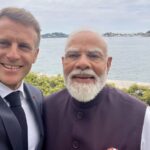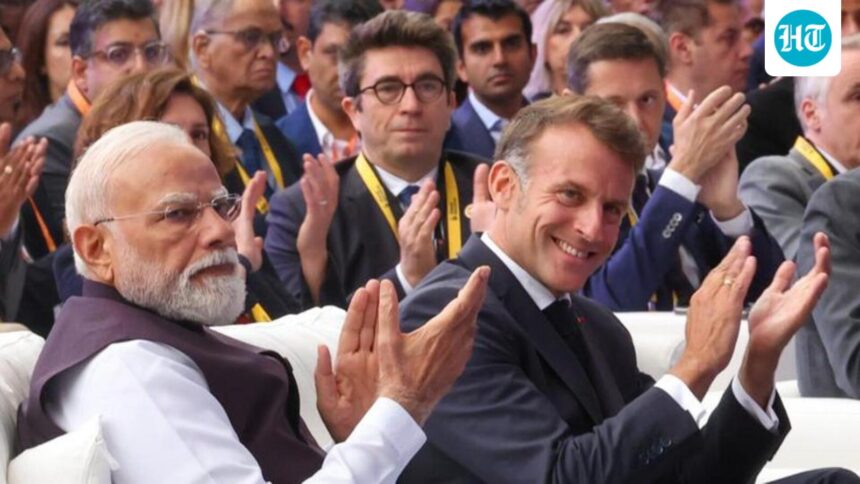
India and France on Sunday set a target to double bilateral trade from the current level of about $16 billion within five years and agreed to work more closely on civil nuclear energy, as Prime Minister Narendra Modi and President Emmanuel Macron held talks on boosting bilateral ties and global crises such as conflicts in Ukraine and West Asia.

The two leaders held a bilateral meeting at Villa Kyrillos in the port city of Nice after jointly opening Bharat Innovates 2026, an event aimed at matching Indian deep-tech startups with global investors. Nice was the first stop on Modi’s nearly week-long European tour that will also take him to Slovakia, before he returns to France to join outreach sessions for the G7 summit later this week.
Modi said on social media after the meeting that his “exceptionally fruitful” talks with Macron focused on strengthening cooperation in the areas of defence, technology, space, security, counter-terrorism, innovation, healthcare and education.
“India and France will continue to work together to strengthen economic ties. The India-EU Free Trade Agreement provides unparalleled momentum in this regard,” Modi said. “We are also launching a dialogue on economic security to ensure stronger supply chains in minerals and biotechnology.”
Foreign Minister Vikram Al-Masry said at a press conference in Nice that the two sides agreed to establish a high-level mechanism to double bilateral trade within five years, establish a dialogue on economic security, and adopt a 2030 innovation roadmap.
France is India’s third-largest trading partner within the European Union, after the Netherlands and Germany, with bilateral trade doubling in the past decade to $15.81 billion during 2025-26. India’s exports to France in this period amounted to US$7.1 billion, and bilateral trade is expected to grow with the signing of the India-EU Free Trade Agreement later this year.
“The main focus of the discussions was to strengthen and diversify bilateral relations in the areas of economic growth, technology and innovation. This is particularly important in light of the conclusion of negotiations earlier this year on the India-EU Free Trade Agreement,” Masri said.
Defense cooperation, including India’s plans to acquire 114 Rafale fighter jets, and French private sector participation in developing India’s nuclear energy sector, also figured in the discussions, Masri said. This was the first meeting between the two leaders since bilateral relations were elevated to a global strategic partnership, especially during Macron’s visit to India in February.
Al-Masry admitted that talks between the two countries regarding the Rafale deal, currently operated by the Indian Air Force, had progressed, including the issue of the aircraft containing as much local content as possible. “On indigenization of Rafale, the Prime Minister has emphasized in all his meetings that maximum effort should be made to take forward the ‘Make in India’ concept in the defense sector. We want to move towards co-development, co-design, co-production and co-manufacturing,” he said.
Under the Multi-Role Fighter Aircraft (MRFA) project, India plans to get 18 Rafale aircraft from French major Dassault Aviation into flying condition, and another 96 aircraft will be manufactured in India with about 50% indigenous content.
In the area of civilian nuclear energy, Modi and Macron noted that the Shanti Act (Sustainably Harnessing and Developing Nuclear Energy to Transform India) creates “new opportunities” for cooperation, including in small and advanced modular reactors, according to a statement from the Ministry of External Affairs.
Referring to earlier discussions between French state-run EDF Group and Nuclear Energy Corporation of India Ltd over a nuclear power project in Jaitapur in Maharashtra, Masri said Modi highlighted the changes brought by the Shanti Act to the nuclear industry to facilitate private sector participation and foreign direct investments.
Masri said that while talks on the Jaitapur project continue, including its technical aspects and various financing possibilities, a “rich series of discussions” have been opened on small modular reactors (SMRs) and advanced modular reactors (AMRs).
“The way is open for French nuclear companies… to start looking at direct participation in the Indian nuclear sector or… participation with Indian private sector companies, whether in conventional nuclear power reactors or in more advanced small and medium reactors,” he said.
Other key outcomes of the meeting were a Public Security Agreement on the exchange and protection of confidential information, establishment of a joint bilateral working group focused on global AI governance, expansion of possibilities for use of India’s Unified Payments Interface (UPI) system in France, Memorandum of Understanding on establishing a Center of Excellence for Skills in Aviation at the Indian Institute of Technology in Kanpur, declaration of intent on cooperation in high-speed rail, and signing of 19 inter-institutional agreements in the innovation ecosystems of India and France.
Modi and Macron also discussed ways to enhance cooperation in human spaceflight and space situational awareness, as well as expand private sector cooperation in space.
Modi thanked Macron for activating visa-free transit for Indian citizens at French airports, and they discussed ways to enhance the mobility of talents and students, and expand mutual recognition of educational qualifications.
The meeting also touched on global issues such as the situation in West Asia and the war in Ukraine, and Modi said he looked forward to participating in the G7 summit in Evian, according to the statement.