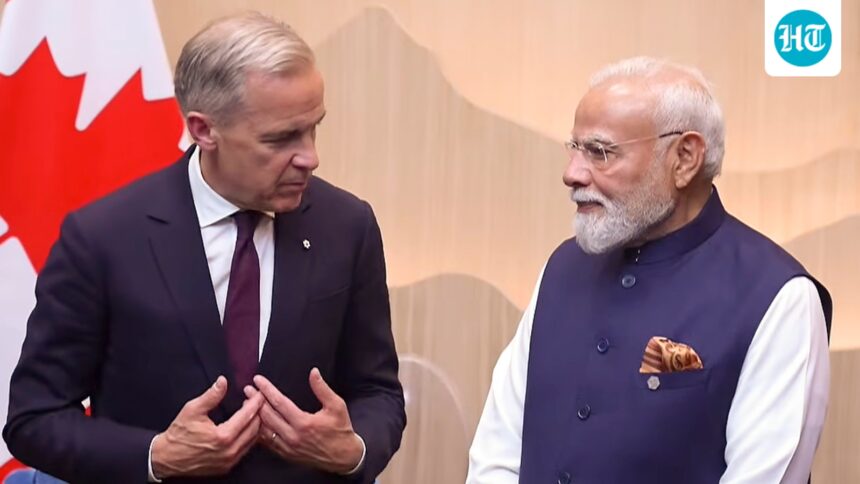
India and Canada on Tuesday agreed to deepen defense and security cooperation and conclude negotiations on a free trade agreement by the end of the year, with Prime Minister Narendra Modi and his Canadian counterpart Mark Carney expressing satisfaction with the progress made in resetting bilateral relations after a turbulent period over the past few years.

Modi and Carney, who met on the sidelines of the G7 summit in the French resort of Evian, welcomed the “positive momentum” in bilateral relations and expressed satisfaction with the progress made since the Canadian Prime Minister’s visit to India in March, according to a joint press release.
“In less than a year, this is our fourth meeting, indicating our commitment to strong India-Canada relations. We have reviewed the entire scope of relations between our two countries, especially the ground covered since we last met,” Modi said on social media. He added that the discussions covered cooperation within the framework of the four pillars of trade, economy, energy, technology and people-to-people relations.
In order to deepen defense and security cooperation, the two Prime Ministers agreed to launch negotiations on the “General Information Security Agreement”, which will allow the exchange of sensitive information and intelligence. They welcomed exchanges between defense institutions, including the visit of representatives of the Indian National Defense College to Canada.
“Both sides expressed satisfaction with the progress made in negotiations towards the Comprehensive Economic Partnership Agreement (CEPA), and reaffirmed their shared goal of concluding negotiations in 2026,” the press release said.
Indo-Canadian relations deteriorated when former Canadian Prime Minister Justin Trudeau alleged in September 2023 that Indian government agents were linked to the killing of Khalistani separatist Hardeep Singh Nigar in the town of Surrey that year. India rejected the charge as “ridiculous” and the two sides halted talks on a trade agreement, downgraded diplomatic relations and expelled dozens of each other’s diplomats.
The two sides resumed contacts between the security services in late 2024 as part of efforts to improve relations, and Carney’s victory in the 2025 general elections gave impetus to these steps.
The leaders reviewed progress in bilateral economic cooperation, including developments in trade arrangements related to liquefied natural gas, liquefied petroleum gas and metallurgical coal, the press release said. They welcomed the momentum in high-level visits between the two sides, including Commerce Minister Piyush Goyal’s recent trip to Canada, and looked forward to a Canadian trade mission to India, led by the International Trade Minister, later in 2026.
While pledging to build a forward-looking strategic partnership, Modi and Karni noted the complementarities between the Indian and Canadian economies and stressed the importance of resilient and reliable supply chains in enhancing global energy and food security.
Modi and Karni also welcomed the strengthening of institutional linkages between the two governments, including the recent meetings of the Joint Science and Technology Committee and the Consular Dialogue. They expressed their aspiration for future dialogues in the areas of defence, finance and migration.
The two sides are also cooperating under the Canada-India Talent and Innovation Strategy, including measures to promote skills development, innovation partnerships and collaboration between educational institutions.
Modi expressed India’s support for Canada becoming a dialogue partner of the Indian Ocean Rim Association (IORA), and the leaders announced the establishment of ‘Raisina Americas’ as a platform to enhance dialogue, exchanges and cooperation. Modi also thanked Karney for inviting him to visit Canada in 2026, and the two sides agreed to work on a mutually convenient date for the trip.