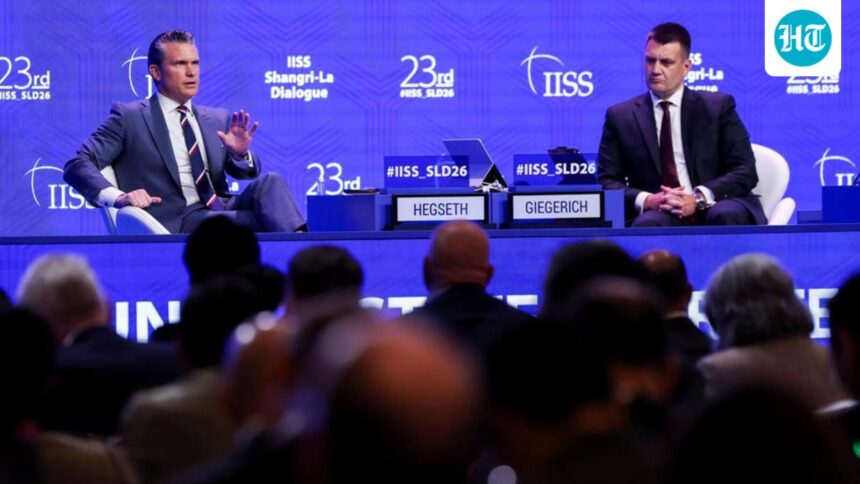
Washington: India is an “important anchor” in South Asia, and a strong New Delhi will help maintain the balance of power in the Indo-Pacific region, US Secretary of War Pete Hegseth said at the Shangri-La Dialogues in Singapore.

In a speech to politicians and officials from across the region, Hegseth noted closer cooperation between India and the United States on maritime matters and joint production of Javelin anti-tank guided munitions.
“In South Asia, India is a critical anchor to hold the line. A strong India acting in its own self-interest advances our shared goal of maintaining the balance of power across the region. India is modernizing its military to shoulder its share of the security burden, especially in the Indian Ocean,” Hegseth said.
“It is building heavy industrial and logistics capacity to sustain cutting-edge military operations including the ability to repair and maintain our joint platforms and support US Navy ships operating in theater. We have also committed to pursuing co-production with India to enhance capabilities such as Javelin anti-tank guided munitions,” he added.
Hegseth added that the rise of a hegemon in the Pacific would destabilize the regional balance of power. While he mentioned China, he added that no country could impose its hegemony and “put the security or prosperity of our nation and our allies in doubt.” Hegseth also made specific reference to China’s military buildup and the “legitimate alarm” it has caused in the Indo-Pacific region.
Hegseth’s statements came after US Secretary of State Marco Rubio completed a four-day visit to India. Pakistani Foreign Minister Ishaq Dar also met with Rubio in Washington this week.
Referring to Pakistan’s mediation role in the Iranian conflict, Hegseth said that this development was “unexpected” but stressed that Washington had established a “true friendship” with Pakistani Prime Minister Shehbaz Sharif and Field Marshal Asim Munir. The US Secretary of War also reiterated the Trump administration’s claim that US President Donald Trump mediated an end to the India-Pakistan conflict. India has previously rejected such claims.
Hegseth was also questioned about India’s testing of the Agni-6 intercontinental ballistic missile (ICBM) and the recent decision by the US intelligence community that Islamabad’s development of ICBMs could pose a threat to the United States.
“Both sides will see understandable threats coming from the other,” Hegseth said in response. “Maybe we will see some of them differently, as when countries want to develop ICBM threats. But we are not pointing the finger, at least from our perspective now, at either country and calling them a threat to us. We are grateful, in every way, for the benefits they have provided to peace around the world.”