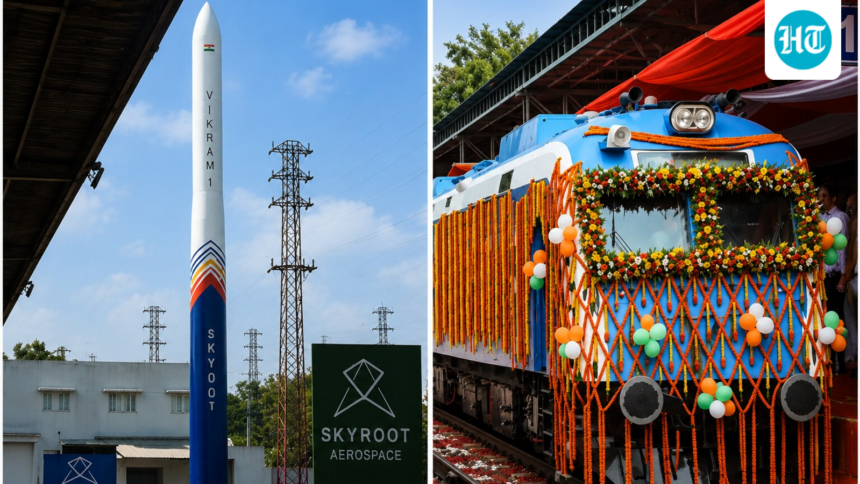
Within less than 48 hours, India achieved two significant technological achievements – one on Earth and the other in space. While Hyderabad-based Skyroot Aerospace successfully launched Vikram-1, the country’s first privately developed orbital launch vehicle, Prime Minister Narendra Modi launched India’s first indigenously made hydrogen-powered train, placing the country among a select group of countries using clean energy rail technology.
Together, the two developments reflect India’s growing ambitions in commercial space technology and sustainable transportation.
Vikram-1 puts India’s private space sector in orbit
Hyderabad-based Skyroot Aerospace wrote history on Saturday after successfully launching Vikram-1 under the Aagaman mission from the Satish Dhawan Space Center in Sriharikota.
Read also | Explanation of HT | India’s first hydrogen train: Everything you need to know
This launch marks the first time that a private Indian company has developed and launched an orbital rocket. Unlike suborbital vehicles, Vikram-1 is designed to place satellites into geostationary orbit, supporting applications such as communications, navigation, Earth observation and scientific research.
The mission is also seen as a major milestone for India’s private space industry following reforms introduced under the Indian Space Policy 2023, which opened up the country’s entire space value chain to private sector participation.
What makes Vikram-1 different?
Vikram-1 is 24 metres, roughly equivalent to the height of a seven-storey building, and is designed for rapid and on-demand launch services.
Read also | Vikram-1: All about India’s first specially developed orbital rocket to say ‘hello’ to space
The rocket can carry up to 350 kg of payload into a 450 km low Earth orbit (LEO) with an inclination of 60 degrees. It features an all-carbon composite body to reduce weight while improving durability.
Its four-stage configuration combines three solid-propellant stages and a liquid-propellant orbital modulation unit. Skyroot also equipped the car with 3D-printed liquid motors, a design aimed at reducing manufacturing time and complexity.
India joins select countries with hydrogen-powered train
A day before the launch of Vikram-1, Prime Minister Narendra Modi launched India’s first indigenously made hydrogen-powered train from Jind.
Read also | ‘We must trust the youth of the country’: Vikram-1 achieves India’s first private orbital launch
With this launch, India joins a small group of countries – including Japan, Germany, the US and China – that have introduced hydrogen-powered rail transport.
The train consists of 10 cars, making it among the longest hydrogen-powered passenger trains developed to date. It is powered by a 3,200 horsepower propulsion system, making it among the most powerful hydrogen-powered train sets currently in operation in the world.
Prime Minister Modi is on India’s hydrogen train
Addressing a public gathering in Jind after getting off the train, Modi highlighted how new hydrogen railway technology is on the global stage. “Hydrogen trains have only recently arrived on the global stage. They came into existence only seven or eight years ago. Currently, only three or four countries have the capacity to operate hydrogen trains, and even in those countries, the technology is still in its nascent stage. However, hearing about India’s hydrogen train capabilities will fill you and every Indian with pride,” the Prime Minister said.