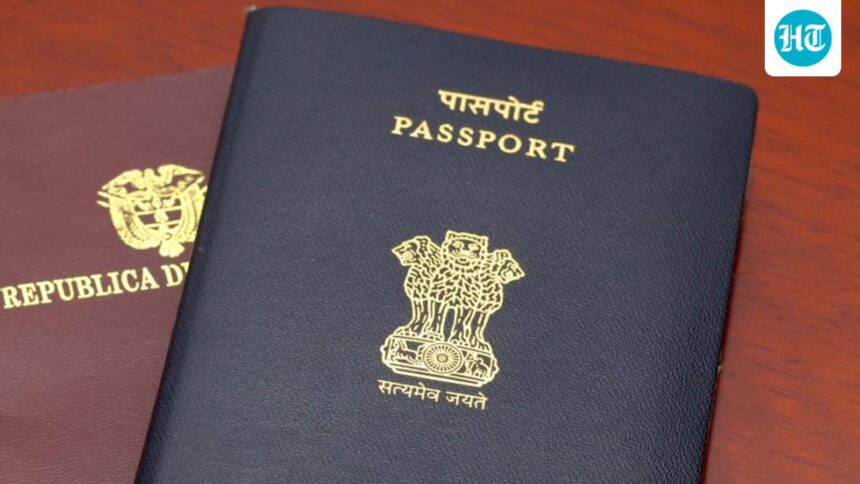
A passport can cross international borders for an Indian citizen, secure consular protection in a foreign country and prove citizenship before immigration authorities across the world. However, according to officials at the Ministry of Foreign Affairs, it is not proof of citizenship.

The seemingly technical clarification, given on the passport seva divas on Wednesday while unveiling the benefits of chip-enabled e-passports, has revived a long-standing legal issue that has gained renewed importance amid recent controversies over electoral roll revisions and citizenship verification exercises: If even a passport does not conclusively prove citizenship, what document proves citizenship?
Irony
This statement seems counter-intuitive because the law governing passports is based on the premise that the holder is an Indian citizen.
Under Section 5 of the Passports Act, 1967, a Passport Authority may issue a passport only after considering the application and making such inquiry as it deems necessary, while Section 6(2)(a) expressly requires the Authority to refuse a passport if the applicant is not an Indian citizen. In other words, the law stipulates that a passport is issued only after the state is satisfied of the applicant’s nationality. This is what makes the ministry’s clarification interesting: If a document that cannot legally be issued to a non-citizen is still not proof of citizenship, citizens may legitimately wonder what the document even is.
Under the Passport Act, passports are issued to Indian citizens for international travel. Applicants are subject to police verification and multiple government records checks before the document is granted.
The Ministry’s position appears to distinguish between a passport being proof of citizenship and being conclusive proof of citizenship. Legally, the government retains the power to seize or revoke a passport if it discovers that citizenship was wrongly claimed or obtained by misrepresentation.
However, the clarification raises an obvious question. If the document issued by the sovereign after comprehensive verification is insufficient, the universe of documents capable of proving citizenship becomes considerably narrower.
Previous voter ID:
The issue is not just academic. During the recent special intensive review of electoral rolls, one of the central legal questions before the Supreme Court was whether existing voters could be required to provide new documentation proving eligibility.
This controversy revealed an important distinction inherent in Indian law.
A voter ID card proves that a person is registered as a voter. Citizenship is not established independently. This follows the scheme of the Representation of the People Act 1950, under which only citizens could be registered as voters. However, electoral registration authorities retain the power to inquire whether a person’s inclusion on the lists meets the legal requirements. As a result, possession of an old voter card in itself does not necessarily answer citizenship-related questions during the SIR exercise.
MEA’s recent clarification arguably pushes the debate further. If voter cards are not conclusive proof of citizenship and passports are not, citizens may reasonably ask which document has that status.
What does Indian law say?
The answer is complicated. Unlike many countries, India does not have a single, globally recognized citizenship certificate that is automatically issued to every citizen at birth.
The government’s position reflects this complexity.
In February 2020, when asked in Parliament whether Aadhaar, passport, voter ID card, PAN card or birth certificate could be treated as valid documents to prove citizenship, the Home Ministry refused to specify any of them as conclusive evidence. Instead, it stated that the acquisition and determination of citizenship is governed by the Citizenship Act 1955 and the rules made thereunder, and that citizenship may be acquired by birth, descent, registration, naturalization or territorial incorporation. The ministry said that eligibility criteria for citizenship will be evaluated and determined under the provisions of the Citizenship Law.
Citizenship in India stems from the Constitution and the Citizenship Act, 1955. A person’s status may arise through birth, descent, registration, naturalization or incorporation of territory.
Thus, proof of nationality often depends on the route by which nationality is claimed. For some individuals, a birth certificate may be the primary document. Others may rely on passports, citizenship certificates issued upon registration or naturalization, parental records, electoral records, school certificates, or a combination of documents proving parentage and residence.
In legal proceedings, courts generally examine the totality of the evidence rather than treating any single document as universally conclusive.
A passport may be strong evidence that the state has accepted a person’s claim to citizenship. A voter card may indicate that electoral authorities consider a person eligible to register as a citizen voter. A birth certificate may prove birth in India but it does not necessarily answer every question regarding citizenship under the evolving legal framework. Every document proves a fact; Nothing necessarily resolves the issue of citizenship in every case.
This is what makes the Ministry of Foreign Affairs’ recent clarification noteworthy. If a passport or voter ID card cannot conclusively prove citizenship, the burden often shifts to a mosaic of documents and circumstances – an approach that may be legally defensible but that may leave ordinary citizens uncertain about what evidence is ultimately sufficient to prove their affiliation.
Can there be one final document?
The short answer is no. India has never adopted a National Citizenship Card.
Aadhaar explicitly does not specify nationality. The law governing Aadhaar only allows registration of residents, not citizens, and the rule of law states that it is not proof of citizenship. Likewise, a PAN card is a tax ID. The voter card establishes the electoral registration process. The ration card proves inclusion in the social welfare system.
Even passports, although among the most accurate documents issued by a state, have generally been treated by courts as strong evidence of citizenship rather than as irrefutable evidence.
The only document that specifically proves citizenship is a certificate of citizenship issued under the Citizenship Act, but these certificates apply only to those who have acquired citizenship through registration or naturalization and not to the overwhelming majority of Indians who are citizens by birth.
The larger constitutional question
This controversy highlights a structural feature of Indian citizenship law.
India’s legal system has historically operated on the assumption that most people are citizens unless a specific dispute arises. Citizenship is therefore inferred from a large body of records rather than proven through a single founding document.
This model has worked relatively smoothly for decades because citizens are rarely required to positively prove their status. However, processes involving citizenship verification, electoral roll scrutiny, and immigration control have increasingly revealed the lack of a universally accepted citizenship document.
The result is a strange situation. An individual may possess a passport, voter card, Aadhaar card, PAN card, birth certificate, yet still face requests for additional evidence in a legal proceeding that questions citizenship status.
The Ministry of Foreign Affairs’ clarification may have been intended as a technical clarification of the function of the passport as a travel document. But he talks about something else Aiming at a much deeper issue.
In a country where citizenship is the gateway to voting, public office, constitutional protections and political membership itself, the question remains unresolved: If a passport is not proof of citizenship, then what exactly is?
And perhaps more importantly, should modern democracy continue to rely on a patchwork of documents and assumptions to establish the most fundamental legal relationship between individual and state?