It only took a week for the crisis facing Mamata Banerjee’s Trinamool Congress in Bengal to reach Parliament in Delhi. On Monday, at least 14 TMC MPs met West Bengal Chief Minister Suvendu Adhikari, a former TMC defector, to discuss breaking away from the party and forming a separate bloc that would support the BJP-led National Democratic Front.

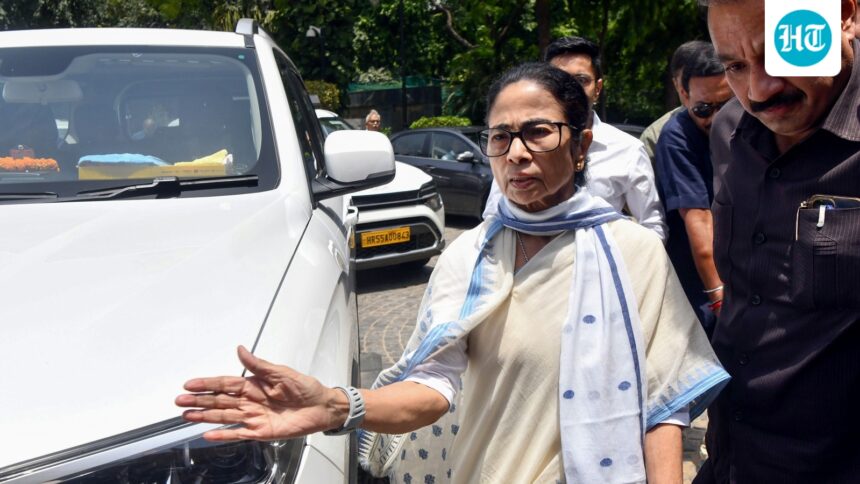
Now, Mamata Banerjee, who has been at the helm in West Bengal for more than a month, having served as chief minister for three consecutive terms since 2011, finds herself fighting battles on several fronts to keep her party intact – Parliament, Legislative Assembly and civic bodies. She founded TMC in 1998 after separating from Congress.
Follow live updates on the TMC crisis here
The cracks in Mamata’s party seemed to become evident when 58 of the 80 TMC MLAs opposed her in supporting Ritabrata Banerjee as Leader of the Opposition in the West Bengal Assembly. Now, another key Trinamool leader, MP Parasat Kakoli Ghosh Dastidar, a political doctor considered a close confidant of Mamata Banerjee, is leading a campaign to break away from the party in Parliament and working towards this through constant meetings with BJP leaders.
All this after Mamata and her party faced a crushing defeat in the recently held state assembly elections, which saw the BJP come to power in West Bengal for the first time, and that too with a landslide majority.
First betrayal by MLAs
When TMC MLA Ritabrata Banerjee was expelled by the party for “anti-party activities” along with Sandeepan Saha last month, he emerged as a central figure who led a section of rebellious TMC MLAs to support him as leader of the opposition in the West Bengal Assembly and consolidate their position as the main opposition, completely cornering Mamata. The Council President accepted the proposal.
Read also: Who is Yusuf Pathan fighting? The Slog-overs specialist transforms the arcade puzzle into the games within TMC
The second jolt came from the mayor of Kolkata
Another shock for the TMC came later that week when veteran party leader Firhad Hakim resigned from the post of Kolkata Municipal Corporation (KMC) mayor on Friday, June 5. However, he said he sought permission from Mamata before taking the step. He remained vague as to his reasons for doing so.
Referring to himself emphatically, he told reporters, “Farhad Hakim is no one. It is the chair that calls for respect. Respected personalities have sat on this chair in the past. When I was Minister of Municipal Affairs and Mayor, I ran it (KMC) well. I used to provide relief to people. This is no longer possible now. I cannot disrespect the chair. I cannot cling to the chair while being a soldier carrying weapons and armour. It would be disrespectful to those honorable personalities and that is why I have decided to resign.”
The third wave of rebellion in New Delhi
While Mamata turned to the India bloc amid mounting challenges around her and attended a key meeting of the alliance in Delhi, another similar rebellion was brewing against her in the national capital.
Also read: Why does the number 19 matter in Kakoli Ghosh’s TMC rebellion, and why does it come to mind for Raghav Chadha
Kakoli Ghosh along with 13 other MPs met CM Suvendu Adhikari at Union Minister Bhupender Yadav’s residence. Yadav was the BJP’s observer for the Bengal elections.
However, to get protection under the anti-defection law, at least two-thirds of MPs need to defect together, making 19 the TMC’s magic number in the Lok Sabha. Ghosh alleged that around 20 TMC MPs, including herself, have decided to break away from the party to support the NDA. However, nothing is official yet.
“The message has already reached the Speaker of Parliament. We have sought separate seating arrangements as a separate bloc,” she said on Monday evening. The alleged message is not public.
During one of the meetings, Adhikari said, “You are all senior MPs but you were treated badly by the TMC officers,” an MP told HT.
The meetings came after veteran TMC leader Sukhendu Sekhar Rai resigned from the Rajya Sabha, citing the party’s “unbridled corruption” and “chaotic governance” as the reason behind his decision.
Also read: TMC crisis worsens: 14 rebel MLAs meet Suvendu Adhikari, discuss exit as Mamata attends key India bloc meeting
Who are the rebel representatives who attended the meeting?
According to a photo that went viral, the rebel MPs who attended the meeting included Coochbehar MP Jagadish Basonia, Bankura MP Arup Chakraborty, Howrah MP Prasoon Banerjee, Jhargram MP Kalipada Sareen, Bolpur MP Asit Mal, Murshidabad MP Abu Tahir Khan, Burdhaman MP Purba Sharmila Sarkar along with Kakoli Ghosh and Birbhum MP Shatabdi Roy.
Other MPs who attended the meeting were Khalilur Rehman (Janjipur), Deepak Adhikari (Ghatal), Babi Haldar (Mathurapur) and Partha Bhowmik (Barrackpore). Medinipur MP June Malliah joined the second meeting held at Shatabdi Roy’s residence in Delhi on Monday, people familiar with the matter told HT.
Who are the representatives of the Transitional Military Council who did not attend the meeting?
Eight of the TMC’s 28 MPs did not attend any of Monday’s meetings in Delhi. They include Diamond Harbor MP Abhishek Banerjee, Mamata’s nephew whom the rebels blame for their actions; MP Kalyan Banerjee from Srirampur, Mahua Moitra from Krishnanagar, Sujata Rai from Dum Dum, Kirti Azad from Bardhaman-Durgapur, Shatrughan Sinha from Asansol, Sayuni Ghosh from Jadavpur and Kolkata Uttar MP Sudeep Bandopadhyay.
The MPs who remained loyal to Mamata stressed that they would not change their position and that it would be difficult for the rebels to touch the magic number.
What’s next?
While nothing is official yet, if the rebellious TMC MPs in Lok Sabha manage to touch the magic number, it would leave the TMC chief in the worst-ever crisis since she became West Bengal Chief Minister in 2011. Meanwhile, Mamata is refusing to back down, scrambling for support wherever she can find it and is currently relying on the India bloc.
Mamata met Congress parliamentary party president Sonia Gandhi on Tuesday evening.
(With inputs from Subhadra Chatterjee)