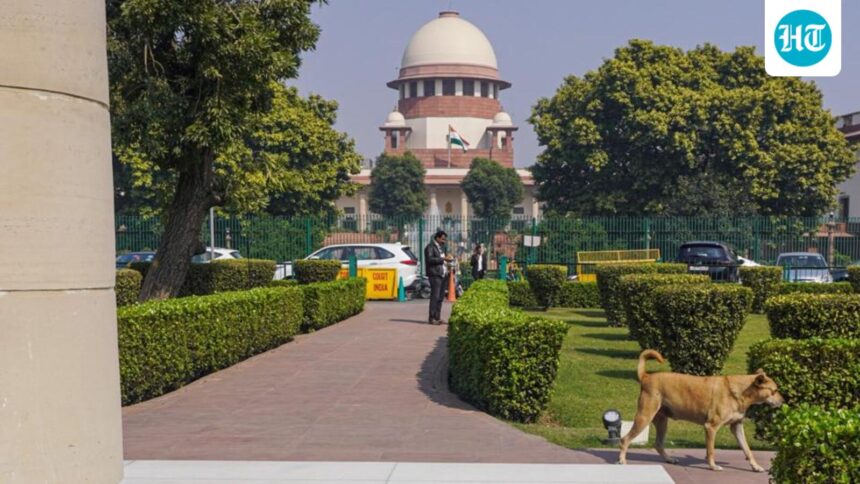
The Supreme Court ruled on Thursday that unpaid domestic work performed by housewives must be monetised at a minimum $30,000 per month while calculating compensation for their deaths in road accidents, declaring that housewives deserve to be recognized as “nation builders”.

In a landmark ruling that is likely to reshape compensation awards in car accident cases across the country, a bench of Justices Sanjay Karol and N Koteswar Singh rejected the long-standing judicial practice of equating the notional income of homemakers with the wages of skilled workers, arguing that such an approach fails to capture the true economic and social value of home care work.
“We have developed a new principle and stipulated that the loss of home care must be monetized at a minimum $“30,000 per month, in addition to all other remedies available under the Supreme Court judgment in the Pranay Sethi case,” Justice Carroll said while pronouncing the executive part of the judgement.
The court emphasized the central role played by women within the family and society, and noted that the term “housewives” should acquire the status of “nation builders.”
Read also: Presumption of innocence ends with a guilty verdict: Supreme Court
The ruling came in an appeal arising from a car accident claim in Punjab, where a woman named Reshma died in a road accident in November 2001. Her husband and three children approached the Motor Accident Claims Tribunal for compensation. Although the court granted compensation in 2003, the matter remained in dispute for years, and the Punjab and Haryana High Court did not rule on the appeal until December 2024 – more than two decades after the accident.
The Supreme Court expressed concern about such delays and said that car accident compensation claims should normally be decided within one year. The council said: “Such cases should usually be decided within a year.”
The court also asked the chief justices of all high courts to monitor car accident claims cases and issue appropriate administrative directions to ensure that such matters are disposed of within the stipulated time frame.
The ruling is expected to have far-reaching implications because courts across India routinely determine compensation for deceased housewives by allocating them a notional income based on the prevailing minimum wage, often treating them on par with skilled or unskilled workers. The Supreme Court’s ruling represents a departure from this approach by recognizing that home care work cannot be reduced to traditional labor market standards.
The court’s observations build on a growing line of precedent in which the Supreme Court has recognized that homemakers’ contributions have measurable economic value even though they are not paid. In several previous decisions, including Kirti Vs Oriental Insurance Co Ltd (2021) and Arun Kumar Agrawal Vs National Insurance Co Ltd (2010), the Supreme Court has warned against treating services provided by homemakers as worthless simply because they do not earn a formal salary.
The latest ruling goes further by setting concrete minimum standards $30,000 per month for loss of home care assessment.
The standard will work alongside the principles laid down by the Constitutional Council in National Insurance Corporation Limited v. Pranay Sethi (2017), which remains the governing precedent for determining compensation under the Motor Vehicles Act.
In Pranay Sethi, the Supreme Court unified the law relating to compensation for car accidents by recognizing future prospects as an element of income, prescribing fixed amounts under traditional items such as property loss and funeral expenses, and seeking greater uniformity in awarding compensation across the country.
The Court has also repeatedly held that compensation under the Motor Vehicle Act must be “just compensation” – neither a windfall nor a pittance, and that courts must adopt a realistic rather than a technical approach in assessing the financial losses incurred by dependents.
Read also: The Supreme Court slams threats made against retired Bombay High Court judge Gautam Patel over the 2024 ruling
Thursday’s ruling is likely to significantly boost compensation amounts in cases involving the deaths of housewives, particularly where courts have previously relied on theoretical lower income figures based on minimum wage notices.
The ruling also seeks to address another chronic problem in car accident litigation – extraordinary delays in issuing rulings. Noting that the claimants in this case are still seeking compensation more than 20 years after the accident, the bench stressed that the welfare-oriented objective of the Motor Vehicles Act is defeated when victims and their families are forced to wait decades for relief.