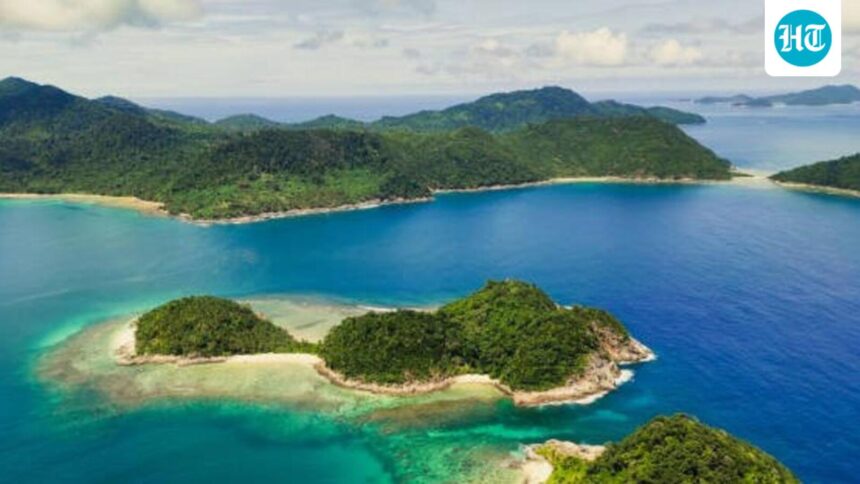
Greater Nicobar is a distinct group of islands that is closer to Banda Aceh, a port of North Sumatra in Indonesia, than Port Blair. The southern tip of Grand Nicobar Island, Indira Point, represents India’s southernmost territory. The flying distance from its capital to this last village in India is about 3,500 km, and the understanding of mainland Nicobar Indians is very little. Often clubbed with the Andaman Islands, best known as a penal island with the notorious Cellular Jail built to imprison freedom fighters and others deemed criminals by the British, Nicobar is less visible and remains a little-known piece of land. Only the most enthusiastic and wealthy travelers have gone to the islands, which are inhabited by former soldiers and their families.

For India, Nicobar’s geostrategic importance is high as it straddles important shipping routes and is located close to the Strait of Malacca. Both Andaman and Nicobar were created as a result of a historical geological development that occurred more than 100 million years ago. They are seamounts that rose from the ocean floor when the Indian plate collided with the Burma Minor Plate, which is part of the Eurasian plate in the Cretaceous period. This event continues to define the two archipelagos. There are three hundred exotic islands in Andaman, and some endangered tribes live on a few of these islands such as the Jarawa, and the Sentinelese are classified as of Negrito origin. Only a few dozen of the two hundred individual Nicobar Islands are inhabited, and their particularly weak tribal group – the Shumbeen or Chamhab (Shumbeen is a British mispronunciation), the Nicobarians have been studied as being of Mongolian origin.
Read also: History City: Indian history is full of succession games
Nicobarians, is a collective name for all non-Chamhaban tribes living on different islands such as Car Nicobar, Bumbuka, Teresa and Nancouri. The Chamhab tribe lives in the interior of the Great Nicobar Islands, which is why they were protected from the 2004 tsunami that caused devastation in both Andaman and Nicobar. The Chamhab tribe are hunter-gatherers, numbering less than a hundred according to 2011 census estimates. They may have arrived from the islands of Sumatra more than 30,000 years ago and settled on Great Nicobar Island, the largest island covering more than 900 square kilometers of dense rainforest and a UNESCO-designated biosphere reserve. On this island, a proposed container transshipment port, an airport, a 450 MVA power station and a town are planned to be built on an estimated 166 square kilometers of land. As compensation, it is proposed that afforestation be carried out in the northern Indian state of Haryana, which is at least 3,000 kilometers away.
History of the shooting star
Being a hunter-gatherer tribe that fiercely protected their privacy, only a few important details are known about them, such as carrying a bow and arrows, spears, an ax in a loin belt made of tree bark, and carrying a fire drill. They are hunters of boars and other wild animals, live in huts, use canoes, remain naked and wear earplugs, unlike a few tribes in remote northeastern India. For decoration, the Shamhab wears beaded necklaces and bracelets.
The first conclusive evidence of the existence of the Chamhaps comes to us from the Chola inscription at Thanjavur. Dating from the early 11th century, it is a record of their conquests, and while mentioning the places “captured” as part of their subjugation to Sri Vijaya’s thalassocratic empire, it says: “After Rajendra had sent many ships into the midst of the rushing sea… it was captured… Srivijaya, with a small jeweled gate adorned with great grandeur and a gate of great jewels… the great Nakavaram who in his vast groves gathered honey…”.
Arrival of Europeans in Nicobar
Galatea Bay, where the container port will be built and which will likely destroy pristine coral reefs and a marine ecosystem that has survived for millions of years, is named after a Danish survey ship that searched for minerals in the mid-19th century. The Danes arrived 100 years earlier in 1755, and the strategically located island of Grand Neckabar was renamed New Denmark, while the entire archipelago was named Frederikwern. Administered from their headquarters at Tranquebar on the east coast of India in Tamil Nadu, the Danes’ stubbornness gave in to recurring malaria outbreaks and they sold the area to the British along with other Indian assets in 1868.
While the Chamhaps speak their own language, their almost complete isolation means that the rest of the world knows little about them other than their existence and a few settlements. The first effort to study them dates back to 1846. F. A. Robstorff, the British official in charge of the Nicobar Islands, wrote in the Geographical Journal in 1875, “In 1846, the Danish warship ‘Galathia’ visited the Nicobar Islands, on her voyage around the world, and among the parts explored was the river (or creek) which opens into the port of Galatea, in Great Nicobar.”
Read also:City of History | Tamil Nadu’s Christian roots go back two thousand years
Just as at the present time, the observant and inquisitive Robstorff found that the Nicobarians inhabiting the coast and the Chamhaps who preferred the interior did not mix much. “It was so evident,” he wrote after his visit in the 1860s, “that these two peoples, though living on the same island, which is only 28 miles in length, and 12 to 16 miles in breadth at its widest part, were so completely ignorant of each other, that the people of the coast spoke of the inland tribe as forest devils, living in the trees, and eating frogs and snakes, which they caught by supernatural means…” he wrote after his visit in the 1860s.
Roopstorff was killed in 1883 by an Indian havildar (sergeant) who was wrongly about to be expelled from the army.
Even as the specter of irreversible change and extinction looms over the Chamhab and Nicobar environment, there are signs that this rare tribe of ancestors – a living link between the prehistoric past and the present – has evolved.
From scientific explorations conducted in the 21st century, it appears that Chamhaps itself is more than just a monolith. “One of the Shombins is a semi-nomadic group of hunter-gatherers ‘living in the deep forests in the northern and central parts of the island around the Galathea and Alexandria rivers,’” wrote George van Driem, citing studies by SC Chattopadhyay and AK Mukhopadhyay. “They trade forest products for food and also receive food and medical care through a government welfare program. They hunt with spears and are said to be unaccustomed to bow and arrow.” The other Shombin group lives on the east coast. of Greater Nicobar, where they are “in better contact, especially with the local Nicobar tribe, the eastern coastal group speak some coastal Nicobaran languages, and some of these Shombeans also understand Indian and frequent government offices at Campbell Bay.”
HistoriCity by Valay Singh is a column about a city in the news based on its documented history, legends, and archaeological excavations. The opinions expressed are personal.