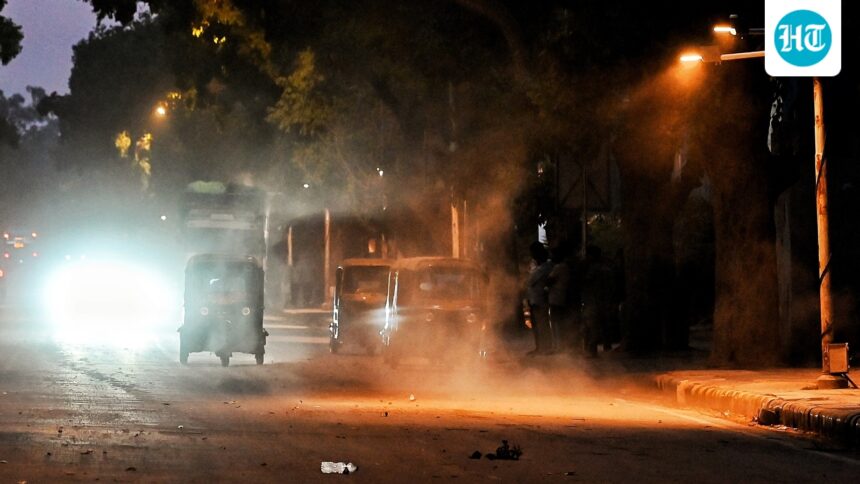
The pre-monsoon storm reaches speeds of up to 128 km/h. Trees were uprooted, roads were closed, and most of this devastation came with almost no rain.

The pre-monsoon storm that hit Delhi on Tuesday evening and continued through the night reached speeds of 128 kmph at Posa, higher than the 120 kmph recorded at Palam airport hours earlier, which has already led to the diversion of at least two flights and the delay of more than 400 others. Across the city, residents woke up on Wednesday to fallen trees and blocked roads, with areas including Hauz Khas, Defense Colony, Panchsheel Park and Vasant Kunj among the worst affected; Photos posted on X showed uprooted trees that had crushed boundary walls and lifted sidewalks with their roots.

Most of this devastation arrived with almost no rain.
The mechanism behind the storm, and the unusual frequency of such events in the pre-monsoon season, point to an increasingly specific and documented set of weather conditions in northwest India.
the components
Two things shaped the atmosphere on Tuesday. The first was the extreme heat. At 43.5 degrees Celsius – four degrees above normal and the highest reading for June so far – the ground was warming much faster than the upper atmosphere.

This exacerbated what meteorologists call the lapse rate: the rate at which the temperature drops with altitude, or the temperature gap between the scorching ground and the cold sky above. The wider this gap, the more unstable the atmosphere becomes and the more energy it stores.
A pocket of hot surface air that, once it begins to rise, remains warmer and lighter than the surrounding air at all levels. It keeps going up. It’s accelerating. This stored upward force is measured as CAPE (convective available energy) – in effect, the amount of explosive energy that has built up in the atmosphere.
Research on a similar pre-monsoon dust storm in Delhi in May 2018 recorded CAPE values of 2,696 joules per kilogram, with a high index of -8.98, both indicating the influence of extreme convection (Chakravarty et al., Agriculture and Forest Meteorology, 2021). Values above 2500 J/kg are typically associated with severe storm conditions.
Even maximum CAPE does not guarantee a storm. Another quantity — CIN, or convective inhibition — acts as a blanket that helps prevent instability. High CIN values typically suppress cloud development, even if CAPE—the energy that fuels updrafts—is high.
During Tuesday, surface heating would have steadily eroded the CIN cap. By late afternoon, he was gone.
CAPE essentially acts as the “juice” for a storm of this intensity, said Ashwary Tiwari of IndiaMetSky. “Basically, it’s an unstable environment and just needs a spark to develop thunderclouds. The more energy there is, the more it helps develop bigger and stronger storms,” he said, explaining underneath, warm, moist air quickly rises to the top. “CAPE and CIN are working against each other in that sense in the region,” he added.
The second element was moisture, fed by the hot plume through a cyclonic circulation – a counterclockwise swirl of winds – drifting from the northwest, near Pakistan. Humidity is important for a reason beyond simple humidity. It lowers the level of lift condensation — in other words, the height at which the rising air cools enough to condense into clouds. A lower cloud base means that a pocket of hot, rising air condenses faster; At this point, condensation releases heat back into the rising air, making it climb harder and faster.
Therefore, surface heat provides stored energy; Humidity lowers the trigger threshold and amplifies the updraft once it is triggered.
The surface-level trough — a low-pressure corridor extending through Rajasthan, Haryana and Delhi — acted as a funnel, drawing moist air inward and upward to the base of the developing plume. “The high temperature and humidity caused instability,” Tiwari said.
“There is still a surface-level trough, which will eventually turn into the axis of the monsoon,” he said.
Mohapatra, director general of IMD, told HT that such storms are not uncommon during the pre-monsoon period, but their intensity can depend on atmospheric instability. “Typically, there are four factors that determine the type and intensity of these storms. The first is intense heat and we’ve seen that over the last couple of days. The second is humidity. The third is the unstable atmosphere and the fourth is the trigger, which is usually a weather system. In this case, it was a cyclonic circulation. If there’s enough moisture, we get heavy rains, but usually, we see drier storms across northwest India. There’s a greater chance of rain falling late at night, when temperatures drop.” He said.
Read also: How good or bad have the monsoon rains been so far? | Number theory
Detonation
The weather is not gradually turning stormy. It holds up and then explodes.

By 5:30pm on Tuesday, the cover had been broken. Cumulus — a deep, anvil-topped storm cloud capable of reaching 15 kilometers into the atmosphere, higher than most commercial aircraft fly — developed over the next hour, its updraft pulling warm, moist surface air upward at speeds of tens of meters per second. Precipitation formed high in the cloud.
Dry thunderstorm
This is the counterintuitive essence of what happened on Tuesday.
The air below the cloud base over northwest India in the pre-monsoon period is very hot and dry. Precipitation from the cumulonimbus fell into this layer and began evaporating before it could fall—a phenomenon called virga, visible as soft gray curtains hanging beneath a cloud base dissolving in the air.
As precipitation evaporates, it strips heat from the surrounding air column, cooling it quickly. The cold air is dense and heavy. This mass began to sink rapidly. The falling rain and ice particles pulled the air down with them, accelerating the descent even further. The result was a downdraft: a column of cold, dense air barreling toward the surface like a piston falling from height. Research on the May 2018 Delhi dust storm has confirmed that this downdraft-driven mechanism is the hallmark of this class of storms (Banerjee et al., Journal of Geophysical Research: Atmospheres, 2021).
On the surface, the descending column hit the ground and quickly spread outward in all directions, like cold water spilled on a flat table. This spreading mass is the outflow of the cold pond, as the wind advances across the ground, lifting loose topsoil as it goes. The dust wall was the visible imprint of the downdraft whose rain had evaporated on its way down.
35]Precipitation data from overnight make the mechanism clear.
Palam, which recorded the highest wind speed in the evening at 120 km/h, received only 0.1 mm of rain overnight. In other words, the heaviest flow arrived where there was almost no rain, and the storm was strongest in drier areas. Farther from the outflow centre, rainfall increased: Safdarjung recorded 9.6 mm between 11:30 pm and 2:30 am and peak winds reached 74 km/h; Lodi road record was 7.4mm. The city of Bosa witnessed the highest wind speed during the night, reaching 128 km/h, and the wind strength reached 4 mm. “No significant drop in temperatures was reported, as it was mostly a dry thunderstorm,” Krishna Mishra, a scientist at the India Meteorological Department, said of the evening storm.
The gradient in wind readings across stations also reflects topography. “There are limited obstructions around the airport,” Skymet’s Mahesh Palawat noted, explaining Palam’s exposure. The open, flat ground gives the outflow no friction to slow it down.
Read also: The long arm of the El Nino phenomenon that prevents seasonal rains Number theory
Andy and what the season shows
Andhi’s book needs no introduction to most Delhi readers—the pre-monsoon dust storm that arrives with violent, dark suddenness is one of the city’s most famous monsoon events.

What the meteorological literature, going back to Joseph Joseph’s seminal study in Maussum in 1980, has proven is the mechanism: that the Ande is moved not by surface winds, but by a downdraft – the cold outflow of the cumulonimbus described above – which is why its force and rain often reach different places. Historical records indicate that Delhi averages about eight andis per year (Joseph, Mausam, 1980). The 101 km/h speed on Sunday at Palam was a separate episode in the same pre-monsoon period.
The broader pre-monsoon pattern of 2026 warrants greater attention. Westerlies—cyclonic storm systems that move eastward along the subtropical jet, and are typically more active in winter—have doubled in frequency during June over the past 20 years, driven by delayed northward migration of the jet stream (Hunt, Weather and Climate Dynamics, 2024), a band of westerly winds. More westerly disturbances in June mean more cyclonic circulations available to deliver moisture to the hot plains, and more frequent convective triggers of the type set off Tuesday.
Read also: Why Delhi’s water crisis keeps returning to the same choke point
This intersects with a well-established finding in the scientific heatwave literature: that extreme heat spells in northwest India – persistent events of 46-48°C – are consistently associated with an upper-level anticyclone, a high-pressure system that suppresses convection, trapping heat under clear skies, and preventing moisture from entering.

When this system becomes established, temperatures rise without interruption for several days in a row. When it is absent or weak, moisture penetrates, and convective storms ignite at low thresholds (Ratnam et al., Scientific Reports, 2016).

Binayak reports on information security, privacy, and scientific research in health and environment with explanatory articles. He also edits the newspaper’s news sections.