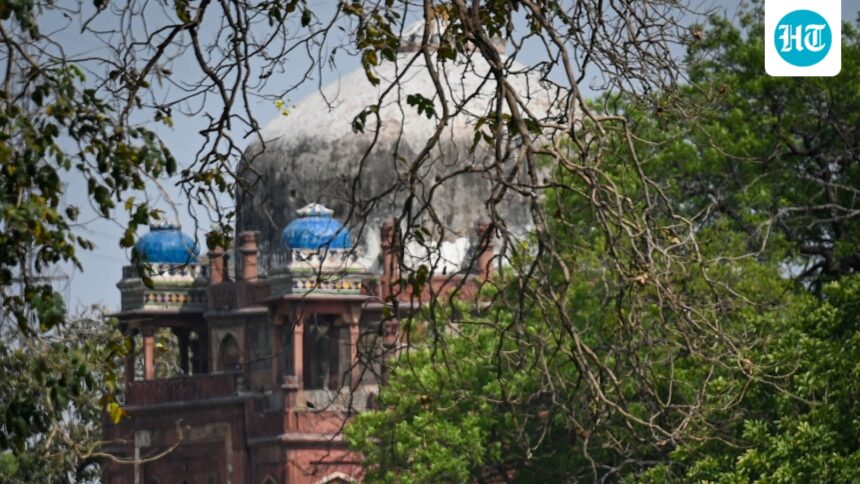
At the entrance gate of the Delhi Golf Club (DGC), against the complex’s wall, stand two Mughal-era shrines, at the center of a legal battle that has once again thrust the Archaeological Survey of India (ASI) and its director general, Yadubir Singh Rawat, 67, into the headlines.

From trespasses to religious disputes to controversies surrounding hosting events at ancient ruins, ASI is suddenly everywhere in the news. Sample: On May 15, the Madhya Pradesh High Court ruled that Bhoshala in Dhar was a Hindu temple based on a 2,189-page ASI report that relied heavily on ground penetrating radar (GPR) technology.
Court rulings
On May 28, the Supreme Court – which heard a petition filed by Rajeev Suri over neglected heritage structures – issued a personal notice to Rawat over what it termed a “callous and informal approach”, citing ASI’s failure to enforce the 100-metre restricted zone around monuments inside the DGC. Heritage activists have long claimed that the tombs remain effectively off-limits because the only entrance is through a club members-only gate with no separate public access point.
Rawat replied
In an interview, Rawat defended his organization’s record on both fronts.
“We have written several letters to the Directorate General of Cemeteries asking them not to create any obstacle to people visiting the graves. A guard has been posted there. The grave is open – anyone denied entry can file a complaint directly with the ASI. We have also done multiple restoration works there in the past.”
“Based on the court notice, we will file a comprehensive affidavit. All correspondence with the club will be recorded, boundaries will be marked, and we will clearly identify which buildings fall within the restricted area, what can be kept within the permitted limits, and what buildings must be removed or demolished.”
Regarding disputed religious sites, even while acknowledging the limitations of technology, he noted the importance of physical evidence. “We use GPR, LiDAR, photogrammetry — but even with all of those tools, you can’t get a completely accurate picture of what’s underneath. The only way to get something that’s completely conclusive and waterproof is to actually dig,” he said.
As far as Hogshala is concerned, “evidence does not just come from the radar,” he added.
“We have found 94 sculptures and inscriptions in Sanskrit, Pali and Brahmi – ‘Om Namah Shivaya’, ‘Om Saraswatiai Namah’, an inscription naming King Naravarman of the Paramara dynasty. The findings confirm themselves.”
Regarding the Gyanvapi at Kashi, another disputed religious structure, Rawat was more circumspect. “The structure called ‘Shivling’ by the Hindu side, maintained by the Anjuman Integrated Mosque Committee is a stone fountain used for ablutions before prayers – and this decision can come only after the court gives us directions. We will work within what the court orders.”
But he admitted that ASI is tempted to handle more such disputes.
He pointed to the Jama Masjid within the Rudramahal complex in Vadodara, where a medieval mosque stands on the ruins of an 11th-century Hindu temple, as an example of a long-pending issue that is now witnessing a new movement. Rawat confirmed that ASI received a request following a 2009 court order to refer the matter to the Home Ministry. “The Ministry of Home Affairs has asked us to restore the site. One portion is already with the ASI, and the remaining structure is in custody. We have requested the lifting of Section 144 and full access to the entire structure. Without this, the restoration cannot be started,” he said.
Parties and events
Regarding events, Rawat said ASI is constantly receiving requests for private parties, weddings and corporate functions at popular locations. In July 2025, the Delhi government proposed opening 70 to 80 Delhi government-protected heritage monuments including Ghalib Haveli, Dara Shikoh Library, Baik Cemetery and Lodhi Syed tombs as wedding and event venues.
This proposal does not cover centrally protected monuments in the ASI – over which the UT government has no jurisdiction. Even at Humayun’s Tomb, a centrally protected site, ASI scrapped a plan to host trade events, extending visiting hours to 9pm instead as an alternative.
What the ASI has allowed and expanded are sound and light shows at some monuments – Ishq-e-Dilli in Purana Qila, the Red Fort and Qutub Minar in Delhi, Golconda Fort in Hyderabad, Chittorgarh Fort in Rajasthan, and at 12 new sites approved by the Culture Ministry including Leh Palace, Shor Temple in Tamil Nadu, and Raigad Fort in Maharashtra.
There are 414 ASI monuments nationwide which are actively being encroached upon, Rawat said, adding that ASI is trying to resolve the issue.