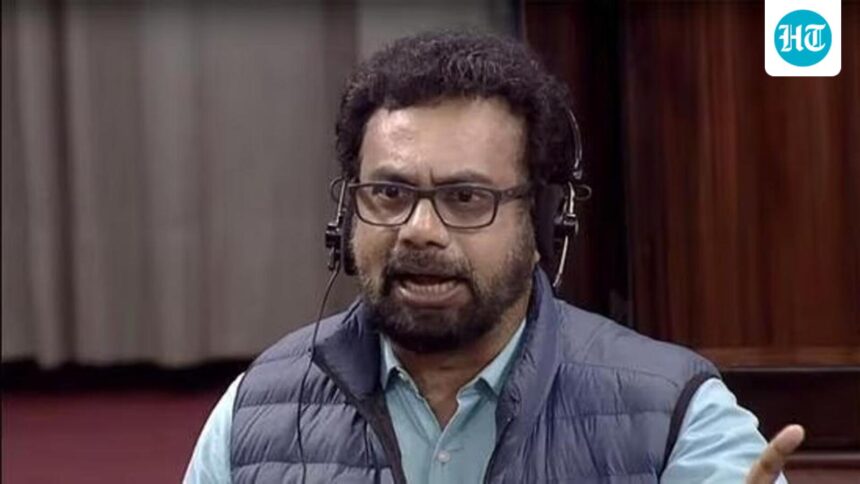
CPI(M) MP John Brittas on Sunday said the government’s continued institutional presence in the Shri Ram Janmbhoomi Teerth Kshetra Trust “cannot be ignored”. His comments came a day after he wrote to Union Home Minister Amit Shah seeking a review of the Centre’s stand that the fund falls outside the ambit of the Right to Information (RTI) Act, 2005.

“Transparency cannot become a victim simply because the government has chosen to describe the fund as ‘independent,’” Britas said on Sunday, adding that complying with the Supreme Court ruling does not erase the legal character of the government’s notification.
The letter comes months after the Central Information Commission (CIC) ruled on June 6, 2025, that the trust was not a “public authority” under Section 2(h) of the RTI Act, a position the commission based largely on submissions made by the Ministry of Home Affairs.
The Trust was set up through a government-approved scheme under the Ayodhya Designated Area Acquisition Act, 1993, following the Supreme Court judgment of November 9, 2019, and the subsequent gazette notification vested all rights, title and interest in the acquired land in the Trust.
Britas’ intervention comes against the backdrop of weeks of scrutiny of the fund’s performance, after allegations emerged of the theft of gold and silver donations at the Ayodhya temple.
The Congress separately demanded a Supreme Court-monitored probe and dissolution of the trust, while the Rashtriya Swayamsevak Sangh called for accountability and reforms without elaborating on the details.
Of the 15 members of the Fund, 12 were nominated directly by the Government of India, while the remaining three were selected at its first meeting, Britas noted in the letter. “The legal existence of the fund is closely linked to government actions taken under legal authority,” he said.
Read also:’70 kg of silver and 1,250 kg of gold’: Mahua Moitra slams Center for ‘stealing’ Ram Mandir donation
The Home Ministry maintained that the trust cannot be treated as “established or constituted by notification” under Section 2(h)(d) of the RTI Act, as the notification was issued only as directed by the Supreme Court and not independently by the government.
Brittas called this argument questionable. “The source of the obligation to issue the notice cannot change the legal character of the notice itself,” he wrote.
Citing the Supreme Court judgments in DAV College Trust and Management Society v. Director of Public Instructions, 2019, and Thalappalam Service Cooperative Bank Ltd v. State of Kerala, 2013, Brittas argued that the different parties to Section 2(h) act independently of each other, and that the body need not be government-owned or substantially funded to remain eligible as a public authority under Section (d).
He also cited the Delhi High Court judgment of July 1, 2026, which made the National Stock Exchange a public authority under the RTI Act, saying it reiterated that the law must be read meaningfully to promote transparency.
Brittas noted the continued presence of bureaucrats working in the Fund’s administrative structure. The Center representative is an Additional Secretary in the Home Ministry, while the Uttar Pradesh government nominee is also an IAS officer, besides the Ayodhya District Magistrate, he said. He added that another ex-officio member was once the most senior officer in the Prime Minister’s Office.
“If the Fund is entirely private in nature and completely outside the scope of public accountability, why has the government itself deemed it necessary to provide continued government representation in its administrative structure?” Brittas asked in the message.
Compared to the Shri Mata Vaishno Devi Shrine Board, Prithas said the experience of such institutions has shown that religious independence and administrative accountability are not mutually exclusive. Extending RTI-style transparency to the Ayodhya Trust’s finances and contracts, he said, “will not impair its religious independence and will not impinge on religious freedom.”
“Trusts with unparalleled public faith must also adhere to the highest standards of transparency and public accountability,” Britas said, asking the department to register its revised position before the Supreme Court.