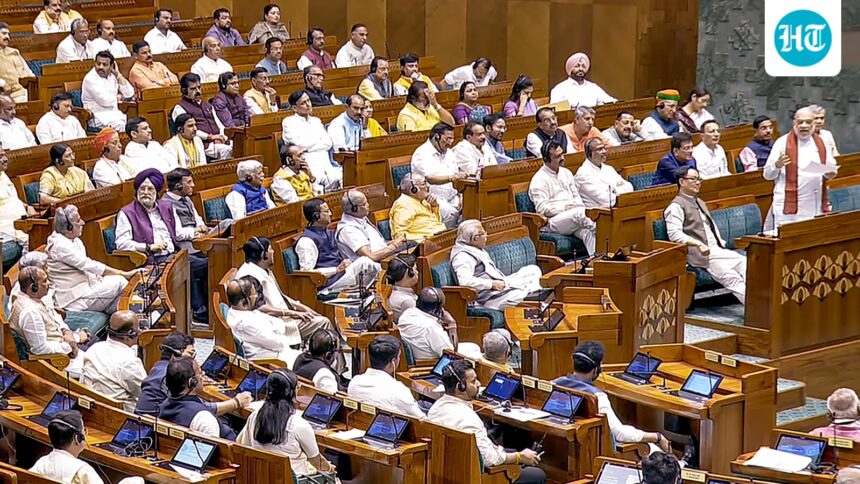
The government on Thursday tried to convince the Opposition that the proposal to increase the strength of the Lok Sabha and 33% fast-track reservation for women would entail a 50% proportional increase in seats in each state, and thus would not hurt the southern states that fear erosion of their relative position in Parliament.

On the first day of discussion on the Constitution Amendment Bill and the two Delimitation Bills in the House, Prime Minister Narendra Modi, Union Home Minister Amit Shah and Union Law Minister Arjun Ram Meghwal told the Opposition that each state’s seat share would not be changed, with Shah even reading out a table showing that southern states would not be harmed if the strength of the Lok Sabha was increased from 543 to 816.
Read also | Lok Sabha seats for all states increased by 50%, law minister says; 272 is for women
The Opposition questions the Centre’s intention regarding caste census
But the opposition remained unconvinced, pointing out that the government’s assurances were verbal and were not included in the text of the draft laws.
They also raised questions about the Centre’s intent on the caste census, the timing of the special session – in the middle of the election campaign in Tamil Nadu and West Bengal later this month – and asked why reservation for women could not be implemented with the current strength of the House.
“A completely false narrative is being spun that these three bills will reduce the strength of the southern states in Parliament. Such fears are baseless,” Shah said, adding that the strength of the Assembly would rise from 543 to 816 and that all states would see their seats rise by the same proportion.
The minister added: “If we look at the full story about the south, at the present time, 129 representatives from these states out of 543 seats sit in the council, which is approximately 23.76%. In the new council, 195 representatives will represent these states, and their share will be 23.97%.” He briefly intervened in the discussion on Thursday evening and will provide a full response on Friday.
Prime Minister Modi: No change in proportions
Modi said the process would not discriminate against anyone. He added: “Whatever the demarcation process was in the past under previous governments, and whatever proportions have been followed since then, there will be no change in those proportions, and any increase will be in the same proportion as well. If the word ‘guarantee’ is required, I use the word guarantee. If you want the word ‘promise’, I use the word promise. If there is a good word in Tamil, I am willing to use it as well, because when the intention is clear, we don’t need to play with words.”
Meghwal described the government’s proposal as a simple formula that ensures that no state is deprived. “The seats in all states will be increased by 50%. The total Lok Sabha seats will be 815, and 272 seats will be reserved for women,” he added.
But the opposition refused to believe the government’s words. “The Prime Minister cannot be trusted. As long as the caste census is not done, all sections of society will not get proper representation. This government wants to go ahead with the 2011 census as it does not have an OBC census,” Congress MP Priyanka Gandhi Vadra said.
The Constitution Amendment Bill 131 – which raises the seat ceiling in the Lok Sabha to 850 and implements a 33% reservation for women in time for the 2029 elections – requires a two-thirds majority of members present and voting for its passage in each house.
Passing the Delimitation Bill and the Federal Territories Bill – the former imposing border demarcation on the basis of the latest available population census, effectively the 2011 census, and the latter implementing changes in the federal territories – requires a simple majority. There was no mention of a fixed percentage or freeze in the relative power of the states in any of the three draft laws.
The Opposition has the numbers to thwart the government’s move in the Lok Sabha, but the key lies in the big non-Congress parties like the Samajwadi Party, Trinamool Congress and Dravida Munnetra Kazhagam. The bills were introduced 251-185 on Thursday – the Lok Sabha discussed the bills until 11pm at night – and are scheduled to come up for vote at 4pm on Friday.
Read also | Special session of Parliament begins today: Delimitation row, Lok Sabha expands to dominate agenda
Amit Shah reads the numbers to be sure
In his intervention, Shah read out the numbers to illustrate his point that no country will lose representation. “Karnataka has 28 seats, which is 5.15% of the 543 seats in the House. After the bill is passed, the number of MPs from Karnataka will increase from 28 to 42, and its share in the Lok Sabha will rise to 5.44%. Karnataka will not suffer any loss at all. Andhra Pradesh has 25 seats, which is 4.60%. After the bill is passed, he added that the number Representatives will increase from 25 to 38, or 4.65%.
“Telangana has 17 seats, which is 3.13%. After the bill is passed, the number of MPs will rise from 17 to 26, making it 3.18%. Tamil Nadu has 49 seats, which is 7.18%. After the bill is passed, the number of MPs will rise to 59, and its share in the new assembly of 816 MPs will be 7.23%. Tamil Nadu will also have 20 seats, or 3.68%. After the draft law is passed, the number of representatives will increase to 30, and their share in the new council will be 3.67%.
“I want to assure the people of Tamil Nadu that your representation will not go down, it will go up.”
He also rejected allegations that the government was abandoning the caste census and modifying the delimitation process to suit its political needs. “The Modi government has decided to conduct a caste census. The ongoing population census is being conducted on the basis of caste census. There is no need to spread confusion,” he said.
He added, “The Boundary Demarcation Commission law is completely consistent with the current (old) law. There is no change. It will not affect the ongoing elections.”
Read also | Delimitation Bill: Do you favor opposition math in Lok Sabha?
Opposition to “harming the southern states”
But the opposition, which disrupted the speeches of Modi and Shah, claimed that the relative hike was not mentioned in the text of the bills circulating. They also said that drawing borders based on the 2011 census would put Southern states at a disadvantage.
“There is a dangerous aspect. They are saying 50% increase in Lok Sabha numbers but the Bill does not speak a single word about the process. Surprisingly, in the entire Bill there is not a single word about the process and method of this major amendment. Representation was stamped on the basis of the 1971 census but this Bill will fix everything. Despite the hollow assurances of the Prime Minister and other ministers, the representation of small states will certainly be changed. The way it has been divided. The Opposition has captured seats in Assam and got its own seats by demarcating new boundaries for political gain, which is the same thing they were going to do to the entire country.”
Congress leader Jairam Ramesh published a gazette notification on [April 16] Amendments to it are being discussed and will be voted on tomorrow. “Totally confused,” he posted on X.