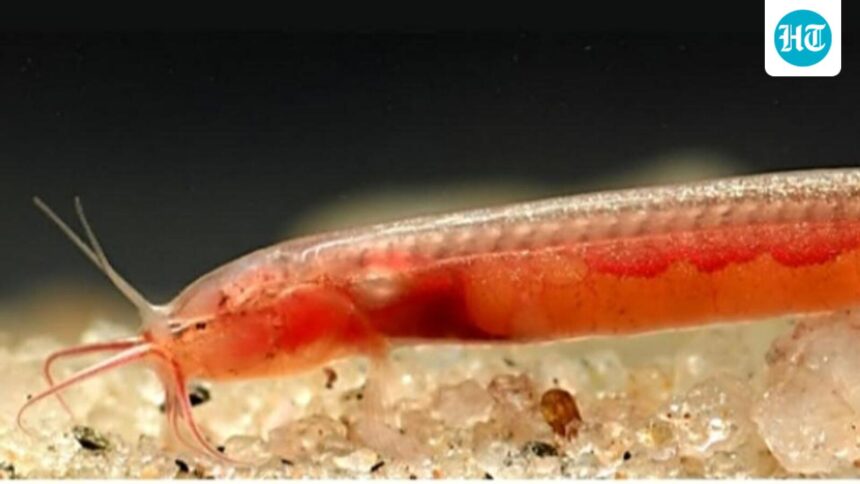
A team of ichthyologists from Europe, America and India has discovered the Gitchak nakana, the first phreatobitic fish from northeastern India, marking the first discovery of a previously unknown subterranean fauna in this part of Asia.

The discovery was published in Nature Portfolio Scientific Reports, one of the world’s leading scientific journals, on February 26 this year.
“This new genus and species is the most unusual among the other groups due to the complete lack of a cranial roof, with the brain covered only dorsally by skin,” says Dr. Lokishore from UDM, a key member of the team. “Underground animals are usually met with great fascination by both lay people and biologists.”
“While most of these animals have been reported from caves, some species have adapted to other underground habitats. One special subterranean aquatic habitat is aquifers, which are home to a number of invertebrates and fish.”
He added that of the more than 300 known subterranean fish, less than 10% have been recovered from aquifers, and they are found only rarely and by chance.
According to scientific reports, this blind lok was discovered in a drilled well in Assam, India. It shows a number of characters usually associated with subterranean life, called troglomorphies.
The genus name is derived from the Jaro word gitchak, meaning red, in reference to the striking red color of this species of loach, while the specific name is derived from the Jaro words na·tok, fish, and kana, blind, in reference to the absence of eyes in this species.
The team of ichthyologists includes Dr. Ralph Bretz and Dr. Amanda K. Benyon from Senckenberg Naturhistorische Sammlungen Dresden (Germany); Weimarethi K. Marak and Kanjam Velentina of Assam Don Bosco University, Assam (India); Dr. Yumnam Lokishore Singh from DM University, Manipur (India); Rajeev Raghavan of Kerala University of Fisheries and Ocean Studies, Kochi (India); and Dr. Lukas Robert from the Institute of Ecology and Evolution at the University of Bern (Switzerland).
The journey leading to the discovery of this unusual locus has been going on since 2018, when it was collected and brought by Wimarithi, a researcher for Dr. Lokishore, for identification at Assam University’s Don Bosco Laboratory.
Since then, the team has worked on the sample and formalized the discovery after collaborating with Dr. Ralph. As part of the collaborative project, two researchers under the supervision of Dr. Lokishore, Velentina Kangam and Wimarithi K. Marak, visited Senckenberg Naturhistorische Sammlungen, Dresden, Germany, to analyze the species.
“This discovery will add to the list of endemic species in the region and the world,” adds Dr. Lokishore, who has so far discovered 25 new species of fish.