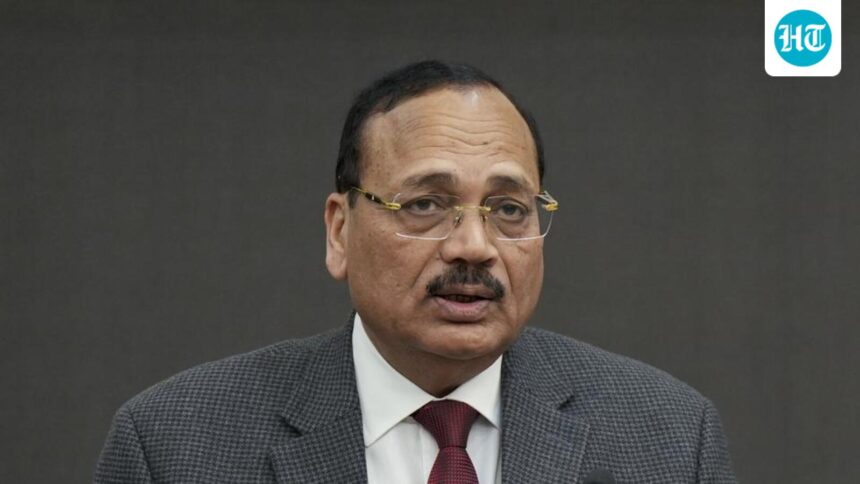
Cyber breaches, digital fraud and transnational data crimes challenge traditional investigative models, making forensic science a vital shield protecting the integrity of justice from technological deception and information chaos, Chief Justice of India Surya Kant said on Friday.

Addressing the meeting of the National University of Forensic Sciences in Gandhinagar, the CJI said the digital age has transformed the nature of crime and the process of investigations.
The International Commission of Justice said: “The quality of justice provided in any legal system depends fundamentally on the quality of evidence presented to decision-makers. Judicial reasoning is only as strong as the facts that support it.”
He described forensic science as a compass pointing to the truth, and said it enhances judicial processes by basing conclusions on verified facts rather than competing assertions.
He said: “Cyber intrusions, digital fraud, identity manipulation, and transnational data crimes challenge traditional investigative models. In such an environment, forensic science becomes more than just a technical discipline. It becomes a protective shield that protects the integrity of justice against technical deception and information chaos.”
He added: “When the forensic science Ksoraksha Kavach operates in an increasingly technological environment, it does more than just resolve individual disputes. Instead, it maintains institutional legitimacy itself. The stable role it plays in interpreting complex digital evidence puts the public’s trust in your hands.”
He said that although citizens may not fully understand the technological processes behind forensic analysis, they can trust that these processes are conducted with impartiality, discipline and integrity. He added that the legitimacy of the judicial system ultimately depends on this trust.
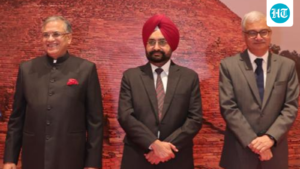
The dignitaries who attended the event included Deputy Chief Minister of Gujarat Harsh Sanghavi and Justice Sunita Agarwal, Chief Justice of the Gujarat High Court, among others. Dr GM Vyas, Vice Chancellor, NFSU, conferred degrees on 1,799 students, including 17 PhD recipients, during the convocation ceremony. In recognition of academic excellence, 52 gold medals were also awarded to outstanding students.
In his speech, CJI Kant said that when courts evaluate electronic evidence or deal with technology-based disputes, they rely on professionals who are able to bridge scientific complexity and legal standards. “Your expertise therefore acts as a stabilizing force, ensuring that technological progress strengthens the rule of law rather than undermines it,” he told the graduating students.
NFSU, founded in 2009 and formerly known as Gujarat Forensic Sciences University, offers undergraduate, postgraduate and doctoral programs in forensic science, cybersecurity, criminology and related disciplines.
The CJI warned that increasing reliance on scientific materials also increases liability. “The more decisive scientific analysis becomes in shaping legal outcomes, the more important it is that this analysis remain guided not only by technical competence but also by moral clarity. Scientific analysis cannot exist in an ethical vacuum.”
Emphasizing the centrality of evidence in arbitration, Judge Kant said: “The quality of justice provided in any legal system depends primarily on the quality of evidence presented to decision-makers. Judicial reasoning is only as strong as the facts that support it.”
He said that legal systems gradually moved “from relying on assertions to relying on documented facts.”
“Human memory, although indispensable, is not infallible. Perception can be subjective. Remembering can be affected by time and circumstances. Stories may diverge despite honest intentions,” he said, adding: “A person can lie, but not documents.”