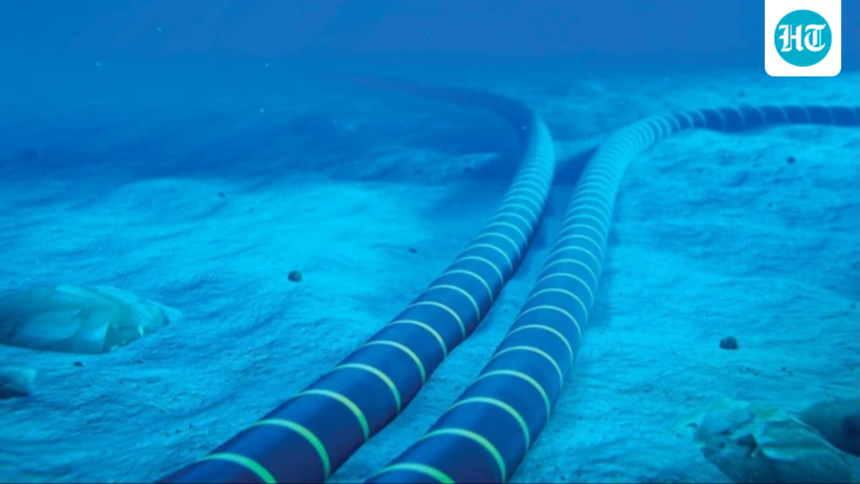
As the war continues to rage in West Asia, concerns and concerns about internet outages due to potential breaks in Red Sea cables have increased. While Iran has not officially threatened to cut undersea communications cables, several X accounts have warned of this possibility as tensions rise between the United States, Israel, and Iran.

The last time the world saw a Red Sea cable outage was in September 2025, which was allegedly caused by a commercial ship dragging its anchor and cutting several undersea fiber optic cables.
As a result of this incident, many countries experienced internet outages, especially in West and South Asia.
However, with the US-Iran war escalating daily, the fear of severe internet outages has increased, especially with the Yemeni Houthi armed group joining the fight.
The Iran-backed group has threatened on several occasions to cut fiber optic cables in the Red Sea via its social media channels.
For this reason, the possibility of a future Houthi attack on the Red Sea cables cannot be ruled out.
Red Sea cables and internet connection
According to the International Cable Protection Commission, the accident in September 2025 affected four main cables –
- Southeast Asia – Middle East – Western Europe 4
- Cable India, Middle East and Western Europe
- Falcon GCX
- Europe and India portal
About 30% of annual cable accidents are caused by pulled anchors, which account for roughly 60 defects annually, John Routsley of the International Cable Protection Commission told The Associated Press last year.
However, as conflict continues in West Asia, deliberate obstruction is now a major concern in the world.
The cables in the Red Sea are responsible for a large number of services such as financial transactions, cloud services, video calls, emails, and even workloads for artificial intelligence networks.
What does cutting the Red Sea mean for India?
India was also affected by the September 2025 incident. Although internet services did not stop, major networks across India faced service outages and delays in operation.
Given India’s increasing reliance on cloud services, digital payments and artificial intelligence devices, any damage to cables in the Red Sea could hamper connectivity and lead to major economic consequences for the country.
Nearly 95 percent of the world’s international data flows through these submarine cables. Of these, India currently hosts 17 cables across 14 landing stations in Mumbai, Chennai, Cochin, Tuticorin and Trivandrum.
India remains vulnerable to internet congestion and performance issues due to conflict in West Asia, with the Red Sea and Strait of Hormuz remaining risky areas.
Moreover, India’s internet traffic remains unevenly distributed, with about two-thirds of it being routed through Mumbai and the rest through Chennai, which may be a weak point for the country.
If anything goes wrong in Mumbai or Chennai, be it a natural disaster or a technical malfunction, a large part of the country will see a loss of connectivity.