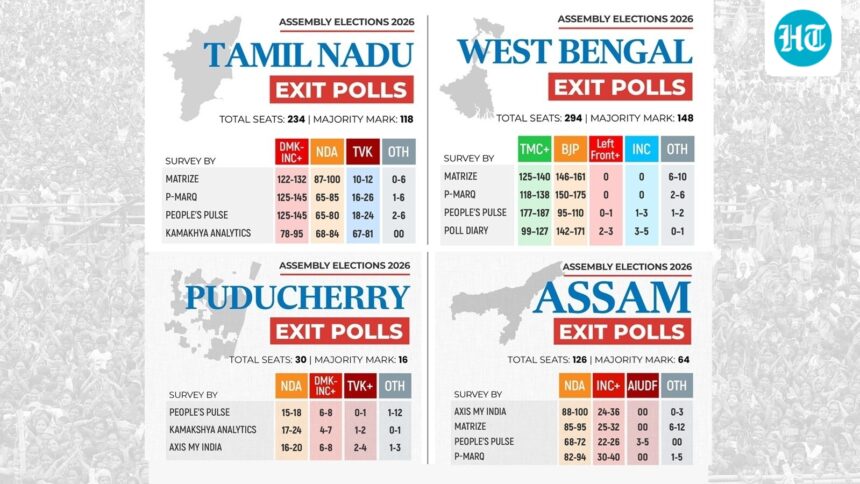
The BJP is on course for a historic victory in West Bengal and a third consecutive term in Assam, the Congress-led United Democratic Front is set to win power in Kerala, and the Dravida Munnetra Kazhagam party may overcome anti-incumbency and retain Tamil Nadu, a set of exit polls expected on Wednesday. Follow live updates of the 2026 exit poll

What the 2026 polls say
In West Bengal, the largest and most important of the five regions that went to the polls this session, the majority of opinion polls expected the BJP to achieve a narrow majority in the 294-member assembly, defeating the Trinamool Congress (TMC). But two major agencies have not released their forecasts for the eastern state, where turnout broke previous records, due to widespread deletions under the Special Intensive Review (SIR).
In Tamil Nadu, all but one poll predicted that the DMK-led alliance could achieve a majority in the 234-member Assembly. AxisMyIndia predicts that actor-turned-politician Vijay may overtake both major Dravidian parties and end up as the single largest party – perhaps even a majority – in what could be Tamil Nadu’s first true three-way contest in a generation, with the All India Anna Dravida Munnetra Kazhagam (AIADMK) in complete collapse.
In Puducherry, all opinion polls predict that the National Democratic Alliance is on track to win.
The votes will be counted on Monday.
Are polls accurate?
To be sure, exit polls are not always accurate, and have often made incorrect judgments in previous elections, especially when there are diverse populations, sects, and communities. In 2021, most exit polls placed wrong predictions for West Bengal, where the TMC won in a landslide. Similar errors occurred in forecasts for the 2024 general election.
The polls came after a bruising weeks-long campaign in the five regions where questions of development, identity, elimination under SIR and local anti-incumbency dominated.
Three of the states that went to the polls – Bengal, Tamil Nadu and Kerala – have never seen a BJP government and represent the party’s final frontier. The National Democratic Alliance is in power in Assam, where it hopes to return to power for the third time in a row, and in Puducherry, where it is trying to form a government for the second time in a row.
The elections also represent a survival test for regional strongmen Mamata Banerjee, who is seeking a fourth consecutive term, MK Stalin, who is seeking a second consecutive term, and Pinarayi Vijayan, who is seeking a third consecutive term.
In Kerala, opinion polls were unanimous in favor of the result. They expect the United Democratic Front – which includes the Congress Party, the Indian Muslim League, the Kerala Congress (Joseph), the Kerala Congress (Jacob), the Revolutionary Socialist Party and smaller groups – to return to power with a simple majority after a 10-year absence. No poll predicted that Chief Minister Pinarayi Vijayan — who won improbable victories in 2016 and 2021 in a state where the two major parties typically alternate power — would return for a third straight term. Some opinion polls have predicted that the BJP, which remains a marginal force in the coastal state, will expand its presence but is finding it difficult to convert it into seats.
The exit polls were unanimous in Assam as well. All exit polls predicted that Prime Minister Himanta Biswa Sarma would return with an overwhelming majority – nearly two-thirds in the 126-member Assembly – in the north-eastern state for a second consecutive term, beating the Congress which was seen as a close runner-up by a wide margin. The campaign in the state, where immigration has been a emotive issue for half a century, has been polarizing with Sarma seeking to marginalize Bengali-speaking Muslims, who are pejoratively called “mias.”
In Tamil Nadu, all but one exit poll indicated that Stalin would overcome the anti-incumbents to score a small but significant victory in a state where the KDP has historically struggled to retain power for a second consecutive term. Almost all exit polls indicated that the AIADMK-led NDA in the state would largely repeat its 2021 show, when it bagged about 75 seats, and that a new entrant, Vijay’s Tamil Vitri Kazhagam, would pick up votes but would not threaten the two Dravidian major leaguers.
But AxisMyIndia flipped that scenario, predicting that TVK could become the largest party in the state, and may even win a majority on its own. He predicted that the DMK will be right behind TVK with the complete collapse of the NDA. If these numbers continue, it will be a political upset and will mark the best performance by a first-time electoral candidate in the state since Tamil screen talisman M G Ramachandran in 1977.
A political earthquake in West Bengal has also been predicted by some exit polls predicting that the BJP – which won 77 seats in 2021 – will cross the 148-seat majority mark on its own and defeat the TMC comfortably. One Peoples Pulse poll predicted the opposite, saying the TMC could approach a two-thirds majority on its own.
In a state ruled by the Left Front for 34 years and then Banerjee for another 15 years, the BJP has tried over the past decade to establish a stronghold but has failed repeatedly. If he succeeds in 2026, it will be a historic victory in a state that holds enormous political and social importance for the party, as Jana Sangh founder Syama Prasad Mukherjee hails from the state.
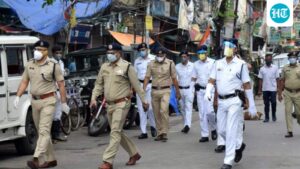
The eastern state saw largely violence-free elections, run by a record number of paramilitary personnel – 2,550 companies, nearly three times that number in 2016 and 2021 – in a region notorious for political violence. The election was marked by the Election Commission of India transferring 30 times more officials in Bengal than in any other poll-bound region, federal agency raids on a number of TMC leaders, and the disenfranchisement of 2.7 million voters who were flagged under the controversial logical inconsistency category under the SIR.
The repercussions of these elections will reverberate far beyond Kolkata, Chennai, Guwahati or Thiruvananthapuram. For the NDA, it is an opportunity to win in areas that have not traditionally warmed to their ideological or electoral appeal. It will set the mood for a host of key Assembly elections next spring, and could steady Prime Minister Narendra Modi’s hand amid international turmoil.
For the opposition, the elections provide an opportunity to stem the wave of losses that followed its performance in the 2024 general elections and win major states with enormous political weight.