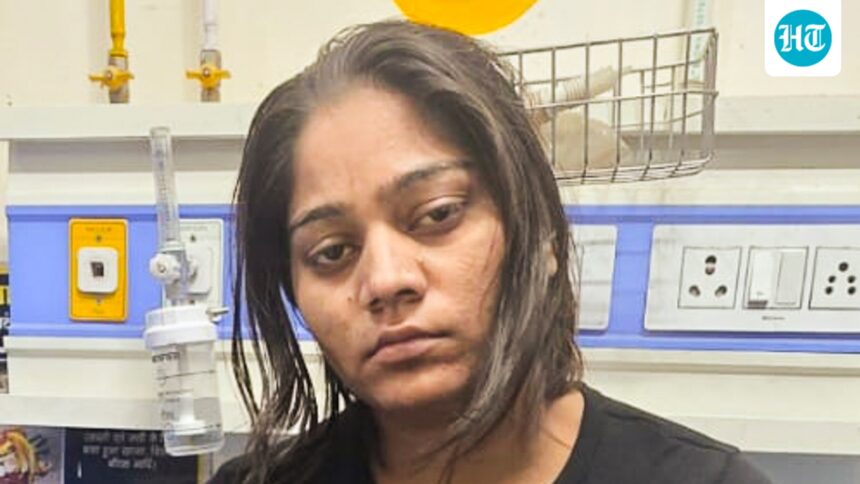
The Supreme Court on Friday refused to send murder accused Sonam Raghuvanshi back to jail, despite expressing serious reservations over the Meghalaya High Court’s decision to grant her bail in the Raja Raghuvanshi murder case. Hearing the Meghalaya government’s appeal against the June 29 bail order, a bench of Justices M M Sundresh and Shail Nagu said it kept in mind the well-established legal principle that “bail is the rule and imprisonment is the exception”, even in cases involving serious allegations.

“We are aware of the fact that she has been in prison for a while. We know that bail is the rule and prison is the exception. No matter how heinous the crime is, we will try to consider a balanced approach.”
The court said it would have been inclined to stay the bail order had Sonam not already been released from jail.
“Prima facie, we would have stayed the bail order, but since she has already been released, we do not want to interfere,” the bench said while issuing notice to Sonam and sending the matter for hearing on July 9.
Why did the Supreme Court refuse to stop Sonam’s bail?
The court indicated that once the accused is released pursuant to a judicial order, the courts must proceed with caution before returning him to prison, especially when the trial has already begun.
The justices also reiterated that criminal allegations, no matter how serious, are ultimately matters that must be tested at trial and cannot override the presumption of innocence that applies until conviction.
“These are facts and issues that must be decided during the trial,” the court observed after Solicitor General Tushar Mehta described the charges as “shocking” and “chilling.”
The Meghalaya government informed the court that Sonam had already been released and was in Shillong following the Supreme Court order, prompting the court to reconsider issuing an interim stay.
What did the Supreme Court find problematic about the Supreme Court order?
Even as it refused to intervene immediately, the Supreme Court made it clear that it was not convinced by the logic adopted by the Meghalaya High Court while upholding Sonam’s bail.
“Prima facie, we have reservations about how the Supreme Court handled this matter,” Justice Sandrich said during the hearing.
The Supreme Court upheld the bail primarily on the basis that the arrest documents repeatedly referred to Section 403 of the Bharatiya Nyaya Sanhita (BNS) Act rather than Section 103, which relates to murder.
The executive order also took into account unrelated allegations made in the arrest papers, including references to crimes outside India and desertion from the armed forces, and described the documents as an example of “total non-application of reason”.
However, the Supreme Court questioned whether this deficiency was enough to justify bail in a murder case, especially when Sonam had been informed of the reasons for her arrest and had never raised the issue in her three previous unsuccessful bail petitions.
“The fact remains that you were informed. The previous bail applications, did not raise this issue. It is not that reasons were not given,” the bench orally observed.
The argument of the Meghalaya government
Appearing on behalf of the Meghalaya government, Solicitor General Tushar Mehta said the Supreme Court granted relief on mere technical grounds despite the vast material collected during the investigation.
According to the prosecution, Raja Raghuvanshi’s murder was a pre-planned conspiracy allegedly hatched by Sonam along with her alleged lover Raj Kushwaha and other accused.
Mehta told the court that Sonam traveled to Meghalaya with three accomplices, actively participated in the assault and later helped dispose of Raja’s body by dumping it in a gorge.
The State also argued that the reference to Section 403 instead of Section 103 in the arrest papers was merely a typographical error that did not cause any prejudice to the accused.
Raja Raghuvanshi murder case
Raja Raghuvanshi, a 29-year-old businessman from Indore, traveled to Meghalaya with his wife Sonam soon after their wedding in May 2025 for their honeymoon.
The couple went missing after leaving their home in Nungria on May 23. Raja’s body was later recovered from a gorge near Wisawdong Falls in Sohra, while Sonam was traced days later in Uttar Pradesh.
Subsequently, the Meghalaya Police filed a chargesheet spanning over 700 pages, alleging that the murder was part of a premeditated conspiracy involving Sonam and her alleged accomplices.
The trial is currently underway, and witnesses are already being questioned.