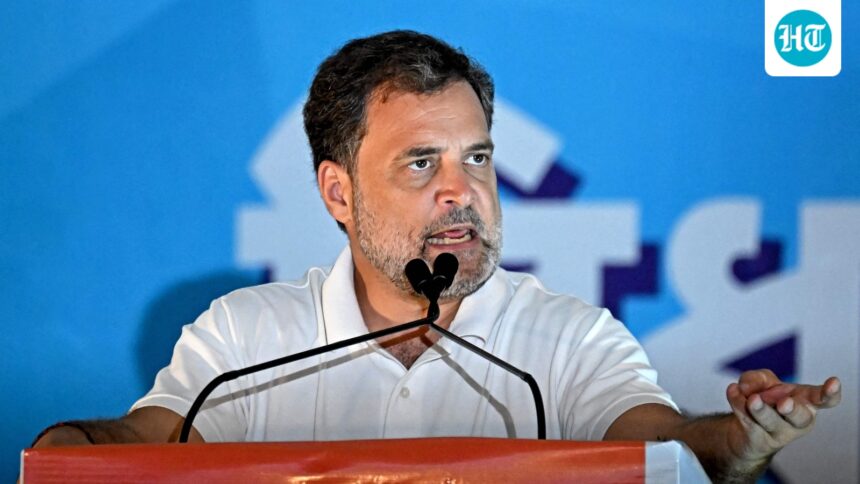
Rahul Gandhi reiterated his criticism of Modi, saying that running the country was no longer within his reach.

Prime Minister Narendra Modi has urged Indians to adopt several lifestyle changes, including shifting to working from home again and avoiding buying gold for nearly a year, in order to cushion the impact of the ongoing war between the US and Iran. But his suggestions failed to convince the opposition as Congress described the challenges as “evidence of failure”.

Modi’s appeal to the nation, which he shared on Sunday while speaking in Hyderabad where he inaugurated several projects, came more than two months after the war in West Asia began on February 28. The war, which is currently under a temporary ceasefire, has sent ripples across the world as it has seriously affected global energy supplies.
Reacting to Modi’s speech, Leader of the Opposition in Lok Sabha Rahul Gandhi wrote in a post on X, “Modi demanded sacrifices from the public yesterday – don’t buy gold, don’t travel abroad, use less petrol, reduce use of fertilizers and cooking oil, take metro, work from home.”
He added that these are not just “mistakes” but “evidence of failure.”
Gandhi wrote: “In 12 years, they have brought the country to a stage where the public has to be told – what to buy, what not to buy, where to go, where not to go. And each time, they shift the responsibility to the people so that they can escape accountability themselves.”
He reiterated his criticism of Modi and said that running the country was no longer within his reach.
Gandhi’s party colleague KC Venugopal also shared the same sentiments and claimed that Modi was “ignorant about ensuring India’s energy security” even weeks after the war began.
Read Also: WFH, Don’t Buy Gold for a Year: PM Modi’s Plan to Combat Impact of US-Iran War
He said it was “shameful, reckless and completely unethical” that the Prime Minister was “pushing the ordinary citizen into inconvenience, rather than building the emergency to ensure our economy is not affected by this global crisis”.
He added that the government must take the necessary steps to ensure that there are sufficient fuel reserves so that no one faces “inconvenience.”
Another Congress leader, Karti Chidambaram, described Modi’s appeal to the nation as a dangerous “directive” and questioned the “motive” behind it. He also called for an immediate session of Parliament to discuss the same and asked the government to take the nation “into confidence” and inform it of the “real situation which necessitated these ‘appeals’.”
Also Read: Why PM Modi asked Indians to avoid buying gold for a year
“WFH, no foreign travel.”
In his speech on Sunday, Modi urged people to switch to working from home if possible to save fuel, as happened during the coronavirus. He also asked people to prefer metro and other public transport to reduce consumption of petrol and diesel.
Modi’s calls come at a time when the whole world is grappling with the energy crisis resulting from the war between the United States and Iran.

“At this time of global crisis, we have to take a decision to keep duty first and fulfill it with full dedication. The big solution is to use petrol and diesel in moderation. We must limit our use of petrol and diesel. In cities with metro lines, we should decide to travel by metro only. If we have to use a car, then we should try car sharing,” Modi said.
He said it would be in the “national interest” for people to resume working from home.
Modi also stressed the need to conserve foreign exchange as India faces increasing import costs.
The Prime Minister’s comments come as the Strait of Hormuz, a major trade waterway hosting about a fifth of the world’s energy supplies, remains effectively closed with no certainty when operations will return to normal.
He asked people to try to postpone traveling abroad for at least a year, and also avoid buying gold for a year “in the national interest.”

Nikita Sharma is a senior content producer at Hindustan Times. She is a Delhi-based digital journalist with five years of experience in writing and editing news stories in various fields including crime, politics, technology, trends and much more, both nationally and internationally. At Hindustan Times, she is part of the news team and focuses on breaking news, tracking what’s happening everywhere, and constantly chasing evolving news stories. She has a penchant for covering crime, geopolitics and Indian politics with a keen eye for stories that are often overlooked in the daily news cycle. At Hindustan Times, she has extensively covered several major events including the US Presidential Election, Indian Airlines plane crash, Pahalgam terror attack, Operation Sindoor, US tariff war, among others. As a Delhi enthusiast, she especially enjoys wandering around and writing about the national capital – its heritage, food, art and culture, and the many problems that come with it – pollution, waterlogging, traffic, and more. Nikita holds a bachelor’s degree in Journalism and Mass Communication from GGSIPU and started working as a digital journalist in 2021. During her first assignment, she covered local news in a Delhi-based newsroom, writing and editing stories on conflicts between builders and buyers, civic issues like potholes, waterlogging, lack of facilities in hospitals in Delhi, and paralyzing the city during the peak monsoon season. She has also written articles covering Delhi art galleries, heritage walks, artist profiles, museums, Hindustani classical music concerts and dance performances. She entered mainstream news in 2023 and previously worked at NDTV.Read more