A year after the crash of AI 171, investigators have created a devastating timeline that begins on a hot June afternoon and ends a half-minute later in a fireball.

It has been a year since Air India flight AI-171 fell from the sky over Ahmedabad and exploded on the PG Medical College campus, killing 260 people and leaving behind one of the most baffling mysteries in Indian aviation history.

The Boeing 787 Dreamliner was supposed to be a routine flight from Ahmedabad to London Gatwick Airport. Instead, it turned into a disaster that unfolded in just 32 seconds — a series of events so short that investigators are still struggling to explain exactly why it happened.
The Aircraft Accident Investigation Bureau (AAIB) is expected to issue an update on the status of its investigation on Friday. Officials familiar with the matter cautioned that the document would not answer the question everyone has been asking for a year. The plane’s engines are still being examined, and investigators are not yet ready to say why the plane crashed.
For the families of the dead, this uncertainty has become a burden.
“We hear different stories every few months,” said Muktiben Vansadia, who lost her parents on their first ever flight. “But no one can tell us exactly what happened.”

What investigators created was a devastating timeline that began on a hot June afternoon and ended half a minute later in a fireball.
Routine departure
June 12, 2025 began like any other travel day at Ahmedabad airport.
Passengers checked in for Air India flight AI-171, a Boeing 787-8 Dreamliner scheduled to fly to London Gatwick. Among the 242 people on board were students, families, professionals traveling abroad and former Gujarat Chief Minister Vijay Rupani.
Nothing in the plane’s logs indicates a future problem.
Investigators later found that the weather was suitable. The vision was clear. The wind was light. The aircraft was within weight and balance limits. Fuel quality tests gave satisfactory results. There was no evidence of bird collisions. The flaps were configured correctly and the landing gear was operating normally.
The Dreamliner accelerated down the runway and rose smoothly into the afternoon sky.
For a few seconds, everything seemed completely normal.
Then something happened that investigators are still trying to explain.
Three seconds after take-off
According to data obtained from the aircraft’s flight recorders, both fuel control switches in the cockpit went from the RUN to CUTOFF position.
The movement did not occur minutes into the flight or during the emergency. This happened approximately three seconds after the plane became airborne.
The keys moved one after the other, only a tenth of a second apart.
For aviation experts, the importance of this measure is enormous.
Fuel control switches regulate the flow of fuel to the engines. When moving to the cut-off point, the fuel supply is cut off. Without fuel, engines cannot continue to produce thrust.
The effect on AI-171 was immediate.
The plane had just left the runway and was still climbing. It did not reach the safe height. There was little room for error and almost no time to recover.
With the fuel supply cut off, both engines began to lose power.
Within moments, the Dreamliner ascending toward London became a glider.

The conversation that changed the investigation
The most revealing evidence recovered from the plane is not a mechanical component or piece of debris. It’s a short conversation recorded inside the cockpit.
According to the AAIB’s initial report last year, one pilot was heard asking the other why the fuel was being cut off.
The response came almost immediately.
He hadn’t done that.
The report deliberately avoided identifying which pilot said what. The full text was not published. He did not reach any conclusions. He simply recorded the exchange and moved on.
However, that one conversation became the focal point of the entire investigation.
From that point on, the debate surrounding the AI-171 split into competing camps.
The pilot groups argued that the exchange should not be interpreted as evidence of intentional action by any crew member. They cautioned against drawing conclusions before the technical investigation was completed, and insisted that the possibility of a malfunction in the system still existed.
Others focused on the recorded movement of the fuel switches and the sequence of events that followed.
A year later, investigators still have not publicly explained why the keys were moved.
Desperate attempt to save the plane
What happened next is a reminder that the AI-171’s final seconds were anything but negative. The crew fought to the end.
The flight recorder data showed that within 10 to 14 seconds of the fuel cutoff event, both switches were moved back to the on position.
The pilots were trying to restore power.
The engines responded.
Investigators found evidence that the restart sequence had begun. One of the engines showed signs of being relighted. The other was trying to recover. The plane no longer simply falls; There were indications that the crew had been able to begin reversing the disaster.
But flight is governed by altitude, speed and time.
The Dreamliner had almost none of those.
At the moment the engines lost power, the plane was only about 625 feet above the ground. This left the crew with a vanishingly small window to diagnose the problem, restart the engines, and recover the fully loaded wide-body aircraft.
Modern jet engines do not come back to life immediately. The restart procedure takes precious seconds. Sometimes it takes longer.
The pilots simply ran out of the sky.
Final descent
When AI-171 touched down, its trajectory took it beyond the airport boundary toward the PJ University College of Medicine campus.
Investigators believe the plane first struck trees and a burn chimney inside the Army Medical Corps complex.
By then, the plane was already descending uncontrollably.

The impact sequence that followed scattered debris hundreds of feet high.
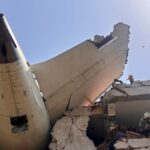
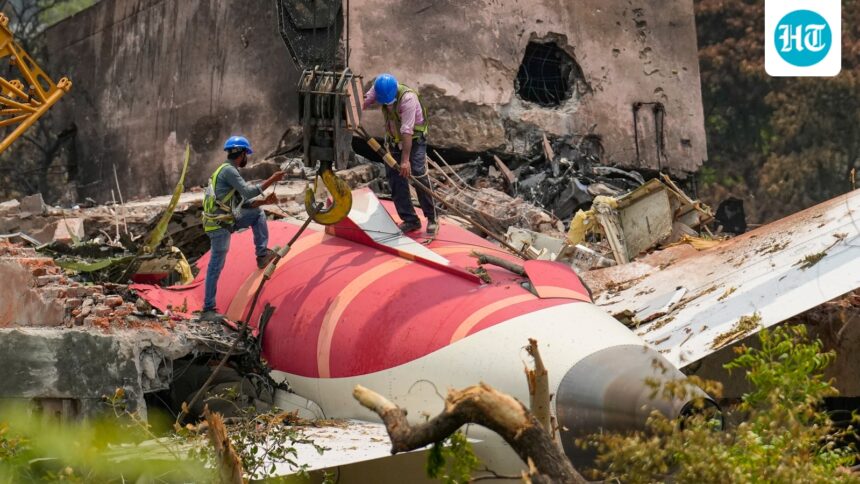
The right engine hit a concrete water tank and separated from the aircraft. Sections of both wings were torn off. The vertical stabilizer and rudder separated from the tail and fell separately from the main fuselage.
The plane penetrated buildings, walls and open ground before crashing into the hostel complex.
The students were inside the cafeteria at that time.
Seconds later, flames engulfed the plane and parts of the buildings it struck.
Investigators later mapped a debris field stretching across the campus. The left engine stalled near Building D. The flight deck came to a halt several hundred feet from the initial point of impact. Wing parts, landing gear, and tail components were found embedded in buildings or scattered throughout the complex.
The violence of the accident left little chance of survival.
Of the 242 people on board, only one passenger survived.
Nineteen people also lost their lives on the ground.
What investigators know – and what they don’t know
Over the past year, investigators have been steadily eliminating many possible causes.
The evidence does not support inclement weather. Does not support bird activity. And he doesn’t point To incorrect configuration of the aircraft. Fuel contamination has been excluded. Both engines were operating normally before the fuel supply was cut off.
The aircraft also had no known fuel control switch defects recorded in its recent maintenance history.
Read also: One year after the AI 171 crash, some questions have been answered, and others remain
However, ruling out possibilities is not the same as solving a puzzle.
The central question remains exactly where it was a year ago: Why did the two fuel control switches move to the final seconds after takeoff?