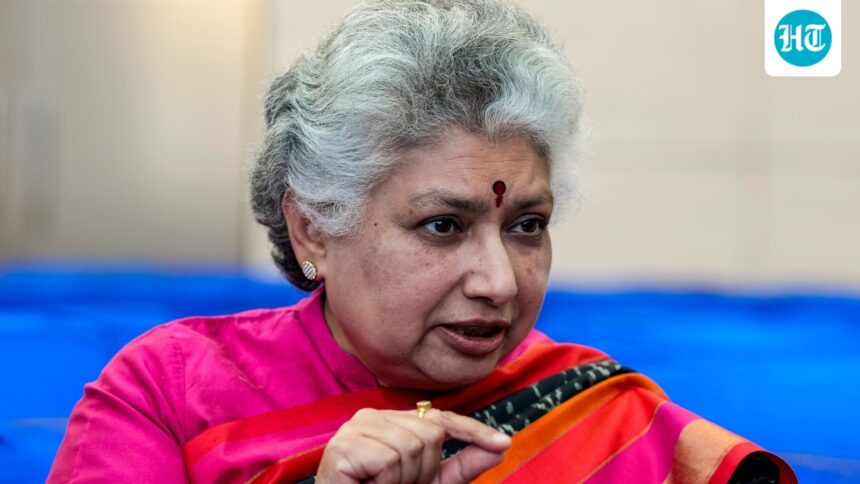
Supreme Court Justice B V Nagarathna on Saturday said the Election Commission of India should work independently and not be influenced by political processes. She noted the importance of the independence of other central agencies as well, apart from the polling body.

“It is very important that these institutions function independently and not be influenced by political processes,” said Nagarathna, who is scheduled to become chief justice of the Supreme Court in September 2027 by seniority.
The Supreme Court judge made the remarks while speaking at the Chanakya National Law University in Patna on the topic ‘Constitutionalism Beyond Rights: Why Structure Matters’.
Also read: SC re-fires bank director, says higher position means higher accountability
About how constitutional collapse occurred
She further argued that constitutional collapse could occur through the gradual hollowing out of the structure, even while rights may remain formally untouched.
She added: “Deconstruction of structure occurs when institutions stop checking each other. At that moment, elections may continue, courts may function, and Parliament may enact laws; however, power is not actually restricted because structural discipline no longer exists.”
Justice Nagarathna said the poll panel, Comptroller and Auditor General (CAG) and Finance Commission were “isolated, specialized and given tasks that may not be sufficient to ensure impartiality,” Bar & Bench reported. “It is very important that these institutions operate independently and not be influenced by political processes,” she said.
Read also: ‘Shocking’: Supreme Court slams Bengal administration’s ‘total failure’ over judicial officers being held hostage in Malda
About elections and “control”
Speaking about the role of the Election Commission in democracy in the country, she said that holding elections is not just a routine task, but a mechanism through which political power is formed.
“Our constitutional democracy has clearly demonstrated smooth changes in government due to timely holding of elections,” she said.
She pointed out that “controlling that process is in fact controlling the conditions of political competition itself.”
Also read: SC notifies 9-judge bench of Sabarimala temple review; Listen from April 7
She said that while she was talking about the validity of the Constitution, it depended on “whether the legislature deliberates on future laws rather than merely approves them” and “whether the executive rules within the law rather than above it.”