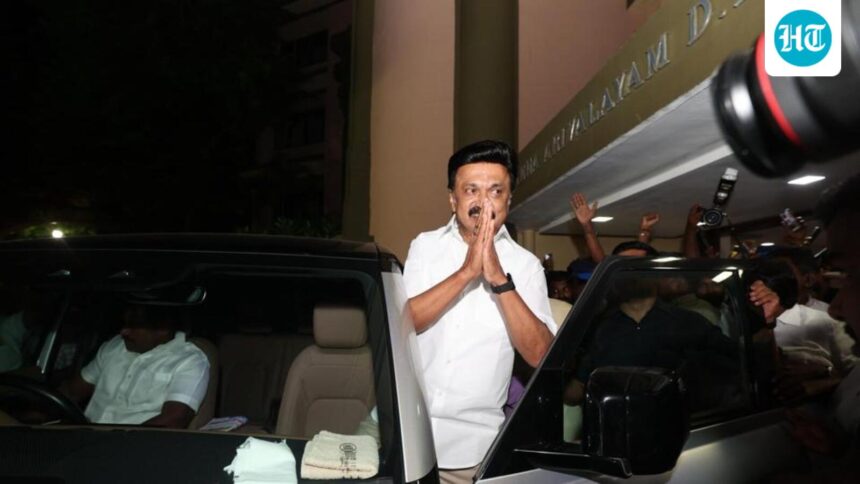
As soon as early trends pointing to the defeat of the ruling Dravida Munnetra Kazhagam (DMK) party in the Tamil Nadu Assembly elections on Monday started emerging, videos of workers removing tents and other arrangements at the party headquarters started going viral on social media. By late evening, DMK chief MK Stalin conceded defeat and said his party would act as an “excellent opposition” in the state assembly.

The KDP, which along with its allies swept the Lok Sabha elections two summers ago, lost the assembly elections to newcomer Tamil Nadu Vetri Kazhagam (TVK), a party headed by actor-politician Vijay. TVK won (or was leading) 107 of the state’s 234 seats, DMK was limited to 60 seats while its arch-rival AIADMK finished third with 47 seats. Much to the dismay of the ruling party, its leader Stalin himself lost to TVK VS Babu by 8,795 votes for the Kolathur seat, a seat he had represented since 2011.
“We bow and accept the judgment of the people. Congratulations to the victors!” Stalin said in a long post on X.
Recalling his government’s record over the past five years, Stalin highlighted the social welfare programs and infrastructure projects that defined his tenure.
“In the last five years, we have created many projects and provided good governance to the people of Tamil Nadu. We have lifted the state of Tamil Nadu in every way. In the electoral arena, we sought votes just by talking about our achievements. We campaigned for votes to ensure the continuation of the welfare schemes we offered to the people. I express my sincere thanks to all the people of Tamil Nadu who supported and voted for the Secular Progressive Alliance led by Dravida Munnetra Kazhagam,” the DMK chief added.
Political analysts asserted that the DMK, which has sharply attacked Dravidian pride for targeting the Bharatiya Janata Party (BJP)-led Center on a range of issues, has failed to effectively gauge the ground reality, especially anti-incumbency against many of its legislators and, more importantly, the growing popularity of actor Vijay.
In the run-up to the April 23 Assembly elections, Vijay-led TVK as well as AIADMK general secretary Edappadi K Palaniswami intensified their attacks on the DMK, accusing the party of promoting “dynastic” politics. Although it is not uncommon in Indian politics for more than one member of a family to hold a key position in a political party, the ‘dynasty’ tag has hit the DMK hard, political experts said.
Stalin’s son Udhayanidhi, who is also the state’s deputy chief minister, won election from the Chepauk-Thiruvilikini assembly constituency in Chennai. Udhayanidhi’s rise within the DMK as well as in the Stalin-led government — from being Youth Welfare and Sports Minister in December 2022 to Deputy Chief Minister in September 2024 — in the last five years has emboldened rivals to target the DMK with a partisan strike.
Besides Stalin, who lost to his former close aide Babu of TVK, he lost several cabinet colleagues, including MA Subramanian (Siddapet), RD Shekhar (Perambur), and Tamilan Prasanna (Egmore) at the polls.
Ramesh Sethuraman, a Chennai-based political expert, pointed out the DMK’s failure to attract aspiring youth and first-time voters, who felt the two Dravidian parties no longer represented their interests, costing the party dearly in the polls.
“The DMK had no plan for young voters even though Udhayanidhi heads the youth wing of the party. This led to the fall of the DMK’s once impenetrable urban strongholds in Chennai,” he added.
This is where TVK captured the aspirational votes – the young and the first – and Vijay pitted himself against the DMK. More than half of TVK candidates are under 45 years of age compared to the average age of DMK candidates of 50 years.
The Opposition also attacked the DMK on issues of law and order and women’s safety in Tamil Nadu.
“The DMK has failed to address women’s safety issues, such as the Anna University incident, allegations of rampant drug use (illicit liquor, ganja and drug abuse), and corruption,” Sethuraman said.
The expert also said that the DMK’s failure to deliver on some of its poll promises, including scrapping NEET for medical admissions, also affected the party’s prospects.
According to DMK leaders, the party’s internal polls have shown rising anti-incumbency of a large number of MLAs. However, the party has not replaced the existing MLAs to prevent revolt by senior leaders.
Friction also emerged in the DMK-led Secular Progressive Alliance, with the fallout between Stalin’s party and the Congress emerging publicly on several occasions. Although the Congress settled for 28 seats under the DMK alliance, many in the party have publicly claimed that it should contest at least 42 seats. Allegations of strained relations became stronger after Congress leader Rahul Gandhi did not share the stage with Stalin during his public campaign in Tamil Nadu.
The DMK’s campaign revolved around the Centre’s alleged imposition of Hindi, insufficient funds provided by the Center to Tamil Nadu and discrimination in southern states through the proposed demarcation of Lok Sabha seats to implement reservation of seats for women.
Pa Krishnan, a noted political expert, said the DMK continued to unnecessarily provoke TVK and its president Vijay, which led to increased sympathy for the new party.
“Though it favored TVK, we must also remember that it influenced the DMK. The DMK also gave several conditions to TVK to hold its general meetings after the Karur incident. They created enough difficulties for TVK,” he added.
However, Stalin assured that his party’s political journey would continue.
“In my public political life, I have witnessed great victories; I have also faced defeats. Therefore, I am a person who acts on the basis that ideals and policies are what matter most, not just victories and defeats. Thus, the political journey of the DMK will continue without faltering,” Stalin said in his post.