NEW DELHI: The capital continued to face a water deficit of around 10% on Thursday, with the Wazirabad Water Treatment Plant — which, along with Chandrawal, supplies more than 20% of the city’s drinking water — operating at half its capacity as the Yamuna river channel remained starved of flow. Although negotiations on the Munak Canal have only resulted in a partial recovery, the Delhi Jal Board will send officials to Haryana to search for additional water through the Sombh, a smaller tributary of the Yamuna.

Data from the Haryana Irrigation Department recorded at 7 pm on Thursday shows the volume of diversion constraining Delhi’s supply: While only 352 cusecs were released into the river channel from the Hathnikund barrage, 2,155.5 cusecs were diverted into the West Jamuna Canal. The DJB is now pressuring Haryana to redirect part of the WJC flow through Somb so that some water can reach Wazirabad.
A senior DJB official said daily water production has fluctuated between 892 million gallons per day and 927 million gallons per day over the past week, hovering around 904-905 million gallons per day on most days, against a targeted supply of 1,002 million gallons per day — leaving the capital with roughly 100 million gallons per day.
“Due to negotiations with Haryana, the flow has increased slightly in the Munak Canal, where we are getting an additional 50-60 cusecs of water, but the Munak also has limited carrying capacity. The situation can be resolved only if water is received in the Yamuna Canal in Wazirabad,” the official said.
A second official said that the company is trying to use all available means. Hathnikund acts as a major regulatory barrier on the Yamuna River, diverting the flow between the river channel, the WJC Channel and the East Jamuna Channel; The Dadubur barrage regulates the flow along the WJC.
The Somb is a seasonal stream originating from the lower Shivalik Hills in Yamuna Nagar, Haryana. It also serves as an escape channel from the Western Jamuna Canal, and joins the Yamuna at Kanalsi in Yamuna Nagar.
Bhim Singh Rawat, a Yamuna activist and coordinator of the South Asia Network on Dams, Rivers and People, warned that the Sombh route is not without restrictions.
“The Sombh was a permanent tributary, but it has been poorly exploited and converted into a seasonal stream. It will continue to suffer evaporation losses as the sand layer is now dry, and regular and continuous release will be needed for the water to reach Wazirabad,” Rawat said.
Noting that a large-scale sustained release over 15 days had been arranged during Chath last year, he said the current crisis called for a similar effort.
Pressure appears across the distribution network. A third DJB official said the facility receives 4,000 to 5,000 complaints a day related to sanitation, water supply and pollution.
“The number of pollution complaints has also increased over the past week. Low supply pressure and use of pumps are exacerbating the problem – there is a shortage of water in the system while the pump pressure is also drawing water from leakage points,” the official said.
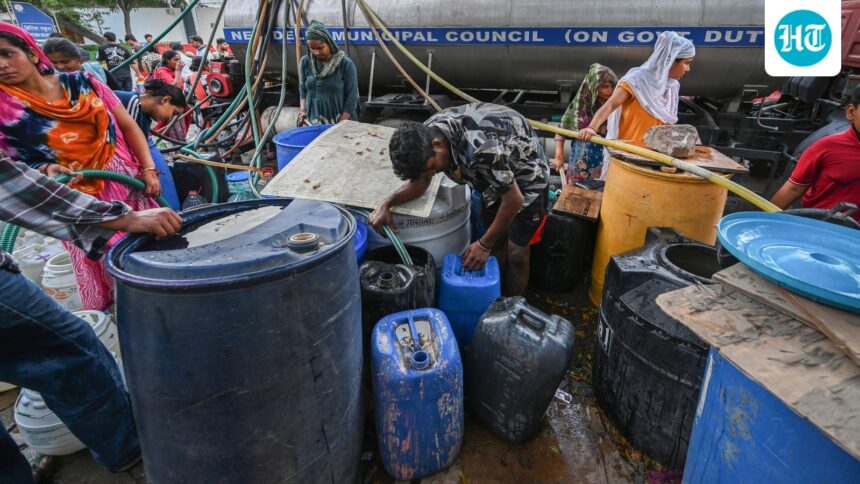
In many affected areas, supplies have been cut from twice a day to once, with timing also reduced.
Nargis Siddique, a resident of Sangam Vihar Ji area, said the taps in her house remained without water for about two weeks.
“We are celebrating Eid, but there is no water. We somehow manage by borrowing a bucket or two from another area. We have submitted two requests for a tanker in the past seven days but have not received anything,” she said.
Officials said Chief Minister Rekha Gupta spoke to Haryana CM Nayab Singh Saini over phone, seeking water, and Union Minister Manohar Lal Khattar also weighed in on the solution.
“All parties are trying to provide relief to people. We have started seeing an increase in raw water through the Monak Canal; we are exploring other options. Haryana is also facing a shortage,” the official said.