The Bharatiya Janata Party (BJP) has rejected allegations of engineering a rebellion in opposition parties like the Trinamool Congress and the Shiv Sena (UBT), blaming the recent unrest on the “leadership deficit” in these parties.

The BJP-led National Democratic Alliance is expected to benefit from these divisions, as rebel groups have shown a tendency to support the ruling coalition. The NDA, which has 293 legislators in the Lok Sabha, could see its number of MPs rise to 319 with 20 rebel MPs from the TMC – which has now merged with the Nationalist Citizens Party of India (NCPI) – and six from the Shiv Sena (UBT) speaking in favor of switching parties.
While the opposition turned its guns on the Bharatiya Janata Party, accusing it of inciting rebellion, the ruling party blamed the “leadership” of the regional satraps for the crisis.
“There are two reasons why legislators or legislators choose to move. The first is the political future – where they see themselves and the party is headed. The second is the relationship between the leader and the cadre, and the third may be for other benefits including financial,” said a senior BJP legislator, requesting anonymity.
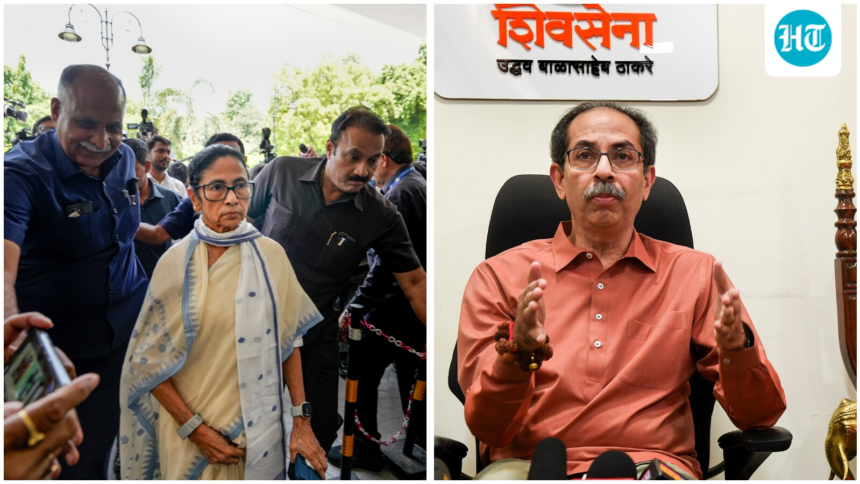
The recent episodes of discontent against TMC and Shiv Sena (UBT) chiefs Mamata Banerjee and Uddhav Thackeray, respectively, illustrate the disconnect between the senior officers and cadre, the leader said.
“There was a time when Balasaheb (Thackeray) ensured that party leaders and workers were taken care of. This leader-worker relationship is missing now. Many of them also feel that Uddhav, by allying with the Congress, has betrayed the Shiv Sena’s cause – protecting Hindutva,” the BJP leader added.
On Friday, while addressing party workers, Uddhav Thackeray denied the allegations and even offered to step down from the post of party president. The BJP has been accused of poaching MPs in a bid to boost its numbers in the Lok Sabha so that it can muster support for legislation such as the delimitation bill which requires a two-thirds majority in Parliament.
Former West Bengal Chief Minister Mamata Banerjee also criticized the BJP for allegedly inciting rebellion in her party. The rebels who broke away from the TMC blamed the party’s national general secretary and Banerjee’s nephew Abhishek for administrative lapses that paved the way for the party’s defeat in the recent Assembly elections.
A second BJP leader from Bengal said: “This does not mean one or two leaders will leave the party in disarray. The JLF almost staged a coup by choosing Ritabrata Banerjee as the party’s MP in the assembly and 20 MPs decided to merge with the BSP… The main issue was the leadership crisis. The party was being run like a fiefdom and the elected leaders had no voice.”
The TMC faced a crushing defeat at the hands of the BJP in the April-May elections. The BJP won 207 of the 294 seats while the TMC managed only 80 seats.
The second leader said several TMC leaders approached the BJP “long before the elections” because they disagreed with the party’s stand on illegal immigrants and the state government’s inability to crack down on “syndicates” that force people to pay bribes.
A third functionary said: “Strong leadership is essential to keep the party together. In the BJP there is a top-down review mechanism. The party has mechanisms in place to address concerns and prevent differences from turning into opposition. In addition to the intra-party programmes, the Sangh (Rashtriya Swayamsevak Sangh) acts as an additional support system.”
The leader also distinguished between the rebellion of TMC and Sena (UBT) leaders and “individual” leaders who have left the BJP.
Pointing to examples of senior party leaders like BS Yediyurappa, Uma Bharti and, more recently, K. Annamalai, who have left the party, the leader said these cases are not comparable.
The third employee said: “The leaders withdrew for personal reasons and not because of systemic problems. In any case, they returned to the party, which in itself is an indicator of the party’s strength.”