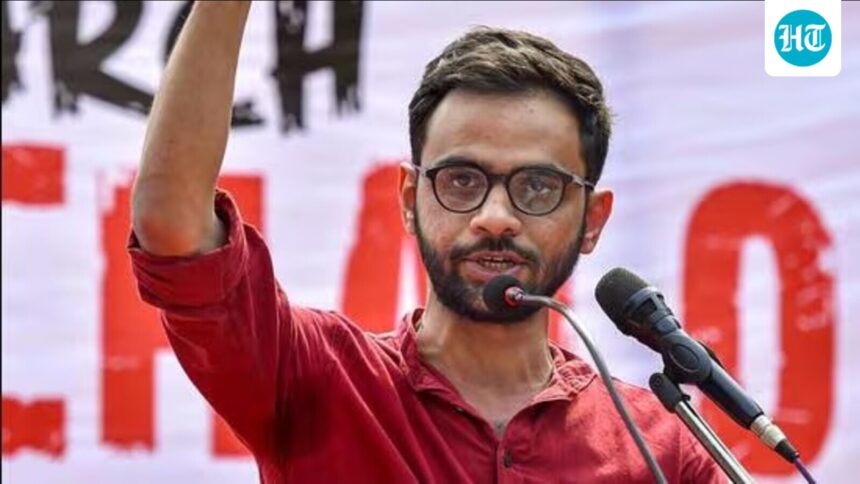
The Delhi Police on Saturday opposed the bail applications of student activists Omar Khalid and Sharjeel Imam in the larger 2020 Delhi riots conspiracy case, arguing that there were no changes in circumstances and that both of them occupied a senior and important role in the conspiracy, distinct from the rest of the co-accused.

The applications were filed before Justice Sameer Bajpai of Karkardooma Courts in additional sessions by Special Public Prosecutor Madhukar Pandey. The court reserved its orders.
In their bail applications filed last month, both Khalid and Imam cited a change in circumstances, highlighting the May 18 ruling by a bench of Supreme Court Justices P V Nagaratna and Ujjal Bhuiyan while granting bail to Syed Iftikhar Andrabi, a resident of Jammu and Kashmir, in a narco-terrorism case being investigated by the National Investigation Agency (NIA).
The Supreme Court expressed “serious reservations” about the reasoning adopted earlier this year in the January 5 judgment, stating that it failed to properly apply the binding principles laid down by a larger three-judge bench in Union of India v. K. A. Najeeb (2021), which recognized that prolonged imprisonment and trial delays could override statutory restrictions on bail under Section 43D(5) of the Unlawful Activities (Prevention) Act (UAPA).
The court also objected to the trend that Khaled and Imam cannot renew their application for release on bail until after the interrogation of protected witnesses or after one year, whichever comes first.
In opposing Khaled’s bail application, the public prosecutor said that the alleged “change of circumstances” as pleaded by him, did not constitute a fundamental or fundamental change that would warrant reconsideration of bail.
“Successive bail applications can be maintained only after it is proven that there has been a fundamental and substantial change in circumstances. No such change has taken place after the rejection of the special leave petition and review application filed by the applicant,” the public prosecutor said.
The prosecutor said that Khaled’s reliance on some subsequent rulings and observations made in other cases did not constitute a change in circumstances.
Read also:Can CAG privately audit disc playback? Question before the Supreme Court in the Delhi dispute
The prosecution said the court was unable to effectively review the Supreme Court’s January 5 ruling, which denied bail to Khalid and Imam while granting relief to five co-accused, and held that they would be free to renew their bail application upon completion of cross-examination of protected witnesses or after one year from the date of the order, whichever is earlier.
Discussing his case, the Public Prosecutor said that the allegations against Khaled are serious and relate to a larger conspiracy leading to widespread sectarian violence.
He said several courts had earlier found that statutory restrictions under Section 43D(5) of the UAPA applied to Khalid’s case.
The prosecution said: “The prosecution’s evidence is wide-ranging and includes protected witnesses and electronic evidence. The possibility of influencing witnesses, directly or indirectly, cannot be ignored.”
In response to Imam’s plea, the prosecution said the Supreme Court’s January 5 order denying him bail states that the applicant “occupied a privileged, senior and key role of ideological and strategic centrality in the conception and execution of the overall criminal conspiracy that culminated in the 2020 North East Delhi riots”. The Public Prosecution said that the imam cannot demand equality with the other defendants.
The Supreme Court, after in-depth scrutiny of the charge sheet and electronic records, has already reached a clear judicial conclusion that the accusations against the accused are prima facie true, the police said.
“The statutory prohibition under Section 43D(5) operates with absolute rigor and completely strips the court of any remaining discretion to grant bail,” the prosecutor added.
The Public Prosecutor said the Grand Imam’s reliance on the High Court’s May 22 interim order in the special leave petition, Tasleem Ahmed v. The State, was completely misplaced.
“An order of referral by a bench to the Chief Justice of India to constitute a larger bench is not a declaration of law under Article 141 of the Constitution, until the larger bench formally resets/amends the law,” the police said.
Police said Imam’s defense that he was detained on January 28, 2020 in another case and that he was absent from Delhi during the height of the violence in February 2020 “is a repeated argument that the Supreme Court has already rejected.”
Police added: “The applicant leads a vast network of student activists and extremist cadres; releasing him at this vulnerable stage before being charged would fatally compromise the safety of witnesses, lead to systematic intimidation, and completely derail the integrity of the impending trial.”