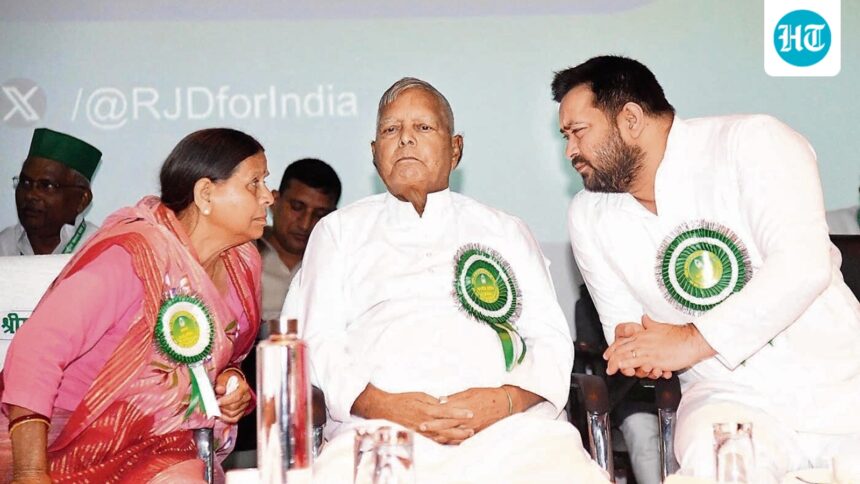
New Delhi: In a setback for Lalu Prasad Yadav, the Delhi High Court on Tuesday refused to quash the CBI’s FIR in the land-for-jobs case involving him and his family, rejecting the RJD chief’s claim that the agency’s action was legally unsustainable in the absence of prior sanction under Section 17A of the Prevention of Corruption Act.

Justice Ravinder Dodija said in his order that the section was introduced in 2018 with prospective effect, while the allegations dated back to the period 2004-2009, and that the court was “persuaded” by the agency’s position that allowing a belated appeal on a technical plea relating to prior approval would frustrate “the orderly administration of criminal justice”.
Justice Ravinder Dodija dismissed the petition filed by Yadav, former railway minister and former Bihar chief minister, who also sought quashing of the three chargesheets filed in 2022, 2023 and 2024, and subsequent cognizance orders in the matter.
While pronouncing the ruling, the judge said: “The petition is baseless and has been rejected.”
The ‘land for jobs’ case relates to Group D appointments made in the Indian Railways’ West Central Zone in Jabalpur, Madhya Pradesh, during Yadav’s tenure as Railway Minister between 2004 and 2009, in exchange for plots of land given or transferred by recruiters in the name of the RJD supremo’s family or associates, officials said.
Yadav submitted that the investigation, the FIR, as well as the investigation and subsequent chargesheets in the matter were legally unsustainable in the absence of prior sanction taken by the CBI under Section 17A of the Prevention of Corruption Act.
The court said Section 17A, which was introduced in 2018, was potentially enforceable and, therefore, did not apply to the current crimes, which were allegedly committed between 2004 and 2009.
It therefore held that absence of prior consent does not invalidate the preliminary investigation, registration of FIR, investigation or notice orders.
The court also said that this ruling does not apply to the present case as the alleged act is not related to any recommendations or decisions taken by Yadav while discharging his official duties or duties as Railway Minister.
“The scope of Article 17A is limited to acts involving recommendations made or decisions taken by a public servant in the performance of his official functions. But in this case, the petitioner was not in a position to make decisions on appointment, but could only influence,” the court said.
“The prosecution case, as put before the court, attributes the formal appointment procedure to the relevant railway authorities, for which it is submitted that approvals under Section 17A were obtained.
“Whether the petitioner exercised actual influence or issued oral directions is a matter of evidence and the extent to which Section 17A applies cannot be determined at this stage,” she added.
The court noted that the award of sentence later in the case undermined Yadav’s claim of bias, and the matter had progressed to an advanced stage.
The CBI had opposed the petition, saying it was filed late, at the stage of filing charges.
It was also held that Section 17A does not apply to the petitioner.
In its ruling, the court said it was “persuaded” by the agency’s position that allowing a late appeal on a technical motion related to prior approval would frustrate “the orderly administration of criminal justice.”
The court noted that Yadav had participated in the investigation, availed himself of his legal remedies, allowed multiple writs of cognizance to reach conclusion, and the extraordinary jurisdiction and inherent powers of the Supreme Court could not be invoked to bypass statutory limitation or to obstruct prosecution at the threshold of trial.
It also took note of the Supreme Court decision which noted that corruption poses a serious threat to constitutional governance and the fundamental values of Indian democracy as well as to the rule of law and, therefore, anti-graft laws must be interpreted in a way that strengthens the fight against corruption.
The case was registered on May 18, 2022, against Yadav and others, including his wife, two daughters, unidentified public officials and private persons.
Yadav, 77, and the other accused are currently out on bail. Yadav’s plea challenging corruption charges in the case is still pending in the Supreme Court.
On January 9, the court ordered framed charges against Yadav, his family members and others. On February 16, charges were formally filed against them under the Prevention of Corruption Act.
Yadav pleaded “not guilty”.