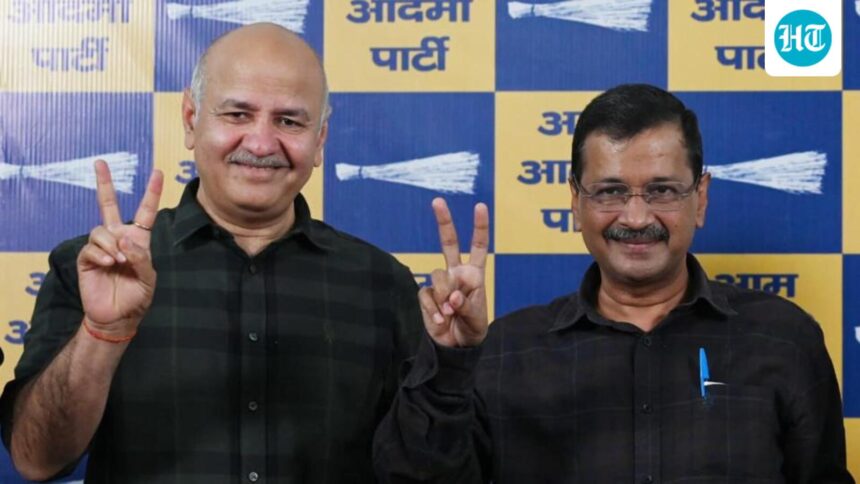
Even as the Delhi court dismissed the CBI’s case against former Delhi Chief Minister Arvind Kejriwal and former MP CM Manish Sisodia, among 23 others, in the Delhi tax policy case, it took issue with the phrase used repeatedly throughout the federal agency’s chargesheet – the “southern group”.

Special Judge Jitendra Singh, even before he formally read out the executive parts of the order, said orally in court that he had concerns about the use of the term.
“I think such kind of terminology should be avoided… Is it possible that if the CBI had filed the same chargesheet in the Chennai court, it would not have been seen as offensive,” the judge commented.
The court went on to question special public prosecutor D B Singh about who coined the term. Why didn’t you say that those in the north who are accused are the northern group?
Read also: Case does not survive judicial scrutiny: Court acquits Kejriwal and Sisodia in excise case
The court went on to warn the Public Prosecution against using such terms, and stressed the need to avoid them.
As per the CBI case, several accused officials of the Excise Department of the Delhi government, in collusion with Kejriwal, Sisodia and others, are alleged to have made changes in relation to manipulation of margins, relaxation of eligibility criteria and relaxation of restrictions on relevant entities, for the benefit of a lobby of liquor businessmen referred to as the ‘Southern Group’, pursuant to a prior understanding.
The court’s disagreement with the use of this phrase was also reflected in its detailed order, which the court said amounted to an identity-based classification, which was not justified in a fair criminal trial.
The court said that the CBI’s deliberate and repeated use of this expression to describe a group of defendants, apparently on the basis of their regional origin, had no basis in law.
“The prosecution’s narrative does not speak of any ‘northern group’ or similar classification. The selective adoption of a geographically specific classification is therefore clearly arbitrary and unjustified,” the order said.
The judge stressed that the criminal procedure, which must remain fair and based on evidence, is biased by such area-based markings.
The court stated that “the continued use of this label, despite the absence of any sustainable legal basis, carries with it a real risk of coloring perception, causing unintended bias, and diverting focus from the evidentiary material, which alone should guide the adjudication process.”
The court said that although it could not find a similar ruling under Indian law to complement its argument, it pointed to a previous case in the United States from 2000, in which the US court if appeals for the Seventh Circuit went so far as to overturn a conviction because the prosecution was repeatedly using identity-based terms – Dominican drug traffickers.
The court said the case demonstrated how criminal trials should be about what the defendant did, not who the defendant is.
The judge went on to caution investigating agencies to exercise restraint in the choice of language while drafting the chargesheets and narrating the investigation. “Descriptions of accused persons must remain strictly neutral, based on evidence, and free from expressions of stigma, division, or contempt,” the order read.
The court added that the use of such terms has a direct impact on ensuring a fair and just trial.
While the prosecution refers to the alleged southern group in the charge sheet, it includes at least four accused – Abhishek Boenpally, Arun Ramchandra Pillai, Mutha Gautam and Sathath Chandra Reddy – who as part of the group negotiated the illegal gratification. $Rs 90-100 crore, part of which will be channeled through hawala channels.
The CBI had claimed that Sisodia played a vital role in coordinating and holding discussions with the South Group members while formulating the policy.
The prosecution alleged that the alleged southern group was headed by a private company called Indospirits, which allegedly made profits of $100 million. $29.29 crore, which formed part of the money that was circulated as slush money.