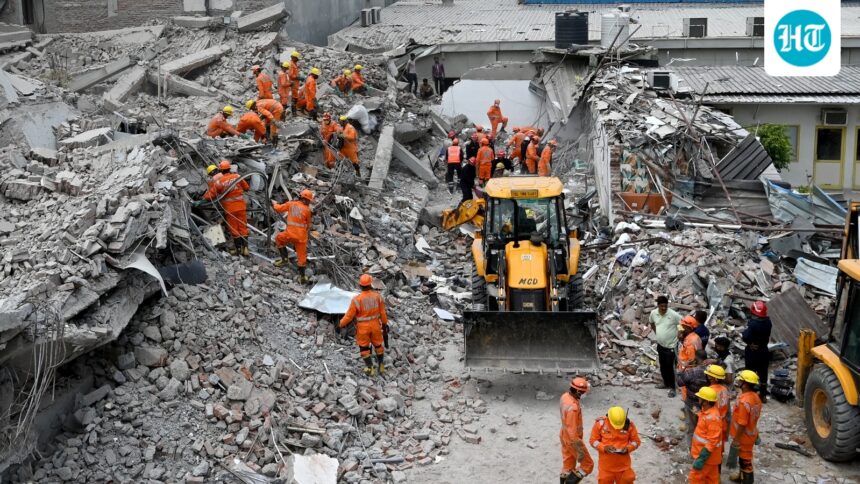
The building collapse in Sidulagab, which killed six people on Saturday, once again exposed Delhi’s long struggle to ensure structural integrity in a city where millions live in buildings that have never been subjected to proper audits, despite years of court monitoring and repeated warnings about widespread construction non-compliance.

The issue has been a recurring topic before the Delhi High Court, which has repeatedly examined the city’s earthquake preparedness and the condition of its old and unsafe buildings.
Read also | The building that collapsed in Delhi’s Saeedulagab area has been ‘seized’ by MCD, but no action has been taken
Delhi falls in seismic zone 4, making it vulnerable to strong earthquakes, and the court has on multiple occasions expressed concern over delays in conducting structural safety audits and upgrading dangerous structures.
After 6 years, compliance remains limited
In June 2020, on the court’s directions, the three erstwhile municipal corporations set a six-month deadline for obtaining structural safety certificates for high-risk buildings and structures constructed before seismic provisions were incorporated into the Delhi Building Regulations. Nearly six years later, compliance remains limited.
Read also | Delhi’s fragile foundation: frequent house collapses and uncontrolled expansion of the city
The Supreme Court had observed that “mere paperwork and consultations will not resolve the eminent threat” faced by Delhi residents. She added that only “actual work on the ground” will come to the rescue of citizens. He added: “We hope that responders will be aware of this, and that some real work will be done on the ground to save citizens from a potential disaster.”
Arpit Bhargava, the petitioner in the case, said the civic agencies had made repeated promises before the court but had delivered little on the ground.
“Accountability must be established to prevent these avoidable deaths,” he said. “The administration does not seem serious. It does not even have enough structural engineers recruited. In 2019, the government promised a five-year action plan. Then a six-month deadline was set in 2020, but six years later little has changed.”
As per the latest report taken before the Supreme Court, the Municipal Corporation of Delhi (MCD) has identified 4,762 old and highly dangerous buildings across the city. Notices were issued in 4,571 cases, but structural review reports were received in only 1,155 cases. Demolition measures were taken in 56 cases and retrofitting was carried out in only 47 buildings.
The figures highlight the wide gap between identifying dangerous structures and making them safe.
A senior MCD official associated with the court-ordered exercise said the scale of the challenge is particularly acute in unauthorized colonies and old neighbourhoods.
“In many cases, notices are issued but people do not respond. If we take stronger measures like disconnecting facilities, there will be public resistance. The scale of non-compliant construction is huge, especially in unauthorized colonies and parts of the walled city,” the official said.
The official added that authorities may have to give priority to buildings with high public occupancy. “Government buildings, high-rise buildings, educational institutions and other large structures should be covered first under modernization and safety programmes,” he said.
However, Bhargava said authorities continued to seek more time without making much progress. “In 2023, the agencies told the court that a political decision would be made. Nothing happened. Schools and hospitals were supposed to be audited within three months, but there was no follow-up,” he said.
Another senior official in the Ministry of Building and Construction pointed out that the practice monitored by the court largely concerns legally constructed buildings, while the biggest challenge lies in dealing with unlicensed buildings.
“The problem of ensuring safety in illegal buildings is much bigger. At present, we are focusing on identifying clearly dangerous or tilted structures. Comprehensive retrofitting and seismic compliance across the city is a much bigger exercise,” the official said.
The challenge is compounded by the sheer number of buildings in Delhi. It is estimated that the city contains more than 5 million buildings, many of which were developed without adhering to planning and building regulations. The Tejendra Khanna Committee, which was formed in 2006 to check unauthorized construction, found that 70% to 80% of buildings in the city violate building standards.