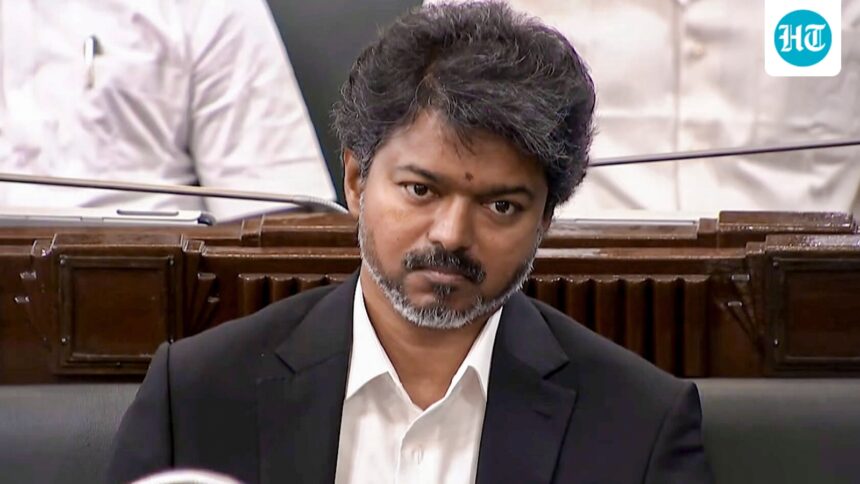
Appointment of astrologer Ricky Radhan Pandit Vetrivel as Officer on Special Duty (Political) in the Prime Minister’s office has drawn reactions from allies Congress, VCK and the Left.

Tamil Nadu Chief Minister C Joseph Vijay is only two days away from assuming office, but his government is already showing signs of some tension. The controversial appointment, the reactions of coalition partners and a divided opposition party together shape the early political landscape of the actor-turned-politician’s new chapter.

He faces a vote of confidence in the Council on Wednesday, May 13, but the dispute has not yet reached dangerous levels for his nascent government. He may now have some backups anyway.
The date sparked controversy
The Tamil Nadu government on Tuesday issued an order appointing astrologer Ricky Radhan Pandit Vetrivel as Officer on Special Duty (Political) to the Chief Minister. The move was not entirely surprising to those who have closely followed Vijay’s political rise.
Vettrivel, who also works as Vijay party’s spokesperson Tamilaga Vettri Kazhagam (TVK), has been practicing astrology for nearly four decades. It is widely believed that he was a key advisor to Vijay during his political journey.
He had publicly predicted a TVK victory long before the votes were counted, and was among the first to arrive at Vijay’s residence when the results confirmed his party’s stunning electoral debut on May 4.
Its influence appears to extend to issues of timing as well. Vijay’s swearing-in ceremony, which was originally scheduled to take place at 3:45 pm on May 10, has been moved forward to 10 am, reportedly on Vetrivel’s recommendation, to a more auspicious time. Vijay did not speak to the media, nor did his party speak about the issue.

Alliance partners are retreating
The harshest criticism came not from the opposition, but from within Vijay’s own coalition. Congressman Sasikanth Senthil posted on X asking why the mine needed an OSD position at all. The Secretary General of the VCK, Dr. Ravikumar called the appointment “unacceptable in a secular government” and urged the Prime Minister to reconsider.
CPM Central Committee member Shanmugam P went further, arguing that appointing an astrologer as a political advisor at the government’s expense would only increase public confidence in astrology – something he said was against the Constitution, which calls for a scientific temperament.
However, later in the day, continuing his outpouring of thanks and courtesy, Vijay met allied leaders IUML, VCK and Congress.
Criticism of questions of rationality versus astrology carries special weight as mainstream parties such as the DMK have historically taken a firm stand against superstition.

Vijay’s TVK party won 108 seats in the 234-member assembly, short of the 118 needed for a majority. His government came into existence because the Indian National Congress, VCK, CPI and CPM chose to support him, as did the IUML.
The lifeline of the AIADMK rebels
Even as Vijay manages friction with his allies, a new potential source of support is emerging from an unexpected direction – the opposition benches.
The AIADMK, which was the dominant force in Tamil Nadu politics alongside the DMK, had a traumatic election. The party won only 47 of the 164 seats it contested, ending up in third place behind TVK and DMK.
The defeat has since sparked a clear internal crisis.
Senior leaders SP Velumani and C Ve Shanmugam parted ways with party president Edappadi K Palaniswami (EPS), alleging that he was open to supporting the DMK-AIADMK government in order to keep TVK out of power. They said that this contradicts the party’s basic principles.
Shanmugam claimed that around 30 AIADMK MLAs are now supporting the Vijay government.
On Tuesday, Vijay visited Shanmugam’s residence in Chennai, where some members of the rebel faction officially extended their support. Shanmugam couched the move in nostalgic terms, invoking Jayalalithaa’s legacy and saying the party needed a “new life”.
The official response of the AIADMK, controlled by the EPS, described the rebels as “liars” and accused them of seeking ministerial positions in the TVK government. The EPS camp claimed that the party cadre remained firmly behind the general secretary. Voting against the party whip could jeopardize the future of rebel AIADMK MLAs under the anti-defection law.

Arish Chhabra is an associate editor on the Hindustan Times online team, where he writes news reports and explanatory features, as well as overseeing the site’s coverage. His career spans nearly two decades across India’s most respected newsrooms in print, digital and broadcast. He has reported, written, and edited across formats—from breaking news and live election coverage, to analytical long-reads and cultural commentary—building a body of work that reflects editorial rigor and a deep curiosity about the community for which he writes. Areesh studied English Literature, Sociology and History along with Journalism at Punjab University in Chandigarh, and began his career in that city, eventually moving to Delhi. He is also the author of Little Big City: What Life is Like from Chandigarh, a collection of critical essays originally published as a weekly column in the Hindustan Times, which examines the culture and politics of a city that is much more than just its famous architecture – and in doing so, holds up a mirror to modern India. During his stints at BBC, The Indian Express, NDTV and Jagran New Media, he has worked across formats and languages; Mainly English, as well as Hindi and Punjabi. He was part of the crack team for the BBC Explainer project which was replicated around the world by the broadcaster. At Jagran, he developed editorial guides and trained journalists on integrity and quality content. He has also worked at the intersection of journalism and education. At the Indian School of Business (ISB) in Hyderabad, he developed a website to streamline academic research in management. At Bennett University’s Times School of Media in Noida, he taught students the craft of digital journalism: from newsgathering and writing to social media strategy and video storytelling. Having moved from small town to larger town to megalopolis for education and work, his intellectual passions lie at the intersection of society, politics, and popular culture—a perspective that guides his writing and worldview. When he’s not working, he’s constantly reading long-form journalism or watching cerebral content, sometimes both at the same time.Read more